


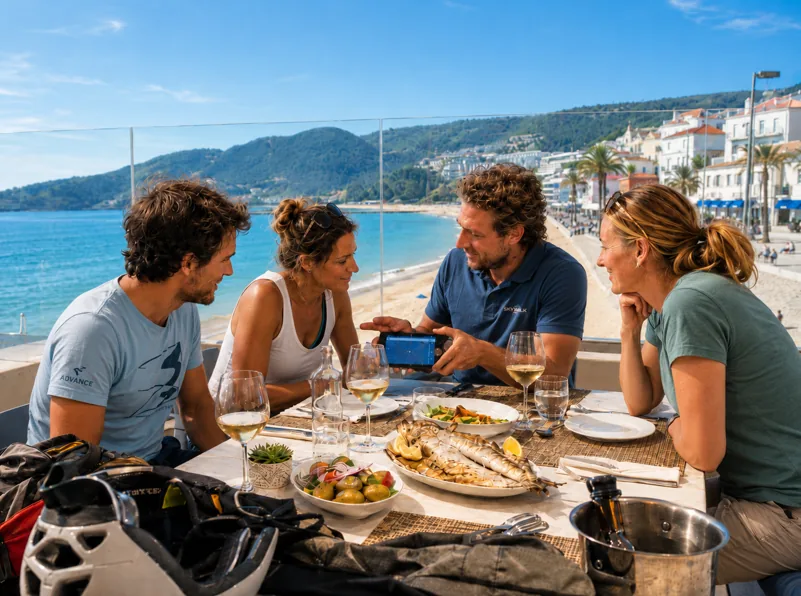
Let me take you through a week. Not an idealised version — a realistic one. A week like the one I ran last October, with a group of four: a German pilot on his second visit, a British couple flying similar skill levels, and a Dutch pilot who had been flying for six years but had never had radio coaching before. This is what the week looked like.
Sunday — Arrival and Evening Briefing
Pilots typically arrive Sunday afternoon or evening. I meet the group for a coffee or a beer in Sesimbra village — usually at one of the esplanades facing the bay, where you can watch the light go off the water and the first stars appear over the castle. We talk through the week: what everyone is hoping to work on, what equipment they are flying, any medical or physical considerations. The German pilot wants to push his XC distance. The British couple want to fly together more confidently and understand the coastal soaring band better. The Dutch pilot hasn't said much yet, but when I ask what he wants to get out of the week, he says: "I want to understand what I'm actually doing up there."
I explain how the week will work — plan-close scheduling, morning check-in at 08:30 by WhatsApp, no fixed flying agenda. We look briefly at the five-day forecast together on my phone, and I walk them through what I'm reading. This week it shows light northerlies Monday and Tuesday, then a stronger nortada Wednesday and Thursday, then a possible SW shift Friday. Good variety. After dinner we walk up to the mirador above the village and look at the cliff. The German pilot recognises it immediately — he flew it in spring. The Dutch pilot stands quietly for a long time.
Monday — Bicas, Coastal Assessment
Monday is assessment day. Everyone is flying the Bicas site, which sits on the western flank of Sesimbra as a flying base — a good landing zone at the beach, easy access, and conditions benign enough to let me watch each pilot inflate, launch, fly, and land without the variables of a more demanding site getting in the way. The nortada is 12–15 km/h, which is ideal for Bicas. Clean flow from the north, smooth soaring band, a forgiving landing field.
I am on the ground with binoculars for the first flights, then in the air with radio for all subsequent ones. I'm watching how each pilot handles the launch — whether they check upwind before committing, how they manage the initial surge of the wing, how they transition from ground to air. In the soaring band I'm watching bank angles in turns, where they're placing themselves relative to the ridge, how they're reading the subtle shift in lift when the nortada pulses slightly. By 1pm I have seen each pilot fly for at least 45 minutes. I know who needs to work on thermal entry technique, who is overcontrolling in the soaring band, and who is flying well and just needs more challenging conditions. The Dutch pilot surprises me. His hands are quiet. He's been working on something, even if he doesn't know it yet.
Lunch at the seafood place at the bottom of the road — grilled bream, house wine, two espressos each. Over lunch I give everyone brief individual feedback. Honest, specific. The British couple listen carefully. The German pilot nods. The Dutch pilot writes something down in a small notebook. That evening we look briefly at Tuesday's forecast. It's holding.
Tuesday — Arrábida, Longer Ridge
The Arrábida ridge is the longest coastal soaring flight in the area — a 7km limestone ridge running east to west above the Setúbal peninsula, with several launch options depending on the exact wind direction. Tuesday's nortada is ideal for the ridge: 18 km/h, consistent, no sign of the rotor that forms at the eastern end when the wind backs even a few degrees south.
I brief the group on the site over breakfast in the village: where the rotor is at the northern end, how to manage the transition from one bay to the next without losing height and getting pushed back, where to turn back if the wind strengthens or the sea breeze starts to feed in from the south. We launch from the main Arrábida site from 11am. The air is transparent — the kind of visibility you get in October when the dust settles and the horizon is 60km away.
Two pilots push the ridge all the way to the eastern end — a 45-minute flight in each direction, the peninsula laid out below them like a map. The British couple soar together for two hours, slowly building confidence in the transitions between bays. On radio I prompt the Dutch pilot to stay higher in the soaring band rather than following the cliff face — he gets 20 metres above where he was, and immediately feels the difference. "Oh," he says on the radio. That's the sound of something clicking.
Track log analysis that evening, over dinner in the old village. I project the height profiles on my laptop — each pilot can see their own flight, their altitude relative to the ridge, where they gained and where they lost. The Dutch pilot stares at his for a long time. His track shows the moment he moved higher: a kink in the altitude trace, then a clean line for the rest of the flight.
Wednesday — Ground Handling Morning, XC Planning Afternoon
The nortada has grown overnight. By 09:00 it's already 22 km/h at the coast, gusting higher on the ridge. Not a safe day for the main cliff sites — not for a mixed group. I message the group at 08:30: coastal flying is off, we're going to Costa Caparica.
The dunes at Costa Caparica are 40 minutes north along the coast. Flat, open, and the wind flows clean over the low dune ridge without any rotor. We arrive at 09:00 and fly kites for two hours in 18–20 km/h of consistent Atlantic breeze. Ground handling in conditions like this is genuinely useful: the wind is strong enough to load the wing fully, which means every input is honest. The British couple work on reverse inflations and kiting in crosswind. The German pilot works on single-riser steering — useful for the thermal turns he wants to sharpen on XC days. The Dutch pilot is already strong on the ground, so I set him tasks: 360-degree kites without walking forward, walking backwards with the wing fully loaded, precision placement on a towel laid on the sand. By 11:30 everyone is tired and the wind is picking up further. We pack and drive back to Sesimbra for coffee.
Wednesday afternoon is XC planning. I project the Alentejo terrain on a map and we spend two hours planning a 60km triangle task for Thursday, when the models show the wind easing and the inland heating up. We talk through task setting on an XC app, goal selection, how to read cu development from a turning point, when to go on glide and when to wait. If you want to understand this deeper, read my guide to flying XC triangles and the full overview of the Alentejo as an XC flying area. The German pilot sets a 62km triangle. The Dutch pilot, after some thought, declares 80km. The British couple plan open distance — aiming north together, no declared goal, just exploring.
Thursday — Alentejo XC Day
05:30 weather check. I'm awake before my alarm. The models have held through the night — the inland heating should begin by 10:30, cu triggering by 11:00, the thermal cycle running hard through early afternoon. I message the group: go.
We drive 40 minutes inland from Sesimbra, crossing the low hills east of Palmela and dropping into the Alentejo plain. By 09:00 we're at the launch site, a low ridge above cork oak scrubland. By 10:30 the first small cumulus are popping to the north. We launch in sequence, the German pilot first. By 11:00 everyone is airborne and climbing.
I'm on radio with all four pilots simultaneously from a high point with mobile coverage and a clear view north. XC days like this require a different kind of attention — I'm tracking four GPSs in my head, monitoring cloud base, watching the street of cu developing to the northwest, listening for the change in tone in each pilot's voice that tells me they're either comfortable or not. The British couple call in from 1200m above the plain, sounding delighted. The Dutch pilot is quiet on the radio — good quiet, the kind that means he's working.
By 14:30 the German pilot closes his triangle, landing 200m from his declared goal. He calls me on the radio. He sounds like he has just done something important. He has. The Dutch pilot is still flying — I can see his glider icon moving northeast on the tracker. He closes at 15:10, 83km, a personal record. By the time we collect everyone and drive to Alcácer do Sal for dinner, it's already dark.
We eat at a restaurant in Alcácer do Sal that smells of smoked paprika and old stone — wild boar stew, regional wine, bread that's still warm. The track log analysis lasts three hours. The Dutch pilot's 83km flight occupies most of it. We trace the thermal sources, the transitions, the moment at the second turning point where he decided to push on rather than head back. That decision added 23km to his flight.
Friday — Sintra for the SW Wind
The SW shift arrived as forecast, and the nortada sites are unflying. Sintra's exposed western ridge runs well on SW — it's one of the most spectacular flying sites in Portugal, and the two-hour drive north along the coast gives me a chance to tell the group what to expect. The Sintra site is not forgiving of inattention. 500m cliffs above the Atlantic, the Pena palace visible to the east on its wooded hilltop, the wind pouring over the ridge in clean laminar bands that carry you out over open sea if you let them. I brief the group in the car park before anyone unpacks a bag.
We launch from the main Sintra site through the morning. The coastal soaring here is at its most spectacular: the cliff is three times the height of Bicas, the soaring band is wide and smooth, and the view south — back towards Sesimbra and Arrábida, 50km away — is one I have never stopped being moved by. The British couple stay in the soaring band for three hours without landing. A different geography, a different wind, a different feeling entirely from the Sesimbra sites. Sintra gives the week a second texture: if Sesimbra is intimate, Sintra is vast.
Lunch at a pastelaria in the village — pastéis de nata for everyone, strong coffee, the last of the week's proper sunshine on the terrace before the Atlantic cloud builds in the afternoon. We drive back to Sesimbra by early evening. The German pilot and the Dutch pilot walk to the mirador again after dinner. I watch them standing there, looking at the cliff in the dark. I don't interrupt.
Saturday — Last Morning Flight, Then Departure
Saturday morning is usually a half-day. The nortada has returned overnight — lighter than Wednesday, around 14 km/h, which means Bicas is flyable. We're on the launch at 09:30. Two hours of coastal soaring, the bay of Sesimbra below catching the morning sun, the castle on the headland throwing a long shadow across the white houses. Everyone flies. The Dutch pilot soars for nearly 90 minutes without coming down, his turns clean and deliberate now in a way they weren't on Monday.
Then lunch together in Sesimbra — the fish restaurant again, the same table we sat at on Monday. Grilled squid, white wine, bread. Pilots leave for Lisbon airport by mid-afternoon.
The pattern at the end of almost every week is the same: the pilots are quiet in a way that is different from how they were quiet at the beginning. Sunday evening they are quiet because they don't know each other. Saturday afternoon they are quiet because the week is over and they are thinking about everything that happened in the air. The German pilot hugs me in the car park. He says he will be back in spring. The Dutch pilot shakes my hand and holds it for a moment longer than necessary. He says: "I understand what I'm doing now." That is the best thing anyone has ever said to me after a week.
What Every Week Looks Like — And Doesn't
No two weeks are identical. The sites change with the weather — one week might be entirely Sesimbra and Arrábida, the next might be Sintra twice and a dunes day. The conditions change from October to March to June in ways that completely alter what's possible. The group dynamic changes: a group of four EN B pilots with 200 hours each flies a very different week from a mixed group with a 500-hour pilot and two pilots who are still building confidence on coastal ridges.
What doesn't change: the 08:30 morning check, the radio in the air on every flight, the track log at dinner, the honest assessment of what each pilot did and what it means. Whether I'm running the Coastal Soaring Week or the XC Coaching week, the structure underneath is the same. I am watching, I am coaching, and I am adjusting the week to what the sky and the pilots in front of me actually need.
Some weeks we don't do XC at all — the group is coastal-focused, or the inland conditions never cooperate, or it simply isn't what the pilots need most. Some weeks we fly six of seven days because the nortada holds perfectly through the whole period and every morning check delivers a green light. Some weeks Wednesday is not a dunes day but a rest day — coffee in the village, a walk to the castle, an afternoon at the beach. The week is a container. What goes into it is decided day by day, by the sky and by the pilots in front of me.