


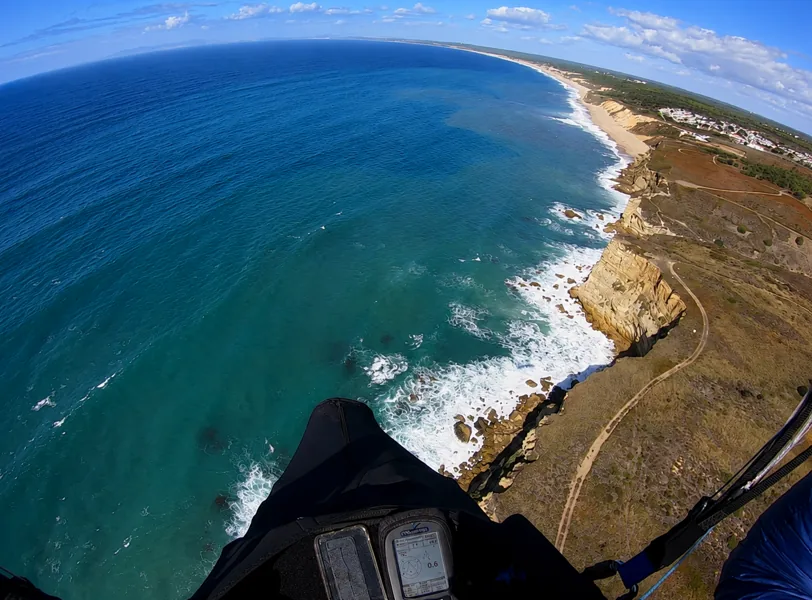
Sesimbra is a small Atlantic fishing town 30 minutes south of Lisbon airport with a paragliding set-up that's genuinely hard to match in Europe. I've been based here for 15 years, first as a visiting pilot, then as a resident, and for the last decade running guided flying weeks from this coastline. The combination of an unusually sheltered microclimate, several high-quality Atlantic cliff launches within 12 minutes of the town centre, and a beach culture that makes non-flying days feel like a bonus is what keeps pilots coming back. This guide covers everything I know about flying Sesimbra — the sites, the wind windows, the conditions, and what to expect if you come here for the first time.
The Sesimbra Microclimate — Why It's Different
Sesimbra sits in a natural basin on the south-facing side of the Setúbal Peninsula, sheltered to the north and west by a limestone ridge that rises to 200–300 metres above sea level. This creates a microclimate that's measurably different from Lisbon 30 km away: sunnier, drier, and consistently calmer in the mornings. On days when the capital is under cloud or light rain, Sesimbra's basin often stays clear. I've flown perfect soaring days at Bicas while watching rain on the Lisbon radar — this is not a coincidence, it's the orography of the peninsula doing what it does.
The microclimate also means the Atlantic ridge lift builds later in the morning and more predictably than exposed headland sites. The wind at Bicas is typically 5–8 knots at 9am, building to 12–18 knots by noon on a good coastal day, and easing again in the late afternoon. This gives you a reliable flying window that's easy to plan around, which is one of the reasons the guiding here feels so different from sites where conditions can change an hour early or late depending on factors nobody predicted.
Praia das Bicas — The Home Site
Bicas is the site that defines Sesimbra flying. A 120-metre sea cliff with a wide, accessible launch ramp and a long Atlantic beach directly below — the landing is the beach, and it stretches far enough that even a slow approach gives you room to set up and commit. The soaring band at Bicas extends from just above the cliff top to approximately 300–350 metres above sea level on a good north to north-northwesterly day, which is comfortable working room for thermalling above the ridge or scratching low in lighter winds.
Wind directions: Northwest through north-northeast. The best conditions are N to NNW at 10–18 knots. In lighter or more northerly winds, the soaring band is lower but still workable. In southerly or easterly wind, Bicas is unflyable — this happens a few times a month in winter and rarely in summer.
Launch: Wide, flat, accessible. A forward or reverse launch is possible depending on conditions. I use reverse in most conditions above 10 knots, forward below that. The ramp is grass over limestone — good grip, no loose material.
Landing: The beach below the cliff. Long, flat, and sandy — as generous a landing area as you'll find at a cliff site in Europe. The only hazard is the surf zone right at the water's edge; aim for the dry sand mid-beach.
Skill level: Club Pilot (BHPA) / DHV A and above. The site is well-suited to pilots with some coastal experience. If this is your first time flying coastal ridge, Bicas is an excellent introduction — the soaring band is well-defined, the launch has good flow, and the beach landing removes the top-land stress.
Praia do Meco — The Strong-Wind Site
Meco is 10 minutes south of Sesimbra on the Atlantic coast, with lower cliffs and a slightly more exposed aspect than Bicas. It comes into its own when the northwesterly is punching above 20 knots — at those wind speeds Bicas starts to feel aggressive, but Meco's lower cliff height and more sheltered approach puts the soaring band in a more manageable position.
Wind directions: West-northwest through northwest. Best in the 18–28 knot range when Bicas is too strong. The site also works well in summer when the nortada (summer northerly) is blowing strongly.
Skill level: Intermediate (P3 / CP or equivalent). The stronger conditions and slightly more complex site require pilots with solid coastal experience. I use Meco on Fly with Behrooz programme days when it's the right call — pilots who have demonstrated comfort at Bicas in moderate conditions.
Praia de Fonte de Telha — The Dune Site
Fonte de Telha is a 20-metre sand dune cliff above a kilometre of Atlantic beach — a completely different flying environment from the limestone cliffs at Bicas and Meco. The vertical height is small and the soaring band is low, but this is exactly what makes it valuable: it's where I run ground handling sessions and where pilots who've only ever flown thermal sites get their first experience of coastal ridge lift in a genuinely low-risk environment.
The dune at Fonte de Telha is forgiving in a way that tall sea cliffs are not. If you come in short, you land on sand. If you lose the lift, you land on sand. The worst-case scenarios are all soft, and the consequence is a short walk back up the dune. For a pilot transitioning from inland flying to coastal, or for a pilot who wants to work on slow-speed wing control in a real sea breeze, this site is excellent.
The Sesimbra Wind Window — Month by Month
| Month | Prevailing wind | Typical strength | Flying character |
|---|---|---|---|
| Jan–Feb | NW–N, variable | 8–16 kts | Laminar coastal soaring; occasional front days. Uncrowded. |
| March | NW–N, strengthening | 10–18 kts | Spring transition. First reliable XC days from Arrábida inland. |
| Apr–May | N–NNW | 12–20 kts | Best overall. Coastal reliable + Alentejo XC on thermic days. |
| June | NNW–NW | 12–22 kts | Nortada establishing. XC still possible mornings. Long days. |
| Jul–Aug | N (nortada) | 15–26 kts | Strong laminar coastal. Early starts (09:00). Afternoons off. |
| Sep–Oct | N–NNW, variable | 10–18 kts | Second XC peak. Autumn light, Alentejo excellent, stable skies. |
| Nov–Dec | NW–N | 8–16 kts | Reliable coastal, mild (17–20—C), very uncrowded. Hidden gem. |
Skill Levels and What to Expect
The Sesimbra sites are well-suited to pilots at Club Pilot / P2 level and above. You don't need SIV training or competition-level wing handling to enjoy the coastal flying here, but you do need to be comfortable in sea breezes and understand the basic rules of cliff flying: stay in front of the cliff, don't get caught behind the ridge, understand the wind gradient from cliff top to cliff base.
N, NNW, NW (10–18 kts): Praia das Bicas. This is the standard Sesimbra flying day.
NW (18–28 kts): Praia do Meco. Bicas is getting too strong; Meco's lower cliff handles it better.
Any direction, light wind: Praia de Fonte de Telha. Low cliff, always appropriate for ground handling and low soaring.
S, SW, SE: All main Sesimbra sites unflyable. Consider driving to an inland thermal site or a north-facing site further north.
Getting to Sesimbra
The simplest option from Lisbon airport (LIS) is an Uber or taxi — approximately 32 km, 30–35 minutes, €35–50. There is no direct public transport from the airport to Sesimbra; the bus option involves a change in Setúbal or Almada and takes 90+ minutes. For a week's trip, the Uber fare is easily worth it. Parking in Sesimbra is limited in summer; pilots on guided weeks don't need a car as I handle all transfers.
Frequently Asked Questions
How many flying days can I realistically expect in a week at Sesimbra?
In 15 years of flying and guiding at Sesimbra, I've never run a week with fewer than 4 flying days. The average across the year is 5–6 flyable days per week when flying with an experienced local guide who knows which site to go to on which day. November and March sometimes produce 7-out-of-7 weeks; July can occasionally be limited to early-morning sessions if the nortada builds hard. Overall, the consistency is one of Sesimbra's most valuable assets.
Is Sesimbra suitable for intermediate pilots who've only flown inland thermals?
Yes, and it's actually an excellent transition site for exactly this type of pilot. The Atlantic ridge lift at Bicas is laminar and predictable — very different from the punchy, tight thermals of inland flying. The beach landing removes the top-landing stress. The main adjustment is learning to read coastal conditions: the wind gradient, the position in front of the cliff, and the signs that it's time to land. All of this is covered in briefings and managed through radio coaching. Many pilots who come here having only flown thermals tell me coastal flying was what was missing from their flying.
Can I fly Sesimbra independently, without a guide?
Yes. The main sites — particularly Bicas — are known to the local flying community and accessible to visiting pilots with a valid licence. English is spoken at the sites, and the local pilots are generally welcoming. That said, the specific local knowledge (which model to watch for the Sesimbra forecast, when Bicas transitions to Meco, how the nortada builds on a typical July day) makes a real practical difference to how much you fly and how safely you make those decisions. If it's your first visit to the area, a guided week will get you significantly more airtime and a much better understanding of the conditions than flying independently.
Come and fly the coast from Sesimbra.
The Coastal Soaring Week is designed specifically for pilots making their first visit to the Sesimbra Atlantic sites. Message me with your dates and I'll tell you what conditions to expect.