


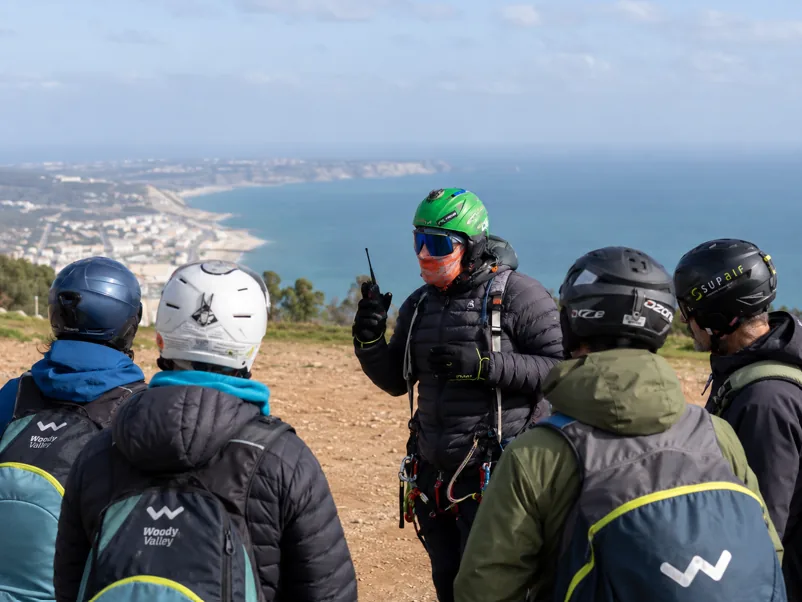
I have been guiding paragliding weeks in Sesimbra for over twenty years. In that time I have taken a certain approach, and I have noticed that pilots who understand the approach before they arrive have a better week than pilots who don't. So I want to explain it here, clearly and honestly. Not as a marketing pitch — as a genuine statement of what I believe makes a good coaching week and how I have tried to build it.
Small Groups Are Non-Negotiable
I take a maximum of four to six pilots in any week. Not four to ten. Not up to twelve. Four to six. The reason is simple: I cannot give radio coaching to more than six pilots effectively in the air. I cannot brief eight pilots on a launch site in thirty minutes and have time to watch each of them inflate and get airborne. I cannot analyse track logs from ten flights in one evening and still be useful. The group size is not a marketing choice — it is a technical constraint imposed by what I believe coaching actually requires. If I took fifteen pilots per week I would make more money. I would also deliver a worse service. I have chosen not to.
What this means in practice is that every pilot in the group gets real attention. I know each person's flying style by the end of day one. I know where their strengths are and where the gaps are. I can tailor what I say over the radio to the individual, not broadcast general advice to a crowd. Small groups are the foundation everything else is built on.
Radio Coaching — The Core Methodology
I use radio on every flight with every pilot in the group. This is not common. Many guided trips involve a guide flying alongside clients, making observations on the ground before and after. Radio coaching means I can tell a pilot to widen their turn in a thermal while they are in the thermal — not when they've already lost it. It means I can warn someone that the wind is picking up on the north launch and they should head to the beach now — before they find out from the wing. The radio loop between pilot and coach in the air is the most powerful teaching tool I know. Everything else is secondary.
The reason radio coaching works so well is timing. Paragliding is a sport where decisions happen in seconds. You feel the right edge of the thermal pull, you need to turn now — not in thirty seconds when you land and I can tell you about it. When I can see a pilot's position in the sky and talk them through a thermal in real time, the learning happens at the moment when it is most relevant. The body and the brain connect the instruction to the sensation. That connection does not happen in a debrief the same way it happens in the air. If you want to understand more about how a week with radio coaching is structured day to day, I've written about that in detail in my guide to what to expect on a paragliding coaching holiday.
The Plan-Close Model — Why I Never Book Flying Days in Advance
This confuses some people when they first enquire. They want to know: on Wednesday, are we flying XC or are we at the coast? I cannot tell them that eight weeks before the week. The Atlantic weather does not give me a reliable eight-week forecast. What I can do is read the conditions 24–48 hours out with the accuracy of a pilot who has been watching the same Sesimbra forecast models for over two decades. And that reading, made 24 hours ahead, is worth more than any pre-planned itinerary.
The plan-close model is how competition pilots operate. You don't declare a task the week before a competition — you read the day, read the sky, and make the call on the morning. I apply the same logic to coaching. The result is that pilots get better flying days than they would if we tried to commit to a schedule in advance. The coast is flying? We soar. The inland is thermal? We go inland. If neither is good, we go to the dunes, we do ground handling, or we take the day off and drive to Lisbon. The week adapts to the weather, not the other way around.
I have seen guided trips where the itinerary said "XC day" and the pilot flew a mediocre XC in marginal conditions because the schedule demanded it. That is backwards. The point of being in Portugal with an experienced local coach is that the local coach knows when conditions are right and can act on that knowledge. Plan-close is the mechanism that makes that knowledge usable.
No Deposit — The Trust-Based Model
I do not take deposits. Pilots confirm a week with a WhatsApp message and pay when they arrive. Some people find this unusual. It reflects a philosophy: paragliding weeks should be flexible. If a pilot's plans change, or the weather is genuinely terrible the whole week, I do not want a financial dispute on top of the disappointment. I want pilots to come back, not to feel cheated by a deposit clause. In twenty years of running this way, the system has worked. The kind of pilot who books a week in Sesimbra without paying a deposit first is, in my experience, exactly the kind of pilot I want in my group.
The no-deposit model also keeps the relationship honest from the start. There is no contract creating pressure on either side. A pilot comes, we fly, they pay for what they got. If the week was limited by weather, that is what it was. I am not going to pretend a difficult weather week was what anyone hoped for, and I am not going to hide behind a clause that says the deposit covers all weather outcomes. The trust runs both ways — I trust pilots to show up when they say they will, and they trust me to deliver what I say I will.
Track Log Analysis Every Evening
After every flying day, I look at the track logs. Every pilot's flight, plotted and reviewed. Where they found lift, where they lost it. Average climb rate, glide ratio between thermals, decision points on the route. This takes time — usually an hour over dinner or a beer — but it is where I learn as much about a pilot as from watching them fly. The track log tells you things the pilot doesn't know they did. I share what I see, and we talk through what it means for the next day. The debrief is not a criticism session — it is a curiosity session. The question is always: what does this tell us, and how do we use it tomorrow?
Pilots are often surprised by what the data shows. A pilot who felt they were flying confidently discovers they were consistently leaving thermals too early — the climb rate was still rising when they topped out. A pilot who thought they had a bad day discovers their glide efficiency between thermals was actually excellent, and the issue was simply that they were working weak thermals when stronger ones were a kilometre to the east. The track log gives us a shared, objective reference point for a conversation that would otherwise rely entirely on memory and feeling. For a deeper look at what track log analysis involves, I've written a full technical guide to reading paragliding track logs and using analysis to improve your flying.
Who I Will Not Take
This section is honest. I will not take pilots who claim a higher skill level than they have — not because I want to exclude people, but because it puts everyone in the group at risk. A pilot who says they have 200 hours and turns out to have 60 is not just a risk to themselves; they change what I can plan for the whole group. I set the week's flying ambitions based on what everyone in the group can handle. One miscalculated skill level affects everyone else's experience.
I will not take pilots with unsuitable equipment for the planned activities. An EN-D competition wing is not appropriate for a coastal soaring week if you are flying 100 hours. I can and do advise on equipment before pilots arrive — it is part of the initial conversation. I will not take pilots who are unwilling to follow guidance. If I say conditions at the main site are not right today, and a pilot insists on launching anyway, that is the last time they fly with me. I say this not to be harsh but because it is the honest contract: I bring my knowledge and judgment, you bring your skill and your willingness to listen to someone who has more experience than you at this specific location.
None of this is about being strict for its own sake. It is about the group functioning as a group. When every pilot is honest about their level and trusts the guidance they are given, the week works well for everyone. When one person breaks that, it degrades the experience for the people around them. I have run enough weeks to know this clearly.
What Progress Looks Like in Seven Days
On the first day, I assess. I watch how each pilot inflates, launches, manages the wing in the air. By day three I know exactly where each pilot is and what is most likely to shift their flying in the remaining days. By day seven, most pilots have made meaningful and measurable progress — better thermal technique, better coastal soaring positioning, better go/no-go judgment. Not every pilot improves the same amount in the same way. But every pilot who arrives honest about their level and willing to engage with coaching goes home with something real. The track log on day seven looks different from the track log on day one. That is the goal.
What I cannot promise is a specific number of flying hours, a specific distance flown, or a specific achievement unlocked. Paragliding does not work that way and anyone who promises those things is not being straight with you. What I can say is that if you spend a week flying in good Portuguese conditions with radio coaching on every flight and a proper debrief each evening, your flying will be different at the end of it. The question of how much depends on how much you bring — your openness to being coached, your honesty about where you are, and the willingness to try something differently because someone who knows more than you suggested it.
That last part is the thing I care most about. Coaching only works if the pilot is willing to be coached. I can create the conditions — the group size, the radio, the track log review, the right sites in the right weather. What happens inside those conditions depends on the pilot. The best weeks I have run have always been with pilots who arrived curious rather than certain. If that is you, we will have a good week.