


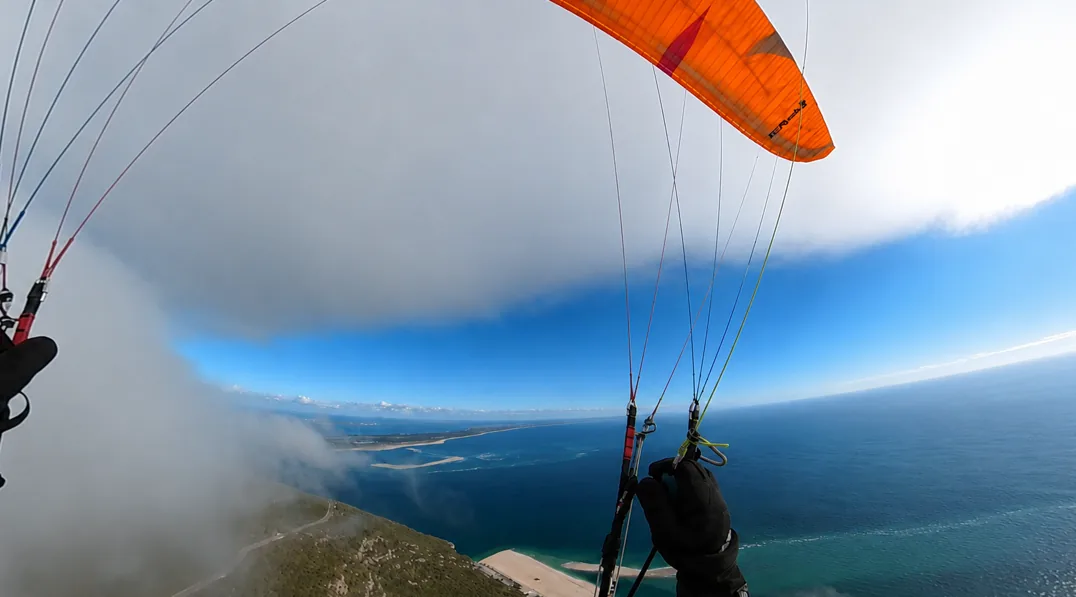
When foreign pilots fly with me for the first time in summer, they often ask the same question: why is the wind always from the north? The answer is the nortada — the northerly sea breeze that dominates Portugal's Atlantic coast from June through September, and that is one of the defining features of what makes Sesimbra's paragliding work. I have been flying the nortada for over twenty-five years. I know its patterns better than I know most people. In this article I want to explain what it is, how it forms, and — most importantly — how to fly in it well.
What the Nortada Is
The nortada (from the Portuguese for "north wind") is a sustained N/NW sea breeze that runs along the west coast of the Iberian Peninsula during summer. It is not a sea breeze in the traditional local sense — it is a regional phenomenon driven by the pressure difference between the Azores High (a semi-permanent high-pressure cell over the Atlantic) and the thermal low that develops over the hot interior of the Iberian Peninsula in summer. Cold, dense Atlantic air is drawn southward along the coast by this pressure gradient. The result is a consistent, persistent northerly or NW flow that can last days — sometimes a week or more — at a time without meaningful interruption.
This is the wind that has shaped coastal life on the western Iberian Peninsula for centuries. Fishermen knew it, sailors feared and relied on it, and now paraglider pilots use it to stay airborne for hours above the cliffs south of Lisbon. Understanding the nortada at a meteorological level makes you a better pilot on it, because you stop guessing and start reading what the atmosphere is actually telling you.
How the Nortada Forms — The Mechanism
The mechanics are worth understanding properly because they explain why the nortada behaves the way it does. The sequence goes like this: as Portugal's interior heats up through spring and into summer, a thermal low develops over the hot Iberian landmass — temperatures inland regularly reach 35–42—C in July and August. This creates a significant pressure deficit compared to the cooler Atlantic, where the Azores High maintains strong surface pressure year-round. The resulting N/NW pressure gradient pulls cool, dense Atlantic air southward along the coast.
What makes the nortada self-reinforcing is coastal upwelling. The sustained northerly flow pushes the surface layer of Atlantic water offshore, and cold deep water rises to replace it along the coast. This cold upwelling water — sea surface temperatures off Sesimbra can sit at 15–17—C even in August, while air temperatures inland are pushing 40—C — strengthens the onshore temperature contrast and intensifies the nortada further through the season. July and August are the peak months. The nortada typically becomes established in May or June, reaches its strongest and most consistent expression in July and August, then begins declining through September and is mostly gone by October.
One practical consequence pilots need to know about is relative humidity. Near the coast in nortada conditions, 70–90% relative humidity is typical. This is the moisture-laden Atlantic air streaming onshore. On many mornings from June through August, this produces coastal fog — the nevoeiro — that can be thick enough to close launch visually. I have walked up to Bicas at 8am in August and been unable to see 50 metres ahead. This is normal. The nevoeiro typically burns off by 10–11am as the sun heats the surface, and by noon the sky is perfectly clear and the nortada is establishing.
What the Nortada Means at Sesimbra
At Sesimbra's coastal sites, the nortada delivers consistent 15–25 km/h N/NW flow against the cliff faces during summer afternoons. For coastal ridge soaring this is close to ideal: strong enough to generate reliable lift across the entire soaring band, light enough not to overstress the wing or push you uncomfortably into the back country, and clean enough — laminar, arriving from a consistent direction over open water — that it does not produce significant turbulence behind headlands during moderate conditions.
The coastal ridge at Bicas and the Arrábida headlands faces squarely into the nortada. The geometry is close to perfect: the cliff faces NW, the wind arrives from N/NW, and the ridge lift band extends broadly and predictably above the face. When the nortada is blowing at 18–22 km/h, the soaring is effortless. I have watched pilots on EN-A wings stay up for three hours without a single moment of concern. The air is smooth, the lift is consistent, and the only skill required is staying centred over the face and not drifting downwind into the sink behind the ridge line. For more on what makes these sites special, I have written a detailed guide to paragliding in Sesimbra.
The Daily Cycle — How to Read It
This is where local knowledge becomes genuinely valuable. The nortada follows a daily cycle that, in summer, is remarkably consistent. Learning to read it is one of the first things I teach pilots who come to fly with me for a week.
Most summer mornings start calm or with a very light flow — 5–10 km/h or less at the coast. The nevoeiro may be present. By 9–10am the fog is usually burning off. By 11am the nortada is beginning to establish — I typically see the first 10–15 km/h readings at the cliff top around this time. By 1–2pm the wind has stepped up, and by 2–4pm it has reached its daily peak. Evening brings a gradual easing as the inland thermal low weakens with the dropping sun, and by sunset the coast is often lighter again.
I read this cycle every morning through a combination of tools and direct observation. I check Windguru for the coastal Sesimbra marine forecast — it is the most reliable single tool for the nortada at our specific latitude. I look at Windy at the 925 hPa level to understand how deep the nortada is on a given day and how far it extends vertically. Then I step outside. I look at the trees. I look at the sea surface — the nortada creates distinctive white-cap patterns that you can read from the cliff top. If the nevoeiro is thick at 9am but I can see the cap starting to break up in the northwest, I know the fog is on its way out. If the sea is already showing organised whitecaps from the north at 10am, the nortada has woken up early and I adjust the day's plan accordingly.
When the Nortada Is Too Strong
The nortada is not always benign. Above approximately 28–35 km/h at the main coastal sites, the character of the air changes. Rotor turbulence starts to form in the lee of headlands and cliff edges. The clean laminar flow that makes the soaring effortless at 20 km/h begins to break down into something less predictable. Top-landing at more exposed sites becomes significantly more demanding — the gust factor increases, and the window for a clean landing narrows.
Importantly, this is not a situation that closes the entire coast. It is a situation that requires you to choose the right site for the conditions. Some launches at Sesimbra and along the Arrábida are relatively sheltered by the headland geometry and tolerate 30+ km/h with less turbulence than others. Others are exposed and become genuinely technical when the nortada steps up. Twenty-five years of flying this coast has given me a clear mental map of which site works in which strength of nortada — and that map is one of the things I share with pilots during a coaching week here. The ability to pick the right site for the day's wind strength is as important as the ability to fly the ridge well.
The Nortada and XC Flying
This is where the nortada gets interesting from a cross-country perspective, and where many visiting pilots are surprised. The assumption is often that consistent strong wind is good for XC. The reality on the coast is more nuanced.
The nortada creates excellent coastal soaring but can actually inhibit thermal XC in the coastal zone through two mechanisms. First, it keeps the air cool and stable near the surface: the marine layer is typically 500–800 metres deep along the coast, and within that layer the surface heating needed to trigger thermals is suppressed by the cold ocean air. Second, as the afternoon progresses, the sea-breeze front pushes inland. By 3–4pm in July and August, the marine influence has often penetrated 15–20 km inland of Sesimbra, shutting down thermals in the Setúbal lowlands entirely.
However — and this is important — the nortada does not kill thermals in the Alentejo interior. Twenty to thirty kilometres inland, above the marine layer influence, the ground is hot, dry, and triggering powerfully from noon to 3pm. I have had some of my best XC days in summer by combining the two environments: coastal soaring in the late morning, then driving or flying inland to intercept the thermal cycle before the sea breeze front arrives. This is the kind of tactical flying that rewards local knowledge. If you want to understand what XC flying in the Alentejo looks like in summer, I have written a dedicated guide to paragliding in the Alentejo.
Reading the Nortada Before You Fly
Every summer morning I go through a short routine before deciding on the day's programme. These are the tools I use and what I look for in each:
- Windguru — Sesimbra coastal point: The 10-metre wind forecast for the coastal site. I look at the 12–16:00 window for peak nortada strength, and I look at whether the model shows acceleration through the day (normal) or a flat profile that might indicate the nortada is blocked by an anomalous pressure configuration.
- Windy at 925 hPa: This level corresponds roughly to 750 metres ASL and shows me how deep the nortada is vertically. A strong gradient at 925 hPa confirms the nortada will be robust at the surface. A weak gradient even with surface wind present can mean the nortada is a shallow feature that will ease earlier than forecast.
- Sea surface temperature maps: Cold upwelling water means the nortada will be stronger and more persistent. When the SST off the cape drops to 14–15—C, the onshore temperature gradient is at its maximum and the nortada will not disappoint. Warmer patches suggest the upwelling is weaker and the nortada may be lighter or more variable.
- The sky and the sea: At 9–10am I step outside. The sea surface texture tells me more than any forecast model. Organised wavelets running from the north mean the nortada is already moving. A flat, glassy surface means it is still calm and the timing of establishment is uncertain. The horizon haze level gives me a humidity read — thick white haze means the marine layer is deep and fog risk was high.
The nortada has a personality. After twenty-five years of watching it, I can feel when it is going to perform well and when it is going to over-deliver or undershoot. That feel — which is really just pattern recognition built on thousands of mornings of observation — is the kind of thing you cannot learn from a forecast model. It is what I try to pass on during a week of coaching here.
The Nortada Monthly Calendar
To give visiting pilots a clear reference for planning, here is how the nortada typically behaves month by month through the season:
| Month | Nortada Strength | Typical Afternoon | Fog Risk | XC Inland? |
|---|---|---|---|---|
| May | Establishing — 10–18 km/h | Good coastal soaring | Low | Yes — thermals fire well |
| June | Growing — 15–22 km/h | Excellent coastal soaring | Moderate | Sometimes — morning inland window |
| July | Peak — 18–28 km/h | Excellent coastal soaring | High — morning nevoeiro common | Morning only before sea breeze front |
| August | Peak — 18–28 km/h | Excellent coastal soaring | High — morning nevoeiro common | Morning only before sea breeze front |
| September | Declining — 12–20 km/h | Good coastal soaring | Low | Yes — excellent XC season begins |
| October | Rare — light and variable | Variable — thermal or coastal | Low | Yes — best XC month of the year |
Why the Nortada Makes Sesimbra Better Than Most Coastal Sites
The consistency argument is the one I find myself making most often to pilots who ask why Sesimbra specifically, when there are coastal sites all over Europe. Most coastal paragliding sites fly when conditions align — a specific wind direction, a specific strength, a specific season. The alignment is often narrow. You might get two or three good days in a week if you are lucky.
The nortada season at Sesimbra is different. From June through September, the N/NW flow arrives on schedule most afternoons with a reliability that is rare in European paragliding. It is not 100% — nothing is in atmospheric science — but in July and August, a week at Sesimbra will typically deliver five or six flying days out of seven, with the flying days being genuinely excellent rather than merely acceptable. The coastal ridge geometry, combined with the consistency of the nortada, means that even the days when the wind is slightly stronger or slightly lighter than ideal usually still produce soarable conditions somewhere on the coast.
Pilots from northern Europe arrive here expecting variable Atlantic weather — because that is what Atlantic coastal Europe usually means. What they find instead is a summer wind system with the consistency of a desert thermal wind, arriving from a consistent direction against a cliff that faces it perfectly. That predictability — which those of us who live here take completely for granted — is the thing visiting pilots comment on most. It changes how you plan a flying week. You stop hoping the weather will cooperate and start simply choosing when in the afternoon you want to fly.
If you are visiting Sesimbra in summer and want to understand the day before you arrive at launch: check Windguru for the Sesimbra coastal point at the 13:00–16:00 window. Under 15 km/h — light soaring day. 15–25 km/h — ideal. 25–32 km/h — pick your site carefully, some launches will be excellent and others will be too exposed. Above 32 km/h — it is a day for sheltered sites or a rest. Do not make the decision from the forecast alone. Come to the cliff top at 11am and look at the sea. The sea does not lie.