


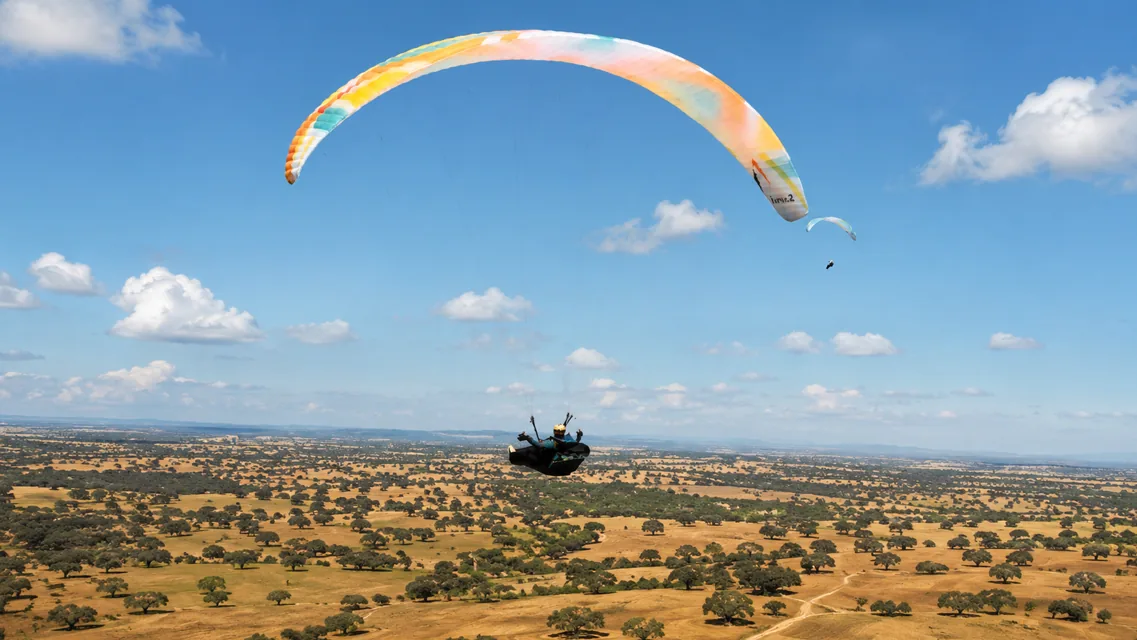
Ask any pilot who has flown southern Europe extensively and most will describe one region in the same terms: honest, powerful thermals over an outlanding-friendly landscape with almost no crowds and 100+ km days on a regular spring schedule. They're usually talking about Alentejo. Portugal's southern interior is a different flying world from the Sesimbra coast — less scenery, more distance, less laminar ridge lift, more raw thermal strength. For pilots ready to step from sea-cliff soaring into serious XC, Alentejo is where Portuguese flying reaches its ceiling.
What Makes Alentejo a Thermal Paradise
Three things converge in the Alentejo to produce XC flying conditions that are hard to match in western Europe:
- Terrain: Rolling plains at 100–400 metres elevation with almost no orographic interference. The thermals develop cleanly, cycle predictably, and have generous working width — you don't need surgical precision to stay in them.
- Surface cover: Cork oak (sobreiro) and olive groves create dark, absorptive ground that supercharges thermal development. The cork harvest strips the bark, exposing reddish wood that acts as a radiator. Flying over a freshly harvested cork area in spring is like flying over a pan on a hob.
- Solar angle and heat budget: Alentejo sits at 38—N with over 3,000 hours of sunshine per year. In spring and autumn the solar angle is close to optimal — strong enough to generate thermals from early morning, mild enough not to overdevelop into hazardous convection by early afternoon.
The result is a region where cloudbase regularly reaches 2,000 metres in spring, thermal streets form over the plains, and distances of 80–120 km are achievable on a standard XC day.
The Flying Calendar — When to Go
Alentejo is a year-round destination for fair weather, but the paragliding season has two clear windows:
| Period | Conditions | Best For |
|---|---|---|
| March — May | Thermals from 10:00, cloudbase 1,500–2,200 m, occasional overdevelopment in May | XC flights 60–120 km, first XC days |
| June — August | Thermals very strong (5–8 m/s), cloudbase 2,500 m+, turbulent in afternoon. Launch early or not at all. | Experienced pilots, early start only (08:00–12:00) |
| September — November | Thermals gentler and cleaner than spring, cloudbase 1,200–1,800 m, stable afternoons | First XC days, skill-building, October is peak month |
| December — February | Thermals weak and intermittent, flying on inversion days only | Not recommended for XC |
If I had to recommend a single week for a first Alentejo XC experience, it would be the second or third week of October. The thermal cycle is reliable and honest — not the spring monster that can bite — and the landscape is at its most beautiful, with the first amber light on the cork groves.
Typical XC Routes from the Sesimbra Coast
The most natural way to access Alentejo XC flying from my base at Sesimbra is via the Arrábida launches. From there, a pilot transitions from coastal ridge soaring to thermal flying in the first 15 minutes after departing the ridge. The Alentejo opens up ahead.
Common XC routes and milestones from an Arrábida launch:
- Palmela / Setúbal area (20–30 km): The first thermal street begins. Pilots learning XC often get here and return — this is a successful first cross-country step.
- Alcácer do Sal (50–70 km): The rice fields and Sado river estuary. A classic milestone — makes for a satisfying first 50+ km day.
- —vora area (80–100 km): Deep Alentejo, megalithic landscape, historic city. Reaching —vora from Sesimbra in a single flight is a landmark achievement for pilots on the XC Coaching Week.
- Spanish border (130–150 km): On a genuine "epic" spring day with a favourable wind component, the Spanish border is reachable.
Outlanding in Alentejo — Why It's Pilot-Friendly
Alentejo is among the most outlanding-friendly XC terrain in Europe. The plains are flat to gently rolling, with agricultural roads, cork tracks, and dirt paths every kilometre or two. Landing options are almost always visible from altitude. The main considerations:
Look for: Stubble fields (flat, firm ground), dirt tracks, open grassland. Avoid: Ploughed fields (soft ground, trip hazard), livestock areas, irrigated crop fields. Access: The Portuguese countryside is quiet — locals are generally helpful. Most pilots can retrieve within 1–2 hours by arranging a driver in advance. The XC Coaching Week includes retrieve logistics as part of the programme.
Including Alentejo in a Portugal Flying Trip
Most pilots coming to fly with me base themselves in the Sesimbra area and day-trip to Alentejo rather than staying inland. The drive from Sesimbra to the Arrábida launches is 20 minutes. From —vora it's 75 minutes. The combination of coastal soaring at Sesimbra and XC days in Alentejo across a single week gives pilots a genuinely diverse experience — calm, laminar ocean ridge one day, powerful inland thermals the next — without changing accommodation.
The XC Coaching Week is structured around exactly this combination: the week opens with Sesimbra coastal flying to calibrate the pilot's level, then builds toward Alentejo XC days as conditions allow and the pilot is ready.
Skill Level and Equipment
Alentejo XC flying is for pilots who are thermalling confidently and have flown at least a handful of XC tasks before. A minimum of intermediate glider (EN B or equivalent DHV 1-2) in good condition is appropriate — high-B or low-C on the best spring days gives more room to work with stronger thermals without excess risk. Reserve deployment drills should be current, and a reliable GPS/vario is essential for route decisions in terrain without visual landmarks.
Pilots flying with me on the XC Coaching Week fly with radio communication throughout — which transforms the safety calculus significantly. You can fly more assertively when someone experienced is watching your glider shape, calling out conditions, and ready to advise on route decisions as they unfold.
Frequently Asked Questions
Is the Alentejo suitable for a first XC day?
With a guide present, yes — the spring or autumn conditions in Alentejo are actually better for a first XC day than many classic XC sites because the terrain is so outlanding-friendly and the thermals are honest rather than turbulent. The issue is arriving there without a guide on a day that turns out to be beyond your current level. With coaching and radio communication, the Alentejo is a very good place to start XC flying. Without it, a pilot who isn't thermalling confidently should not attempt it alone.
How do pilots get retrieved after an outlanding?
On my coached programmes, retrieve logistics are built into the week — either I arrange a driver in advance or we use LiveTrack24 for real-time position tracking so the retrieve vehicle can follow the flight's progress. For independent pilots, the standard approach is to identify your GPS position accurately (What3Words or coordinates), call a pre-arranged driver, and be prepared to wait up to 90 minutes depending on how far you flew. The local taxi services in towns like Alcácer do Sal are used to paraglider retrievals.
Can I combine an Alentejo XC day with visiting —vora?
Easily, and I'd encourage it. —vora is a UNESCO World Heritage city and genuinely worth a visit. After a flight that ends near —vora, spending the evening there before a retrieve or taxi back to Sesimbra the next morning is a natural combination. The old city, the Roman temple, and the Chapel of Bones are all within walking distance of each other. Flying your way to a historic city on the same day you're having dinner there is one of the things that makes XC paragliding a genuinely special travel experience.
Ready to chase the distance?
The XC Coaching Week is built around Alentejo flying. Coaching, radio contact, retrieve logistics, and the full picture — message me to check availability and whether your level is ready for it.