


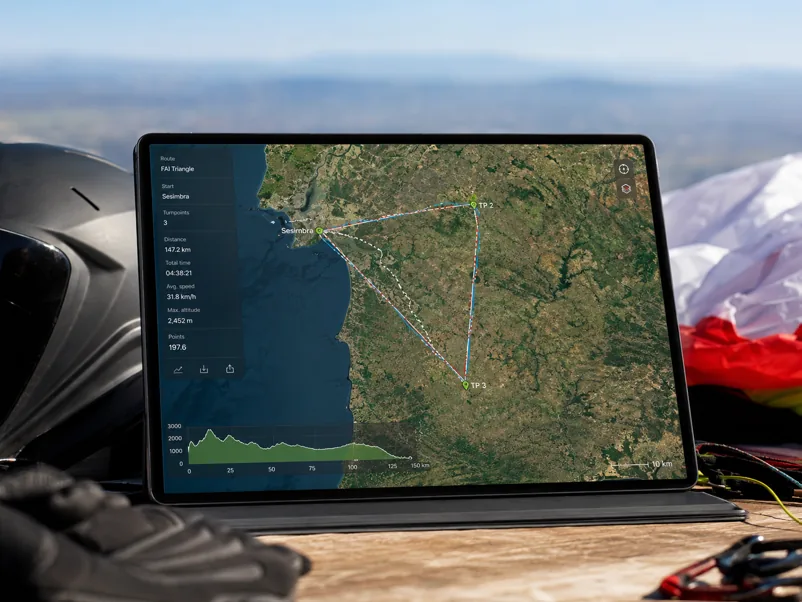
The first time I flew a closed triangle, I understood something about cross-country paragliding that nobody had been able to explain to me in the air. The triangle forces you to work with whatever the sky gives you, because you have to come back to where you started. On a straight-line flight you can always drift with the wind, take the easy line, follow the obvious thermals in the obvious direction. On a triangle you cannot. You are navigating a shape, and the shape does not care whether the best thermal is off-route. The triangle teaches economy, decision-making and route planning in a way that open-distance flying simply does not.
What Is a Paragliding Triangle?
A paragliding triangle is a closed triangular course declared before takeoff. It consists of three turnpoints, with the pilot required to pass through each one within a defined closing radius — for FAI triangles the standard is 400 metres — and return to the start point to close the task. The entire route is declared in advance using an app like XCTrack or directly in the XContest online system before you leave the ground. If you don't declare it first, it doesn't count as a declared triangle for scoring purposes.
Why does this matter for scoring? On XContest and in the Portuguese XC League (APVL), distance is not rewarded equally regardless of how you fly it. Open-distance flights score at a flat 1.0x multiplier. Out-and-return flights — where you fly to a single distant point and return — score at 1.2x. FAI triangles score at 1.4x the raw distance. This means a 70km closed triangle scores the same as a 98km open-distance flight. Serious XC pilots prize triangle flights for exactly this reason: the scoring system recognises that closing a triangle is genuinely harder and demands more from you as a pilot than simply flying in the most favourable direction all day.
There is also an additional category for flat triangles — where all three legs are within 28% of each other in length — which some leagues reward at an even higher multiplier. But when most pilots say "triangle", they mean the FAI format, and that is what this guide addresses.
Why Triangles Make You a Better Pilot
I have been flying XC for over 25 years, and I have competed at national level in Portugal and abroad. Of all the formats I have flown, the triangle is the one that generates the most specific, transferable learning. Here is why.
Thermal selection under directional constraint. When you are flying open distance in the most comfortable direction, you take whatever thermal is in front of you and is going up. On a triangle you may need to leave a strong thermal early because climbing another 200 metres there will put you off the line and you'll spend more time drifting back than you saved in altitude. You learn to evaluate thermals not just on climb rate but on position. That is a competition pilot skill, and it takes most recreational XC pilots years of unstructured flying to develop it. A few triangle days will accelerate that process dramatically.
Glide efficiency. Open-distance flights tend to involve lots of short glides between close thermals. Triangle flights — especially the longer glide legs that connect well-spaced turnpoints — force you to actually commit to a 15 or 20km crossing. On those crossings, every 0.5 glide points matters. You start paying attention to your speed-to-fly technique, your bar use in sink, your line selection relative to cumulus clouds. These are the skills that differentiate experienced XC pilots from beginners, and you cannot develop them properly on short hops.
Wind awareness. A triangle always has at least one leg that is partially or fully into wind. Flying upwind requires a completely different altitude strategy than flying downwind. You need to arrive at your upwind TP with margin to spare, not scraping in low. Managing the altitude differential between legs — banking altitude on the downwind leg to spend it on the upwind leg — is something you only learn by flying in directions you didn't choose.
Mental discipline. There is a specific mental pressure in flying a declared task that free-flying doesn't replicate. Every thermalling decision has a consequence that stretches further into the future. Committing to a glide when you're not sure you'll reach the next trigger, accepting that you might land 5km short of closing — this is the mental side of XC flying that separates pilots who progress from those who plateau. Triangles build it systematically.
The Three Legs — How to Think About Each One
Every triangle has three legs, and on any given flying day, the wind determines their character. Depending on how you orient the triangle relative to the forecast wind direction, you will have one tailwind leg, one upwind leg, and two crosswind legs — or some combination involving partial headwinds and tailwinds on each leg. The standard approach when planning a triangle is to try to set up the task so that the upwind leg is first or second, never last.
The upwind leg is the one that demands the most from you. You are working against the drift, your groundspeed is reduced, and every kilometre of altitude lost to sink costs you more in track distance recovered. The upwind leg is also the one where a low save is most dangerous — if you get low 10km into an upwind leg with no altitude, you are likely going to land there. This is why the upwind leg must be flown when you are freshest and highest after launch, not after you've spent two hours burning altitude on the easier legs.
The downwind leg feels fast and rewarding, and it can seduce you into a mistake. Because your groundspeed is high and thermals feel productive, there is a temptation to skip a thermal and push on, flying lower than you should. Resist it. The extra 30 minutes you save by skipping thermals on the downwind leg often costs you an hour of low saves on the upwind leg that follows. Fly your altitudes on the downwind leg as if the upwind leg is coming next — because it probably is.
The crosswind legs are the most balanced to fly. You have options on both sides of the route, and the wind drift is manageable with a crabbing correction angle. On crosswind legs I use the opportunity to gain altitude if the thermals are good, building a buffer for whatever comes next.
Plan the upwind leg first and make it your first or second leg. Never leave the upwind leg for last — you will arrive at the TP low and in a headwind with no altitude margin.
Planning a Triangle in Portugal's Alentejo
When I run triangle tasks from Sesimbra, we typically drive 25 to 30 kilometres inland — past Palmela, into the Setúbal / Alentejo boundary zone — to escape the marine layer that sits over the coast in summer. The coastal breeze is wonderful for soaring and tandem flying, but it suppresses thermal development and limits cloudbase to 600–800m, which is not enough sky to fly a meaningful XC triangle. Inland, in the Alentejo proper, the landscape dries out, the surface heats more aggressively, and on a good June or July day cloudbase reaches 1600 to 2200 metres. That is the sky I want for triangle flying.
For the triangle size, I calibrate to the group. Intermediate pilots flying their first declared tasks typically fly 40 to 80km triangles — enough to include all three leg types and give the upwind leg some meaningful length, but short enough that the task can close in a reasonable flying window without requiring perfect execution. Experienced pilots with 150+ hours of XC typically fly 80 to 120km triangles. For advanced pilots chasing personal bests, we look at 120km and above, which in the Alentejo means committing to turnpoints that take you toward Grândola, the Monte da Rocha reservoir, or north toward the Arrábida foothills.
For turnpoint selection, I favour landmarks that are easy to identify from altitude and have reliable thermal sources nearby. My standard kit of reference points includes:
- Reservoirs — the Albufeira de Pego do Altar and the Albufeira do Monte da Rocha are both excellent visual turnpoints. Dark water visible from 15km away. The transition from cool water to hot surrounding farmland also generates reliable convergence thermals nearby.
- The Serra de Grândola ridgeline — a low but distinct spine of terrain that reliably triggers thermals from its southwestern slopes from late morning onward.
- Agricultural village squares — small Alentejo villages with their white walls and terracotta roofs are visible from 10km in good visibility, and the concrete and tile of the village centres often produce reliable thermals in mid-afternoon.
I declare the task in XCTrack before takeoff, and I ask every pilot in the group to do the same in their own device. XContest validation requires the declaration timestamp to precede the takeoff timestamp — a rule that catches pilots who "declare" the triangle retrospectively after they've already flown something close to it.
Reading the Sky Before You Start
The pre-flight weather analysis I do before any triangle task goes deeper than checking the general forecast. The questions I am trying to answer are specific:
What is the wind direction and speed at cloudbase level, not at the surface? Surface wind in the Alentejo is typically light to moderate from the west or northwest. But upper-level wind — the wind at 1600 to 2000 metres — can be from a completely different direction, and that is the wind that matters for planning which leg is upwind. I use Windy or Meteoblue to check the 850hPa (roughly 1500m) and 700hPa (roughly 3000m) forecasts. If those diverge significantly from the surface forecast, the triangle needs to be planned around the upper level, not the surface.
How long is the thermal window? In the Alentejo in summer, thermals typically start between 10:30 and 11:00 and last until 18:00 to 19:00. On days with very strong early heating, the window can start sooner but close earlier due to overdevelopment. On slower days the window opens later but extends into the evening. A 70km triangle typically requires 4 to 5 hours of good flying weather. If the thermal window is forecast to be short, I downsize the task or push the launch time earlier.
Is overdevelopment risk high? Towering cumulus building before 14:00, forecasts showing deep convection or CAPE values above 500 J/kg, or a previous day with afternoon thunderstorms — these all push me toward a smaller triangle or no declared task at all. Flying into the base of a building cumulus congestus on the crosswind leg of a triangle is not courageous flying. It is the kind of decision that ends flights — and sometimes more than flights.
What is the thermal strength forecast? Strong thermals (average climb rates above 4 m/s) mean the triangle can be flown with shorter thermalling stops and more aggressive push between turnpoints. Weak thermal days (1.5 to 2.5 m/s average) require more patience in each thermal and more conservative altitude buffers before committing to a glide.
In the Air — The Decision Points
A triangle is not a problem you solve before takeoff. It is a series of decisions you make in the air, each one dependent on where you are, how high you are, and what the sky in front of you is doing. Here are the decision points I coach pilots through.
When to leave a thermal on a glide leg. The standard answer — leave when you are high enough to reach the next trigger with a 300 to 500 metre margin — is correct but requires calibration on the day. On strong days with reliable cloudbase and visible cumulus ahead, I leave thermals earlier and glide faster. On blue days or days with weak, short-cycle thermals, I top up before every glide and accept slower groundspeed. The calculation is: if I leave now at this altitude, on this bearing, in this wind, what altitude do I arrive at the next likely thermal source? If that number is above 600m AGL, I go. If it's below 400m AGL over flat featureless terrain, I stay and climb more.
Altitude buffer management at turnpoints. I teach pilots to aim to never arrive at a triangle turnpoint below 500m AGL if they can help it. Arriving at 500m means you have one thermal attempt to get airborne again before you're looking at a field landing. Arriving at 800m or above means you have options — you can afford to miss the first thermal and try the next one. Turnpoints that sit in flat agricultural land with no obvious thermal trigger nearby demand more altitude buffer than turnpoints near a hilltop or a large dark surface.
What to do when you go low. Going low before a turnpoint — below 300m AGL — is not a failure. It is part of flying XC. The response is methodical: find the nearest slope or terrain feature, work its upslope breeze to gain enough altitude to reach the next obvious thermal trigger, and then climb. Accept that you will lose time. Resist the urge to push forward low and fast across flat terrain hoping to find something — the Alentejo in the middle of the day usually has thermals, but they are separated by 3 to 5km of nothing, and at 200m AGL you cannot afford to be wrong about where the next one is.
Radio coaching on glide legs. When I guide triangle flights with a group, I am on radio with each pilot on each inter-turnpoint glide. The conversation is structured: what altitude are you leaving from, what heading, what does your glide calculator say, what can you see ahead in terms of cloud or terrain triggers? This real-time feedback loop compresses the learning cycle dramatically. A pilot who flies three triangle glide legs with radio coaching will develop their glide judgement faster than one who flies the same legs alone and only reviews the track log afterward.
After the Flight — Track Log Analysis
The triangle's greatest teaching value often emerges after you land, not while you are flying. The track log from a triangle flight is dense with information that a typical open-distance track log does not contain, because the triangle forces you to fly in all directions and at different altitudes in different phases of the flight.
The questions I work through with pilots in the evening debrief:
- Climb rate distribution across the flight. Are your best climbs concentrated on one leg? On many flights, pilots take their best thermals on the downwind leg — not because the thermals are stronger there, but because they are more relaxed and thermalling more patiently. If your average climb rate on the downwind leg is 3.2 m/s and your average on the upwind leg is 1.8 m/s, the thermal strength probably wasn't different — your selection and centring were.
- Average glide ratio on each leg versus your wing's certified performance. A pilot whose wing is rated L/D 10:1 but who achieves 7:1 averaged across the crosswind leg has lost 3 glide points somewhere. Speed-to-fly technique, flying in excess sink without accelerating, or heading errors that added track distance — the track log will show which.
- Time in thermal versus time on glide per leg. On a well-flown triangle, the time ratio shifts: you spend proportionally more time thermalling on the upwind leg (because the thermals matter more there) and more time on glide on the downwind leg (where you can afford to push). If your time distribution shows the opposite pattern, it is usually a sign that you were flying reactively rather than planning ahead.
I work through these numbers with pilots using the track log analysis tools in XContest and Leonardo. If you want to go deeper on this methodology, I have written a full guide on how to read paragliding track logs — it covers the specific metrics and what they mean in practical terms for your next flight.
Triangle Flights in the Context of a Coaching Week
I don't throw pilots into a declared triangle task on day one. The structure of my XC coaching weeks is deliberate: the first two days are always assessment and calibration — usually local coastal flying or a short inland session to get a feel for how each pilot handles thermals, how they make decisions under mild pressure, and where the gaps in their flying are. Rushing to a triangle before I understand a pilot's current level would be poor coaching.
By day three or four, when the group is calibrated and I understand where each pilot needs the most work, we structure a guided triangle. The task size is matched to the group: I will not put a pilot with 80 hours of XC on a 100km triangle, and I will not bore a pilot with 500 hours on a 45km task that they'll close in two hours. The sizing and route planning are done together the evening before, using the forecast, so that pilots understand why the route is the shape it is and what the wind direction means for which leg we're flying first.
I've had pilots tell me at the end of a week that the triangle day was the one that changed something. A Dutch pilot I guided two seasons ago flew his first declared 80km triangle on a Thursday — by the Friday morning debrief he was already talking about which turnpoints he would change and why. That shift from passenger to decision-maker is what the triangle forces. The declared task, the radio on every glide leg, and the track log review that evening create a level of feedback that is simply not available in unstructured XC flying — you can't debrief a meandering free flight with the same precision because there were no committed decision points to interrogate.
If this kind of structured progression appeals to you, the full picture of what an XC coaching week looks like is on the XC coaching programme page. And if you are coming to triangles from the earlier stages of XC flying, the XC cross-country guide covers the foundational skills that triangles build on.