


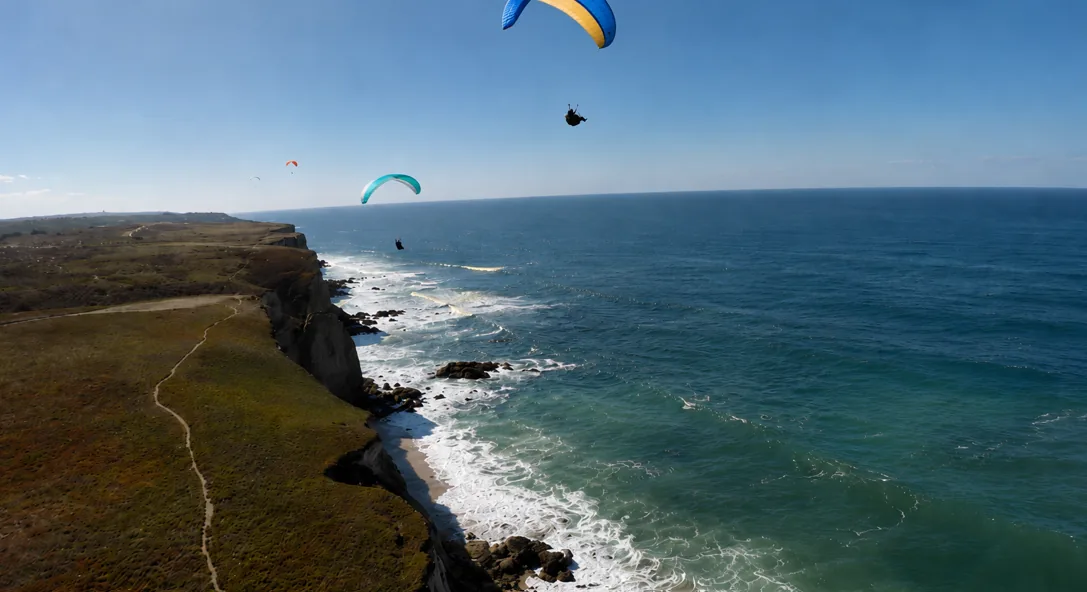
The wind is 15 knots out of the north, steady as a wall. You launch from the cliff edge above Sesimbra, and within ten seconds you're climbing — not because of a thermal, not because of anything invisible, but because the Atlantic itself is pushing air upward off the rock face below you. You make the first figure-8 turn, feel the lift band widen as you gain height, and settle in. Three hours later you'll still be here. Ridge lift doesn't switch off. Understanding the physics behind it, reading where the lift band is, and flying within it efficiently are the skills that turn a day at the coast into hours of continuous, confidence-building flight.
The Physics of Ridge Lift
When wind meets a cliff face or hillside, it cannot go through the rock. Instead, it deflects — primarily upward over the ridge, and partially sideways around the edges. This deflection creates a band of rising air on the windward face of any ridge that has a large enough surface to deflect significant airflow.
The key variables are:
- Wind speed: more wind = more deflection = stronger lift band. On the Portuguese coast, the Nortada (the summer northerly) commonly reaches 15–25 km/h at ridge level, producing strong, consistent ridge lift.
- Wind angle: the lift is strongest when the wind is perpendicular to the ridge face. A wind at 30–45— to the ridge still produces usable lift but reduces its strength and width.
- Ridge height and steepness: taller, more vertical cliffs deflect more air more powerfully. Sesimbra's cliffs rise 100–180m above sea level with near-vertical faces — ideal geometry for ridge lift.
- Cliff length: the longer the continuous cliff face, the larger and more reliable the lift band. At Cabo Espichel, the cliff runs for several kilometres — a vast ridge lift machine.
The Lift Band — Where to Fly and Where Not to Be
The lift band is not a uniform block of rising air. It has a shape — roughly a crescent or banana profile when viewed from the side — and understanding that shape determines where you get lift and where you sink out.
The lift zone
The best lift on a coastal cliff is typically found 50–150m in front of and above the cliff top, and in the upward deflection zone directly above the cliff face. Flying parallel to the cliff face, positioned roughly one to two wing-spans in front of the cliff, places you in the strongest and most consistent lift.
The rotor zone
Behind the cliff top — on the leeward side — the air flows downward and often develops turbulent rotor. Flying into the rotor is one of the most common serious accidents in coastal flying. You never fly behind the ridge in coastal conditions. The rule is absolute: always remain on the windward side of the ridge, with enough clearance to turn away from the cliff if needed.
The wind shadow
Directly at cliff-foot level, below the crest, the air is sheltered from the wind. This creates a wind shadow — apparent calm near the base of the cliff. Pilots who fly too low into the wind shadow find the lift disappears and wind strength drops. If they then turn out to sea, the full wind speed re-engages suddenly, and a high-speed, low-altitude turn can be critical. Maintain altitude — below the crest is not the place to explore.
Always fly with a route to safety. This means: know where your landing zone is, know which turn takes you out to sea (away from the cliff), and never position yourself in a situation where turning into the cliff is your only option. On a crowded ridge, this means thinking about other pilots' positions too — not just your own.
Reading Coastal Wind Conditions
A good coastal flying session requires wind within a specific window. Too little and there's no lift. Too much and conditions become challenging for intermediate pilots. Here's how to read it before and during flight:
| Wind speed (at ridge level) | Conditions for intermediate pilot | Typical Portugal Nortada description |
|---|---|---|
| Under 8 km/h | Insufficient lift, difficult to stay up on the cliff | Light breeze — marginal soaring day |
| 10–18 km/h | Good lift band, moderate penetration, comfortable for P3+ | Moderate Nortada — the ideal intermediate window |
| 20–28 km/h | Strong lift, excellent soaring, more demanding — watch penetration on final approach | Strong Nortada — experienced pilots only in this range |
| Over 30 km/h | Conditions challenging even for advanced pilots — turbulence likely behind topographic features | Very strong — coaches assess site-specifically |
Wind speed alone doesn't tell the whole story. A 20 km/h wind that's perfectly on the nose of the cliff is far more pleasant than 15 km/h at 45— producing cross-turbulence. I assess conditions on arrival — the forecast and the sock are the starting point, but what I see at the cliff edge on the day determines whether we fly.
Soaring Technique — Flying the Lift Band Efficiently
Penetration
On a ridge, you're often flying into wind for part of each pass. Penetration — the ability of your glider to make progress against the wind — is critical near the cliff. A glider at trim or best-glide speed penetrates well. A glider on brakes at near-stall speed penetrates poorly and can be pushed backward toward the cliff face. Key practice: learn your glider's penetration speed in the specific conditions before you need to use it in anger.
Figure-8 pattern
The classic pattern for ridge soaring is a figure-8 — you fly along the cliff face in one direction, turn away from the cliff (never toward it), fly back along the face in the opposite direction, and repeat. All turns must be made away from the cliff. The turn radius and timing should keep you consistently in the lift band without flying over the cliff top or drifting too far downwind.
Gaining altitude above the cliff
On strong days, the lift band extends well above the cliff top. Once you've gained height, you can make figure-8s that traverse the cliff edge at altitude — giving you more room, better visibility of other pilots, and the option to transition to a nearby site if conditions change. Building height is always preferable to scraping the edges of the lift band at low altitude.
Landing back on the ridge
Landing back at the launch site on a ridge requires managing your approach so you're not fighting the wind on final. The standard approach is to spiral down on the seaward side and join the landing circuit from the upwind end — not a straight-in from over the cliff. I brief all pilots on the specific approach procedure for each site before we fly.
The Coastal Sites Near Sesimbra
The main sites used during Coastal Soaring Week and combo programmes:
- Sesimbra cliff (main site): the primary site, 3 minutes from town. Northeast-facing section works on northerly winds, with a broad landing area and a well-defined, predictable lift band. The first site for all new pilots to the location.
- Cabo Espichel: a dramatic headland at the southwestern tip of the Setúbal peninsula. The cliff here runs several kilometres and produces huge, reliable ridge lift on NNW winds. More exposed than Sesimbra — for pilots who've already flown the main site.
- Serra da Arrábida coastal sections: the limestone massif above the protected natural park, with multiple aspects and a complex, interesting lift field mixing ridge lift and thermal activity. Used for progression days.
What Coastal Soaring Builds
Pilots often underestimate how much coastal soaring builds fundamental skill. A long coastal soaring day — three to five hours of continuous flight — develops:
- Weight-shift and brake input precision — you're constantly making micro-adjustments to stay in the lift band
- Spatial awareness near terrain — the cliff is always close, training you to be precise about your position
- Wind reading — you learn to feel gusts and lulls in the lift and respond in advance
- Active piloting — coastal air has structural turbulence; you learn to manage it at low workload before encountering it at high workload
- Confidence — several hours of sustained flight in varied conditions builds the base of experience that ground-based training cannot replicate
Many pilots arrive having rarely flown more than 30–40 minutes at a stretch. By day two of a coastal week, three-hour flights are routine. That shift in flying rhythm — and the confidence it generates — is the thing I see change pilots most fundamentally, faster than any other kind of week.
Frequently Asked Questions
Can I fly the coastal sites if I've only ever flown inland thermals?
Yes, with coaching. Coastal soaring has a specific skill set — particularly around the figure-8 pattern and understanding the lift band edges — that I brief on the ground before your first coastal flight. Most pilots transitioning from inland thermal flying adapt within the first session. The key differences are: always turn away from the cliff, maintain altitude above the crest, and understand that penetration matters in a way it doesn't in calm thermal soaring.
How long can you stay up on a good coastal day?
On a strong Nortada day at Sesimbra, experienced pilots routinely fly 3–5 hours continuously. The limiting factor is usually the pilot's comfort and concentration rather than the lift. I encourage pilots to set a time goal and land before fatigue affects decision-making — tired pilots make sloppy position judgements, which matters more on a cliff than anywhere else.
What happens if conditions deteriorate while I'm in the air?
I monitor conditions from the ground throughout every session. If wind speed increases or the wind direction shifts to put the site off its optimal angle, I'll call pilots down by radio before conditions become problematic. The typical call is to descend and land at the designated area rather than continuing to fly in deteriorating conditions. This is one of the primary reasons for always flying with a working radio and maintaining radio contact with the coach on the ground.
Is coastal soaring more or less dangerous than thermal flying?
The risks are different rather than more or less. Thermal flying has the main risk of canopy collapse in turbulent or strong thermals. Coastal soaring's primary risk is terrain contact — the cliff is always close. In skilled hands with good spatial awareness, both are manageable. The advantage of coastal soaring is that the air is generally smoother (laminar flow from the sea) and conditions are more predictable — the lift doesn't switch off unexpectedly the way a thermal can. This is why coastal soaring is often recommended for pilots rebuilding confidence after a difficult experience.
Fly the Atlantic coast with a coach beside you
The Coastal Soaring Week puts you in the lift band from day one — with radio coaching, daily briefings, and all transfers to the best-conditions site each day.