


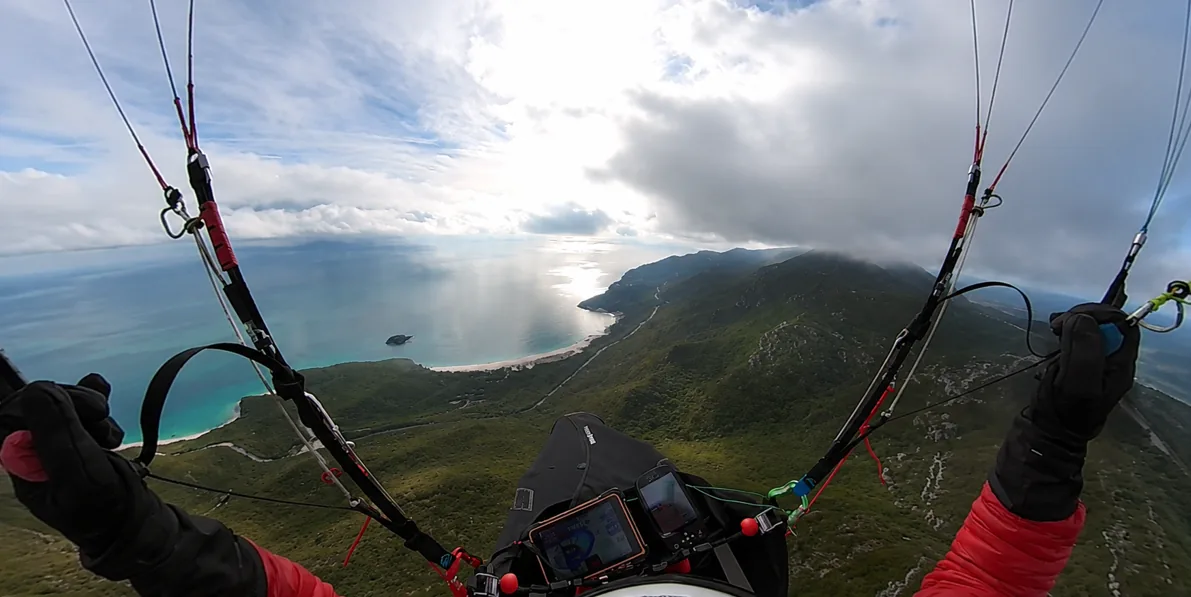
If you ask a European pilot where they go for a serious flying holiday, most will say Annecy, Ölüdeniz, or somewhere in the Alps. A very small number will say Portugal. This imbalance is not based on quality — it is based on information. Portugal is not easier than Annecy. It is not less flyable than Turkey. But it is less talked about, less marketed, and less crowded — which means that pilots who discover it tend to come back, and to come back often. Here is why I think Portugal is the most underrated paragliding destination in Europe, and why you are probably still sleeping on it.
The Coverage Problem
Annecy has dominated the conversation for decades. Ölüdeniz figured out how to market tandem flying to package tourists before anyone else did. Both are genuinely great destinations. But the European paragliding media — magazines, YouTube channels, Facebook groups — has historically followed the crowds rather than led them. Portugal never had a single event or moment that put it on the map internationally the way the Coupe Icare did for Annecy. And so the reputation lagged far behind the reality.
The result is a self-reinforcing blind spot. Pilots plan their holidays based on what they read and who they follow. What they read is mostly about the same handful of destinations that were written about the year before. Portugal sits just outside that loop — not because it lacks the flying, but because it has never had a well-funded marketing machine pushing it into the international conversation. That is changing, slowly, as more visiting pilots discover it and start talking. But right now, the information gap is still very real — and it works entirely in your favour if you know about it.
Reason 1 — The Longest Year-Round Flying Season of Any Mainland European Country
Portugal has exactly one thing almost no other European country can claim: you can fly every month of the year. The Atlantic coastal ridge at Sesimbra does not take a winter break. In January, when pilots in Germany, the Netherlands and the UK are staring at low cloud, Sesimbra is often producing good coastal soaring days. In July and August when Alpine thermal flying becomes dangerously overdeveloped in afternoon, Portugal's nortada provides reliable, clean, laminar ridge lift at any time of day.
This is not a marketing claim — it is the meteorological reality of having a coastline that faces the North Atlantic. The Arrábida peninsula creates a microclimate that is remarkably consistent across the calendar. The nortada — the summer north wind that builds reliably through the morning — delivers some of the most predictable flying conditions in Europe. In winter, south and south-west swells create different but equally consistent coastal dynamics on the alternative sites. The season here is 12 months, not 6. For pilots planning their annual leave around flying, this matters enormously. See also: winter paragliding in Portugal and the best time of year to fly here.
Reason 2 — Two Completely Different Flying Styles in One Country
Most destinations give you one type of flying. Annecy gives Alpine thermals. Ölüdeniz gives you a tandem flight from a mountain to a beach. Algodonales in Spain gives thermal XC. Sesimbra gives you Atlantic coastal ridge soaring and inland XC thermal flying — sometimes in the same day.
On a northerly morning I soar the cliffs at Bicas for two hours with laminar lift and zero turbulence, then drive inland thirty minutes to catch the Alentejo thermals developing at noon. The two experiences are nothing like each other — one is smooth and meditative, the other requires active thermalling and XC decision-making. No other European hub offers this combination so naturally or so close together. Pilots who come expecting one type of flying frequently discover a second type they hadn't anticipated, which makes the week feel twice as full. Read more about flying at Sesimbra and XC flying in Alentejo.
Reason 3 — Completely Uncrowded Skies and Launches
This deserves to be said plainly: at Sesimbra I can launch on a perfect flying day with one or two other pilots in sight. Try that at Annecy's Planpraz on a July Saturday. The queue at Planpraz in high summer is genuinely stressful — launches are regimented, the airspace is dense, and the soaring line is territorial in a way that makes flying feel more like queuing than freedom.
At Sesimbra the cultural atmosphere is entirely different. No queuing at the launch, no crowded airspace, no disputes over the soaring line. The sites are big enough and varied enough that groups can spread out naturally. The local pilot community is welcoming to visiting pilots in a way that reflects the broader Portuguese character — unhurried, generous, not territorial. And because most international pilots still haven't discovered Sesimbra, this window stays open. It will not stay open forever, which is another reason to come sooner rather than later.
Reason 4 — Cost: One of Europe's Most Affordable Capitals at Your Airport
Lisbon is 30 minutes from Sesimbra and has become one of the most connected airports in the world. TAP flies directly from 60+ cities. Ryanair, easyJet, British Airways, Lufthansa — all have regular LIS routes, many at competitive prices. Getting here from almost anywhere in Europe is straightforward and often cheaper than flying to Geneva or Zurich for an Alpine holiday.
But unlike the cost inflation that has hit Paris, Zurich or Salzburg, Lisbon and its surroundings remain genuinely affordable once you arrive. A good dinner of fresh Atlantic fish costs €15–20 per person. Wine with dinner adds a few euros. Accommodation in Sesimbra itself — a proper fishing village with excellent local restaurants and no international hotel chains — is a fraction of what you would pay in Chamonix or Annecy. The guiding fee for a week with me is competitive against any equivalent programme in the Alps, and it includes all site transfers. The value proposition, in other words, is hard to beat. You get serious flying, serious food, and a genuinely local experience for less than most Alpine alternatives.
Reason 5 — Personal, Small-Group Coaching — Not Factory Tourism
When you arrive in Annecy in summer, you are one of thousands of visiting pilots using the same sites, eating the same café lunches, shuffling through the same routine. There is nothing wrong with that experience — but it is not the same as flying with a single guide who has spent 25 years learning every nuance of these specific sites in every wind direction and season.
At Fly with Behrooz, groups never exceed 4–6 pilots. The daily programme is built around who is in the group and what the conditions allow that day — not a fixed schedule designed months in advance for the lowest common denominator. If the group has two strong XC pilots and two pilots working on their thermalling technique, the day is structured to serve both. No factory. No one-size-fits-all programme. The week you fly is designed around you. Find out more about what to expect on a coaching week.
The XC Secret Almost Nobody Knows
Alentejo, Portugal's great southern plain, is a world-class XC territory that most international pilots simply do not know exists. Wide open fields with generous landing options, reliable thermals from April through October, cloudbase reaching 1,800–2,200m on good days. The terrain is open and forgiving — long flat valleys, gentle ridges, agricultural land that makes retrieve simple. It is the kind of place where you can fly conservatively and still cover serious distance, or push harder and achieve distances that would be impressive anywhere in Europe.
Pilots flying Alentejo XC in summer regularly achieve 80–120 km flights in good conditions. Add the option of an Algarve extension taking you down to the southern coast, or cross into Andalusia on the Iberian XC Tour, and you have a cross-country playground that rivals anything in Spain or France for pilots who are serious about distance flying. Almost nobody in the international community knows this territory exists at this level. That is, again, both an indictment of the information gap and an opportunity for pilots reading this. More on Alentejo XC flying and the Iberian XC Tour.
What Pilots Say After Their First Week
I have been guiding for over 20 years and the pattern is absolutely consistent: pilots who book their first week in Sesimbra expecting it to be "nice" come home saying it was one of the best flying experiences of their lives. Not because Portugal is easy — it is not — but because the combination of great flying, great food, genuine village atmosphere, and personal guidance produces something that is genuinely hard to replicate elsewhere in Europe.
The specific feedback I hear most often: the coastal soaring is more technically interesting than they expected, the variety across a week is greater than they anticipated, the weather is more reliable than they assumed, and Sesimbra as a base is more enjoyable than any flying destination they have used before. Most pilots who come once come back. A number have come back every year for several years running. The best evidence for the quality of a destination is repeat booking — and by that measure, Portugal does very well indeed.
So Why Are You Still Booking Annecy?
This is not a rhetorical attack on the French Alps. Annecy is magnificent. The flying is world-class. The infrastructure for visiting pilots is excellent. If you have never been, you should go. But it is worth asking, honestly: when did you last look seriously at Portugal? If the answer is never — or not since reading something years ago that dismissed it as a coastal soaring destination suitable only for beginners — then you are working with outdated information.
The coastal flying at Sesimbra is not beginner flying. The Alentejo XC is not beginner flying. The programme I run is not a beginner programme — it is designed for pilots who want to fly seriously, improve their skills, and do so in conditions that are both excellent and uncrowded. Portugal deserves a place on your shortlist, and on most pilots' current knowledge, it isn't even on the longlist. That is the information gap. Book a week. Fly here for the first time. Then decide.