


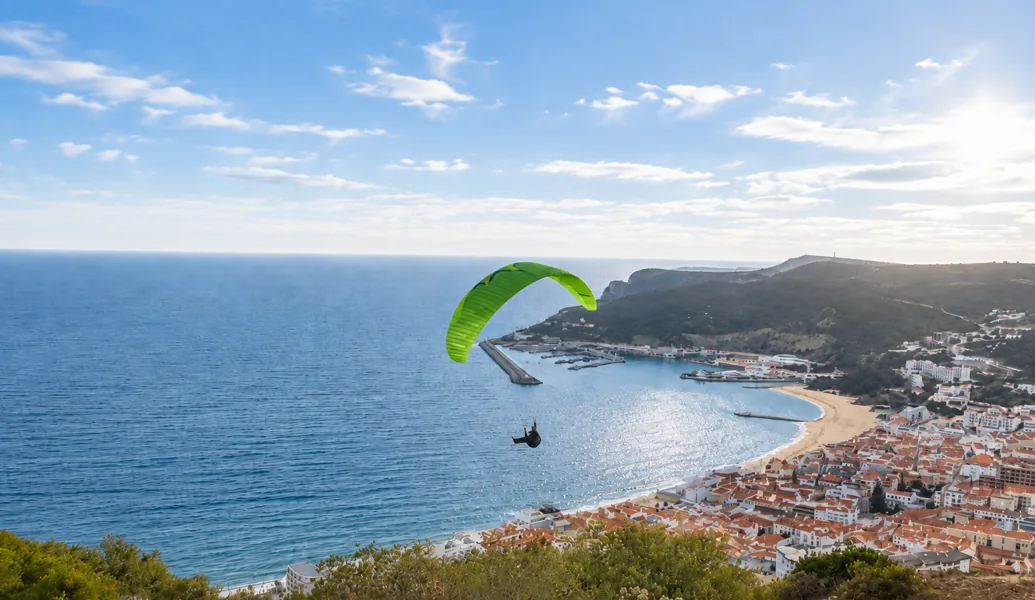
Every European pilot knows Annecy. Most have heard of Ölüdeniz. But paragliding in Portugal? It barely registers on the radar of pilots planning their first overseas flying trip — and that, honestly, is what makes it one of the best-kept secrets on the continent. I've been flying the Portuguese coastline for over 15 years, competing at national and international level from a base in Sesimbra, 30 minutes south of Lisbon. In that time I've watched Portugal's reputation quietly build among pilots who come here once and start plotting their return before they've even landed. This is my attempt to put everything in one place — the sites, the seasons, the licences, the costs, and why you should have booked a paragliding holiday in Portugal years ago.
Why Portugal is Europe's Best-Kept Paragliding Secret
The case for Portugal comes down to four things that the popular alternatives can't match simultaneously: a 12-month flying season, uncrowded skies, extraordinary variety, and prices that don't require a second mortgage. Annecy has the scenery but the airspace is saturated and the cost of a guided week will make your eyes water. Turkey has the sunshine but the flying is largely tandem-focused and the XC potential is limited. Portugal gives you laminar Atlantic ridge lift in the morning, the option of an Alentejo XC day in the afternoon, mountain flying in the centre, and seafood for dinner at a price that makes Chamonix pilots weep.
The other factor nobody talks about: Lisbon airport (LIS) is one of Europe's best-connected hubs. Direct flights from London, Amsterdam, Frankfurt, Paris, Zürich, Stockholm, and most major European cities run daily, with budget carriers keeping prices low. Sesimbra is 30 minutes south of the airport by taxi or Uber. There's no mountain pass to cross, no seasonal road closure, no three-hour transfer from a regional airport. You land at LIS at midday; by 2pm you're looking at the Atlantic from the cliffs.
Portugal's Paragliding Geography at a Glance
Portugal is roughly the size of Scotland, but its flying geography divides into three completely distinct regions, each offering a different type of flying and a different kind of experience.
- The Atlantic coast (Setúbal Peninsula) — Ridge soaring on sea cliffs. Reliable from September through June, excellent in summer too. The main hub for all Fly with Behrooz programmes. 30 minutes from Lisbon airport.
- The Alentejo plains — Portugal's cross-country heartland. Wide open cork oak and wheat country with honest thermals from April through October. Typical XC days of 60–120 km. Pilots come here to make distance.
- The mountain ranges (Serra da Estrela, north) — Mountain thermal flying. Seasonal window spring and autumn. Dramatic landscapes, serious XC territory. Sites like Linhares da Beira are legendary in Portuguese paragliding.
Most visitors spend their first visit on the coast and add inland flying on subsequent trips. The combination of all three regions is what the Iberian XC Tour covers — seven days moving between sites from the Atlantic cliffs to the Spanish interior.
Sesimbra and the Setúbal Peninsula — The Atlantic Heartland
Sesimbra is where I base every programme, and there's a reason for that. It's a small Atlantic fishing town 30 minutes south of Lisbon with its own microclimate — measurably sunnier and drier than the capital — and a dozen launch sites within 15 minutes of the town centre. The limestone cliffs of the Setúbal Peninsula face northwest to northeast, directly into the prevailing Atlantic wind, producing some of the most consistent and laminar ridge lift in Western Europe.
Praia das Bicas — The Flagship Coastal Site
Bicas is my home site and the one I use most in the Coastal Soaring Week. A 120-metre sea cliff above a long Atlantic beach, with a wide and accessible launch on the clifftop. The soaring band is wide and generous — anywhere from 30 metres above cliff-top to 300 metres in a strong northwesterly — and the landing beach below is long enough for a relaxed approach even in strong wind.
- Best wind direction: NW through N-NE
- Wind strength: 10–22 knots at the clifftop
- Skill level: Club Pilot / DHV A and above
- Season: Year-round; best Sept–June
Cabo Espichel — Portugal's Most Dramatic Site
The headland at the southwest tip of the Setúbal Peninsula — a vertical limestone cliff falling 150 metres to the open Atlantic, with an 18th-century pilgrimage sanctuary on the clifftop and nothing visible to the west but ocean. Top-landing on the clifftop grass is part of the experience, and the approach is constrained by the sanctuary buildings. This is a technical site: a confident reverse launch in marine air, comfortable top-landing on a short field, and no hesitation committing to a high approach over the cliff edge. I introduce pilots to Espichel on the XC & Coastal Combo week once they've demonstrated solid top-landing at Bicas.
- Best wind direction: W through NW
- Wind strength: 12–20 knots (stronger winds rotate off the headland)
- Skill level: Intermediate / DHV B and above, top-landing experience required
- Season: Sept–June; avoid peak nortada in July–August
Arrábida Natural Park — Ridge to XC Gateway
The Arrábida hills are the highest point on the Setúbal Peninsula, rising to 500 metres above the sea in a wall of limestone covered in Mediterranean macchia. The flying here crosses a threshold: start on the ridge in the morning, then as the day heats and thermals fire off the south-facing limestone, transition from pure ridge soaring into proper thermal cross-country. On good spring and autumn days, pilots thermal up past 1,500 metres from Arrábida's upper sites and push southeast into the Alentejo plains, covering 80–120 km before outlanding. The XC & Coastal Combo week specifically uses this transition.
Praia do Meco
Eight minutes north of Bicas — a lower cliff (60–80 metres) with a rougher launch but excellent flying in strong northwesterlies when Bicas is at the upper edge of comfortable. On days when Bicas is seeing 20+ knots, I'll shift the group to Meco, where the slightly lower cliff gives a cleaner wind gradient and a softer entry into the soaring band.
Praia de Fonte de Telha — Atlantic Dune Soaring
A different kind of flying — a long sand cliff 15–20 metres above an Atlantic beach, stretching for nearly a kilometre. The soaring here is low and intimate: working the dune lift band at 20–40 metres, landing directly on the beach, launching again from a running forward launch on the sand slope. It's where I start the Ground Handling Week, ideal for pilots working on launch technique in forgiving conditions.
The Sesimbra microclimate is measurably drier and sunnier than Lisbon, 30 km to the north — it's the orography of the Setúbal Peninsula acting as a barrier to Atlantic fronts approaching from the northwest. I've flown perfect beach soaring days at Bicas while watching rain over Lisbon on the radar.
The Atlantic Dune Sites — Alberta Nova and Costa Caparica
North of Sesimbra, between the Setúbal Peninsula and Lisbon, a long strip of Atlantic coastline runs from Costa Caparica to Alberta Nova. Here the cliffs drop to dunes — low, sandy ridges above wide beaches — and the flying is entirely different from the limestone sea cliffs to the south.
Alberta Nova
A prominent dune headland about 40 minutes north of Sesimbra. At 25–30 metres high, it's the tallest of the local dune sites and offers genuine soaring in the right conditions, not just ground handling practice. The beach below is massive and forgiving. It's where I run the intensive kiting and cobra-launch sessions on the Ground Handling and Parakite Week programmes.
Costa Caparica
The long beach south of Lisbon has scattered dune ridges used by local pilots for ground handling and dune soaring — less spectacular than the Sesimbra sites but convenient for pilots based in Lisbon, and useful for windy-afternoon sessions when the sea cliffs are too strong.
Alentejo — Portugal's Cross-Country Country
Drive two hours east from Sesimbra and the limestone cliffs give way to the cork oak forests and golden wheat plains of the Alentejo — the thermal heartland of mainland Portugal, and where the XC flying that pilots come back for lives. The thermals are honest in a way that rewards learning: wide at the base, easier to core than narrow mountain thermals, with a clear trigger signature over the cork oak patches and darker soil.
Évora and the Central Alentejo Plains
The Alentejo plain around Évora (90 km east of Sesimbra) is the classic Portuguese XC destination. Thermals here are wide-based and reliable from April through October, triggering over the darker soil patches and cork oak edges, reaching 1,800–2,500 metres on strong days. The landscape is almost completely open, so outlandings are a phone call and a quick drive rather than a helicopter retrieval. On strong October days, pilots have reached the Spanish border.
- Best months for XC: April–May, September–October
- Typical distances from coastal launches: 60–120 km
- Cloudbase: 1,500–2,800 m on strong thermal days
- Outlanding terrain: Flat, open, excellent — farm tracks every 1–2 km
Montemor-o-Novo and the Setúbal Inland
The transitional zone between the Arrábida hills and the main Alentejo plain fires well on spring mornings. Pilots launching from inland Sesimbra sites can be in thermals within 15 minutes, using the warming south-facing hillsides as trigger points before crossing into the plains — where the XC Coaching Week focuses its early XC sessions.
Serra da Estrela — Mountain Flying in Portugal
Portugal's highest mountain range sits in the centre of the country, peaking at 1,993 metres at Torre — modest by Alpine standards, but the flying here is genuinely different from anything on the coast or the plains: real mountain terrain, with ridge systems, valley thermals, and a decidedly un-Atlantic feel. The best windows are March through May and September through October; summer convection becomes too aggressive by midday, and winter is cold and often wind-affected. This is intermediate-to-advanced territory — thermal flying, XC navigation, and comfort in mountain weather are all required.
- Best months: March–May, September–October
- Typical cloudbase: 1,200–1,700 m above launch
- Skill level: Intermediate/Advanced; XC experience required
- Highest point: Torre, 1,993 m
Linhares da Beira — Portugal's Most Famous XC Launch
Linhares da Beira is a medieval village perched on a granite escarpment above the Mondego river valley, roughly 280 km north of Sesimbra. It's the site I'd recommend most to any XC pilot who finds themselves in Portugal with a free day and a strong forecast. The launch sits right above the medieval castle walls — you inflate above 700-year-old stone fortifications and step off into a valley that opens southeast toward the Beira plains. On strong days in spring or autumn, pilots regularly achieve 100–150 km flights south into the Alentejo or east into Spain. Very few quality English-language guides to this site exist, which is why I cover it in depth in the Design Your Tour week for pilots who want to see the north as well as the coast.
The village itself is a medieval time capsule — granite houses, cobbled streets, a 14th-century castle, and a population of about 150 people who have coexisted with passing paragliders for decades. Launching above the castle walls and looking southeast over the Mondego valley on a clear spring morning is one of the most memorable moments in Portuguese flying.
- Best months: March–May, September–October
- Typical XC distance: 80–150 km
- Skill level: Intermediate+, XC experience essential
Northern Portugal — Penacova, Caldelas and Beyond
The north of Portugal has its own flying identity: greener, wetter, more Atlantic-influenced, with sites built around river gorges and granite hillsides rather than limestone sea cliffs.
Penacova
Penacova sits above the Mondego river gorge south of Coimbra. The launches produce ridge lift from the valley wind channelling through the gorge — a different dynamic from sea-cliff soaring but with a similar laminar quality. Works in northeast winds, complementary to the Sesimbra sites, which work in northwesterlies.
Caldelas (Minho Region)
A thermal site in the Minho region of northwest Portugal — green hills, Atlantic-influenced weather, and a well-established local club. More weather-dependent than the south, but when conditions align in late spring and autumn, the mountain landscape is striking. Included in the northern extension of the Iberian XC Tour.
The Andalusia Extension — Southern Spain
The Iberian XC Tour crosses the Portuguese border into Andalusia in southern Spain, accessing sites that work in different conditions from the Atlantic-influenced Portuguese sites. The Jerez / Sierra de Cádiz area is the main target: high cloudbase (often 2,500–3,500 m in summer), reliable thermals funnelling west from the Sierra Nevada, and a dramatically different landscape from the cork oak plains of the Alentejo — more Mediterranean in character, with more aggressive thermals and higher cloudbases. Combining Portugal's Atlantic sites with Andalusia's Mediterranean-influenced conditions in a single week is what makes the Iberian XC Tour genuinely unique.
Site Summary — All Regions at a Glance
| Site | Type | Skill Level | Best Season | Typical Flying |
|---|---|---|---|---|
| Praia das Bicas | Coastal ridge | Club / DHV A+ | Year-round | Ridge soaring, 1–4 hrs |
| Cabo Espichel | Coastal ridge | Intermediate / DHV B+ | Sept–June | Ridge soaring, top-landing |
| Arrábida | Ridge + thermal XC | Intermediate / DHV B+ | Apr–Jun, Sep–Oct | Soaring → XC, 60–120 km |
| Praia do Meco | Coastal ridge | Club / DHV A+ | Year-round | Ridge soaring (strong wind) |
| Fonte de Telha | Dune soaring | All levels | Year-round | Low soaring, ground handling |
| Alberta Nova | Dune soaring | All levels | Year-round | Ground handling, dune soaring |
| Alentejo Plains | Thermal XC | Intermediate / DHV B+ | Apr–Oct | XC, 60–130 km |
| Serra da Estrela | Mountain thermal | Advanced | Mar–May, Sep–Oct | Mountain XC |
| Linhares da Beira | Mountain XC | Intermediate+ XC | Mar–May, Sep–Oct | Long XC, 80–150 km |
| Penacova | River gorge | Club / DHV A+ | Year-round (NE wind) | Gorge soaring |
| Andalusia (Spain) | Thermal XC | Intermediate+ XC | Apr–Oct | Long XC, high cloudbase |
The Portuguese Paragliding Season — Month by Month
One of Portugal's most important advantages is the season length. The best-known European flying destinations give you May through September at best. Portugal flies reliably from September through June — ten months — and with some adjustment in July and August, the Atlantic sites run virtually year-round.
| Month | Flying Type | Conditions | Who It Suits |
|---|---|---|---|
| Jan–Feb | Coastal soaring | Mild Atlantic, 14–18—C, some rain spells | Northern Europeans escaping winter |
| March | Coastal + early thermals | Spring warming, variable, good for mixed flying | Any level |
| Apr–May | Coastal + Alentejo XC | Best of both: coast reliable, thermals developing — the sweet spot | Any level. Best overall months |
| June | Coastal + early nortada | Sea breeze establishing, XC still viable, warm and sunny | Any level |
| Jul–Aug | Coastal (nortada) | Strong N 15–25 kts, laminar coastal days, limited inland XC | Coastal-focused pilots; early mornings |
| Sep–Oct | Coastal + XC | Second thermal peak, autumn clarity, Alentejo excellent | XC pilots; best months for distance |
| Nov–Dec | Coastal soaring | Atlantic ridge reliable, uncrowded, 16–20—C | Any level |
The nortada — Portugal's summer sea breeze — deserves a word. From June through August, a persistent northerly wind fills in along the Sesimbra coast, typically reaching 15–25 knots by early afternoon. This is outstanding for coastal ridge soaring: it's laminar, consistent, and predictable. But it suppresses inland thermals after midday. My approach in summer is to fly early: launches at 9am, in the air by 9:30, off the hill by 1pm before the wind builds to its daily maximum. Afternoons are for the beach, the restaurant, or the forecast briefing for tomorrow.
Paragliding Licences in Portugal — What You Need to Know
This is the question I receive most often from pilots outside Europe planning their first trip to Portugal, and the answer is straightforward: any nationally-recognised paragliding federation licence is accepted.
Portugal follows the de facto European standard: a valid licence from a recognised national federation — DHV (Germany), BHPA (UK), SHV (Switzerland), FFVL (France), USHPA (USA), or equivalent — qualifies you to fly. The IPPI/CIVL card provides a convenient common-format document that codifies your licence level on an internationally standardised scale (P1—P5), but it is not legally required at Portuguese sites.
A valid licence from your home federation at Club Pilot / DHV A level or above (depending on the programme). Third-party liability insurance — included in most European federation memberships as standard. No medical certificate is required. If you're unsure about your licence level, send me a WhatsApp message before booking and I'll advise.
For independent pilots — those flying Portuguese sites without a guide — the same standard applies. Local clubs at Bicas, Arrábida, and other managed sites are familiar with international visiting pilots and apply the federation licence standard without bureaucracy. English is spoken at most sites.
Guided vs Independent Flying in Portugal
You can fly Portugal independently. The main sites are accessible, the local community is welcoming, and a Portuguese SIM card plus Windguru gives you the tools for self-briefing. Many experienced pilots do exactly this, especially at Sesimbra, which has an active local flying scene and pilots who are generous with site knowledge.
The advantage of flying with me is the forecast interpretation. I've spent 15 years learning to read the specific Atlantic-meets-continental meteorology of the Sesimbra region. I know which Windguru model to weight on which wind direction, why Bicas works on days when the coastal forecast says it shouldn't, and how to extract the maximum airtime from a 7-day window. I also provide private transfers to every launch — no rental car, no logistics — radio coaching in the air, and individual debrief at the end of each flying day.
For pilots visiting Portugal for the first time, a guided week is almost always the better investment — not because the sites are dangerous, but because you'll fly twice as much and learn ten times as fast in the same seven days.
Which Sites You'll Fly on Each Programme
The sites you fly depend on the programme you choose and what the forecast delivers. Here's how they map to the Fly with Behrooz programmes:
- Coastal Soaring Week: Praia das Bicas, Praia do Meco, Cabo Espichel, Fonte de Telha, Arrábida — all 5 Setúbal coastal sites, chosen day-by-day based on conditions.
- XC Coaching Week: Arrábida thermal launches, Alentejo plains, inland Setúbal sites. Days on the coast when thermals aren't available.
- XC & Coastal Combo: Split between coastal ridge and XC thermal days. Best option for pilots who want both disciplines in a single week.
- Ground Handling Week: Fonte de Telha, Alberta Nova, and other dune sites. Occasional soaring days at Bicas when conditions allow.
- Iberian XC Tour: Arrábida, Alentejo, Serra da Estrela or Linhares, Andalusia. A different site every 1–2 days.
How Much Does a Paragliding Holiday in Portugal Cost?
A week of paragliding in Portugal is significantly cheaper than the Alpine or Turkish alternatives, and the flying season means you have much more flexibility on timing than anywhere at altitude.
- Guiding fee (Fly with Behrooz): €80 per day / €560 per week, including private transfers to all launches, radio coaching, daily weather briefing, and site selection.
- Flights to Lisbon: Budget airlines from UK, Germany, Netherlands, France, and Scandinavia run direct to LIS. Return fares typically range from €80–200 depending on season and lead time.
- Accommodation in Sesimbra: Guesthouses from €45/night; boutique hotels €75–110/night. All within walking distance of the town centre and the beach.
- Food: Sesimbra is a fishing town. A full lunch with grilled fish, bread, and wine runs €12–18. Dinner at a proper restaurant: €18–28 per person. Cheaper than Annecy's cafe prices.
Total realistic budget for a 7-night week including flights, accommodation, food, and guiding: €1,200–1,600 all-in. That's less than a comparable week in the French Alps or Turkey when you factor in everything. For more detail, see our dedicated cost breakdown in the full programme pages.
How to Book a Paragliding Week in Portugal
There are no forms, no deposit, and no booking software. I respond to every WhatsApp message personally — usually within a few hours — and every booking is a direct conversation between me and the pilot. Tell me when you're thinking of coming, what level you're at, and what you want to get out of the week. I'll suggest dates based on the seasonal forecast and the kind of flying that suits you, and we'll fix it from there. No spreadsheets, no system, no waiting three days for a confirmation email.
WhatsApp: +351 914 828 076 — the fastest route.
Email: flywithbehrooz@gmail.com
Frequently Asked Questions
Do I need to speak Portuguese to fly here?
Not at all. English is widely spoken in Sesimbra — in hotels, restaurants, and among the flying community. All Fly with Behrooz programmes run entirely in English (and Spanish and Farsi for pilots who prefer). The only Portuguese you'll need is obrigado — thank you.
Can I come as a beginner or on my first solo flights?
The Coastal Soaring Week requires a minimum of Club Pilot (BHPA) / DHV A or equivalent. Complete beginners who haven't yet qualified need to complete a training course at their home school before coming. If you're near that threshold — say, you finished your training last autumn and haven't flown a full season yet — contact me and we'll assess whether a supervised coastal week is appropriate for where you are.
What if the weather is bad for several days?
I plan close — I look at a 10-day forecast window before confirming travel dates, and I'm honest if the window looks poor. Within a week, if one day is genuinely unflyable, I'll often shift the day's plan — drive inland to check an XC site, walk a launch, do a ground handling session on the dunes — rather than writing it off. Weather refunds are not part of the programme structure; what I offer instead is active maximisation of every available window. In 15 years, I've never run a week with fewer than 4 flying days.
Can my non-flying partner join the trip?
Absolutely. Sesimbra is an excellent destination for non-pilots: a beautiful old fishing town with Atlantic beaches, boat trips, seafood, and Lisbon 30 minutes away. Many pilots come with partners who do a tandem paragliding flight on day one and then explore Sesimbra and the Setúbal coastline while the pilots fly. The logistics work naturally — I'm with the pilots; the town and the Arrábida coastline look after everyone else.
How do I get from Lisbon airport to Sesimbra?
Taxi or Uber from Lisbon airport (LIS) to Sesimbra takes approximately 35–45 minutes and costs €35–50. I can arrange an airport transfer for your arrival day if you message me in advance with your flight details. Once you're based in Sesimbra, you don't need a car for the rest of the week — I pick up from your accommodation for every flying day.
Is there a minimum group size?
I run weeks with a minimum of 2 pilots. If you're travelling solo and want to join other pilots in a shared week, contact me — I often have solo pilots who join a shared group week. Maximum group size is 8 pilots, which keeps coaching personal and site management straightforward.
I want to fly XC, not just ridge soaring. Is Portugal suitable?
Genuinely excellent XC flying is available from the Setúbal Peninsula — particularly from the Arrábida launches, which allow you to thermal up from the ridge and push into the Alentejo plains on the right days. The XC Coaching Week is designed specifically for pilots making the transition from site flying to cross-country. The Iberian XC Tour is for experienced XC pilots who want to push further afield into Spain and northern Portugal.
Ready to fly Portugal?
Browse the full programme range or message me directly on WhatsApp. I respond personally to every enquiry — usually within a few hours.