


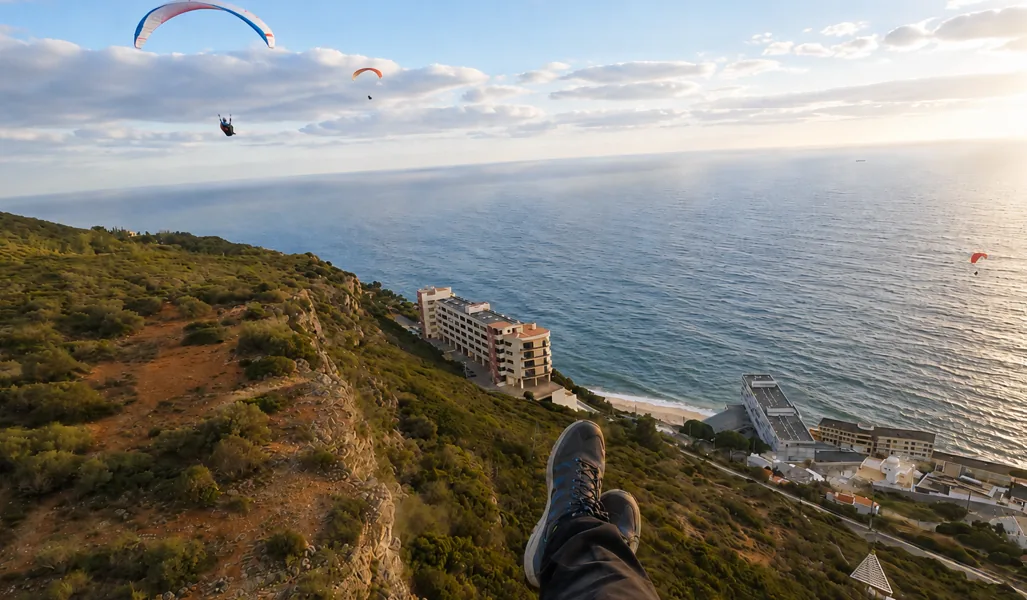
The most honest answer to "when is the best time to go paragliding in Portugal?" is: almost any month works, but for very different reasons. Portugal has one of the longest paragliding seasons in Europe — coastal ridge soaring runs essentially year-round from Sesimbra, and XC flying is viable for six to eight months depending on the year. The real question isn't whether Portugal is flyable in any given month — it almost certainly is — but what kind of flying you want, and which months deliver it most consistently. I've been based in Sesimbra for over 15 years, flying and guiding through every season. Here's how I read the calendar.
Why Portugal Has One of Europe's Longest Flying Seasons
The Atlantic-facing coast of the Setúbal Peninsula gets consistent northwesterly winds for most of the year. This is the same north Atlantic high-pressure system that drives trade winds south toward the equator — it sits over the ocean west of Portugal and drives reliable NW airflow into the Portuguese coast from roughly September through July. As a result, the Sesimbra cliffs produce ridge lift for ten or more months per year.
Compare this to the Alps — where the flying window runs from May to September at best, and where winter brings snow to the launch sites — or Turkey, where summer heat can make flying technical and the shoulder seasons are crowded. Portugal's mild Atlantic climate (Sesimbra averages 17—C in January and 26—C in July) means there's no month that's genuinely cold or genuinely impossible. The variation between months is in the type of flying available, not whether flying is possible at all.
Coastal soaring: year-round, best Sept–June. XC thermal flying: April–October, peak April–May and September–October. Ground handling/dune flying: year-round. There is no month in which I can't find something flyable at Sesimbra.
January–March: Flying When Europe Sleeps
January through March is when German, Dutch, and British pilots come to Portugal because they have nowhere else to fly. Their home sites are under snow, in low cloud, or blowing 40 knots of cold continental wind. Sesimbra in January is 15–17—C, the cliffs are producing ridge lift on most days, and the town is quiet enough that you'll have the beach and the restaurants mostly to yourself.
The flying in this period is pure Atlantic coastal soaring. The thermals aren't developed enough for XC — the sun angle is too low and the air too stable — but the ridge lift at Bicas and Meco is consistent and often laminar. On the best January and February days, you can soar for 2–3 hours above an empty Atlantic beach with temperature at 18—C and visibility extending to the Arrábida headlands. It doesn't feel like winter.
The caveat: January and February can have Atlantic front passages that bring 2–4 days of rain and strong westerlies. These are not flyable — not at any coastal site. My policy for winter weeks is to plan the 10-day forecast carefully before confirming dates and to stay flexible about which days we fly within the week. In a typical January or February, I fly 4–5 days out of 7.
- Coastal ridge soaring: Excellent on clear days
- XC flying: Not available
- Air temperature: 14–18—C
- Tourist crowds: Minimal — Sesimbra is quiet
- Best for: Northern European pilots escaping winter; those wanting long coastal soaring sessions without summer crowds
The Coastal Soaring Week runs in winter for pilots who come specifically for this reason. Cost of accommodation is lower than spring and autumn.
April–May: The Sweet Spot
April and May are, by any measure, the best months of the year for paragliding in Portugal. The sun angle is high enough to trigger thermals on the inland hills by 10–11am, the Atlantic ridge continues to produce reliable morning ridge lift, and the nortada hasn't established its summer dominance yet. The result is flying variety that's simply not available in any other two-month window: you can soar the cliffs in the morning, then transition to thermals and push inland by afternoon — sometimes on the same day.
April is when the Alentejo plains begin to fire. The cork oak forests warm faster than the coastline; by mid-April, a pilot launching from the Arrábida heights at 9am can be in a solid thermal over the Serra de Grândola 40 km east by 11:30, before pushing another 60 km into the Alentejo by early afternoon. These are the days that XC pilots talk about on the drive home from the landing field. The XC Coaching Week in April is routinely the most productive of the year for distance flying.
May adds warmth without yet adding the nortada complication. Air temperatures are 18–23—C, the sea is cool enough to keep the marine layer from forming, and the conditions between coastal and inland are almost perfectly balanced. If you're planning a first paragliding trip to Portugal and you have flexibility on dates, book April or May.
- Coastal ridge soaring: Excellent
- XC flying: Excellent (April onwards)
- Air temperature: 18–24—C
- Tourist crowds: Low–moderate; not yet summer
- Best for: All pilots — the widest combination of flying types
June: The Transition Month
June is a transitional month that's often underrated. The nortada begins to establish — the persistent summer northwesterly that will dominate July and August — but in June it's not yet at full strength. Most days in June have a moderate northwesterly at the coast (12–18 knots) that produces excellent ridge soaring, while the morning hours before the sea breeze fills in fully can still deliver thermal XC days in the interior.
By mid-June, the pattern shifts toward a reliably summer rhythm: coast in the morning, nortada established by 1pm. Pilots who learn to fly early — launch by 8:30, in the air by 9:00 — get the best of both worlds. Those who sleep late and launch at noon find strong, gusty conditions that require more experience to manage comfortably.
The XC & Coastal Combo week is particularly well suited to June, because you can often sequence coastal soaring mornings and XC-focused afternoons (or inland mornings on the few days when the nortada doesn't build early).
July–August: The Nortada Season
The nortada — Portugal's summer sea breeze system — is one of the most consistent wind phenomena in European paragliding. It's what makes Sesimbra flyable in summer when the rest of southern Europe is too hot and convective for comfortable coastal flying. But it requires understanding and respect.
From July through August, the northwesterly fills in along the Sesimbra coast every day, typically reaching 15–20 knots at the clifftop by 11am and 20–28 knots by 2–3pm. The ridge lift is powerful and laminar — genuinely excellent soaring for pilots who can manage strong conditions — but it's not beginner-friendly. The launch timing matters enormously: I aim to have the group in the air by 9:00am, flying until 12:30–1:00pm, and off the hill before the peak nortada strength arrives.
What makes the nortada valuable for experienced pilots is its predictability. Unlike the variable Alpine conditions or the thunderstorm-prone Mediterranean summers, the Sesimbra nortada is consistent: you know it will be there, you know roughly when it will peak, and you can plan accordingly. For pilots who come in July or August specifically for powerful laminar ridge soaring — who enjoy flying in 18+ knots and have the technique to manage it — this is some of the best soaring in Europe.
XC flying in July–August is essentially off the programme. The nortada suppresses inland thermals entirely by midday, and the afternoon coastal conditions are too strong for comfortable XC launches. If XC is your primary goal, July and August are not your months.
- Coastal ridge soaring: Excellent for experienced pilots (strong conditions)
- XC flying: Very limited — morning only, early season July
- Air temperature: 23–28—C
- Tourist crowds: Sesimbra busiest — book accommodation early
- Best for: Experienced pilots who want powerful Atlantic ridge soaring; early risers; not suitable for beginners or XC-focused pilots
September–October: The Autumn Peak
September and October are the second peak of the Portuguese paragliding year, and for XC pilots they are arguably the best months of the year. The nortada weakens as the Atlantic high-pressure retreats south; the thermal season extends into late afternoon; the Alentejo plains are warm from a summer's heating and the thermals are reliable, high, and long-lasting.
October in particular is a month I recommend to any XC pilot planning their first or second trip to Portugal. The combination of factors in October is almost uniquely favourable: thermals trigger early (by 10:30am), climb quickly (3–4 m/s average on good days), and run until 5pm or later. Cloudbase sits at 2,000–2,800 metres on strong days. The Alentejo landscape is golden — harvested wheat fields, cork oak, and the first hint of red in the trees — and the evening light over the Atlantic from the cliffs is something I've never stopped appreciating after 15 years.
Coastal soaring is also excellent in autumn: the nortada has gone but the Atlantic still delivers consistent northwesterlies 5–6 days per week. The wind is more variable than summer — some days moderate northwesterly for perfect ridge soaring, some days light and thermal-triggering for XC, some days a southeast that grounds the coastal sites but opens inland options. That variability is what creates the mixed coastal+XC days that characterise the best autumn weeks.
- Coastal ridge soaring: Excellent
- XC flying: Excellent — best months of the year
- Air temperature: 20–26—C (September), 17–22—C (October)
- Tourist crowds: Dropping significantly — Sesimbra is uncrowded by October
- Best for: XC pilots; anyone who wants the widest combination of flying types; pilots wanting uncrowded skies
November–December: The Quiet Return
By November, Portugal's flying scene has shifted back to pure Atlantic coastal mode. The thermal season is over — or nearly so — but the ridge lift returns to the consistent, reliable pattern of the winter months. The Atlantic northwesterly runs through November and December with less variation than in summer: steadier, more predictable, and often laminar enough that a good November day at Bicas feels almost identical to a good April day.
November and December are the uncrowded months. The summer visitors are gone, the accommodation prices are lower, and the flying community is down to the regulars — Portuguese pilots, a handful of Scandinavian and Dutch pilots who come specifically for the winter coastal season, and whoever I'm guiding that week. If quiet, uncrowded Atlantic soaring with good weather and empty restaurants appeals, November and December are genuinely underrated months to visit.
- Coastal ridge soaring: Excellent on clear days
- XC flying: Occasional on warm days, but not reliable
- Air temperature: 15–20—C
- Tourist crowds: Very low
- Best for: Coastal soaring focus; off-peak budget travel; pilots who prefer quiet conditions
Portugal Paragliding Season — Full Month-by-Month Table
| Month | Coastal Soaring | XC / Thermals | Temp (—C) | Who It Suits Best |
|---|---|---|---|---|
| January | ????? Good | ? Not available | 14–17 | Northern Europeans escaping winter |
| February | ????? Good | ? Not available | 14–17 | Northern Europeans; quiet season |
| March | ????? Good | ????? Early thermals | 15–19 | Any level; transitional conditions |
| April | ????? Excellent | ????? Excellent | 17–22 | All pilots — top pick |
| May | ????? Excellent | ????? Excellent | 18–24 | All pilots — top pick |
| June | ????? Good | ????? Good early | 21–26 | Coastal + early XC; learn to fly early |
| July | ????? Strong wind | ????? Very limited | 24–28 | Experienced coastal pilots only |
| August | ????? Strong wind | ? Not practical | 24–29 | Experienced coastal pilots; early starts |
| September | ????? Excellent | ????? Excellent | 21–26 | All pilots — top pick for XC |
| October | ????? Excellent | ????? Excellent | 18–23 | All pilots — top pick for XC |
| November | ????? Good | ????? Occasional | 16–20 | Coastal soaring; uncrowded season |
| December | ????? Variable | ? Not available | 14–18 | Winter coastal soaring; quiet months |
Is There a Bad Time to Come?
Not really — but there are months that are better suited to specific types of flying. July and August will disappoint you if your goal is XC or thermalling in mild conditions. January and February will disappoint you if you're expecting thermal flying or hoping to avoid rain completely. If you're a complete beginner with a fresh licence and have never flown in strong wind, avoid July and August and come in April, May or October instead.
The one scenario I'd genuinely warn against: arriving in late January with an expectation of guaranteed flying every day. Atlantic fronts pass through in winter, and a week-long visit in late January can lose 2–3 days to frontal rain. I manage around this with flexible scheduling and a 10-day planning window, but it's worth knowing before booking.
How I Plan Around the Forecast
My booking model is deliberately "plan close" — I don't lock pilots into dates months in advance, because the Atlantic forecast is only reliable at 10–14 days. When you contact me to book a week, I look at the pattern for your target window, give you an honest assessment of what the flying is likely to be, and we set dates accordingly. If the 10-day window shows a persistent front, I'll tell you, and we'll shift the week if possible.
Within a booked week, I'm active about maximising every available window. If Monday looks poor, I might schedule a ground handling session or a driving day to a new site, saving the big flying days for Tuesday through Friday when the forecast is better. I'd rather fly six brilliant days in a seven-day week than stick rigidly to a schedule and waste a perfect afternoon because we flew at the wrong time in the morning.
Message me on WhatsApp with your target months and what kind of flying you're after. I'll give you a realistic assessment of what to expect — and, if the timing is poor, I'll suggest alternatives.
Ready to pick your week?
Tell me what months work for you and what flying you're after — coastal soaring, XC, or both. I'll help you pick the right dates and the right programme.