


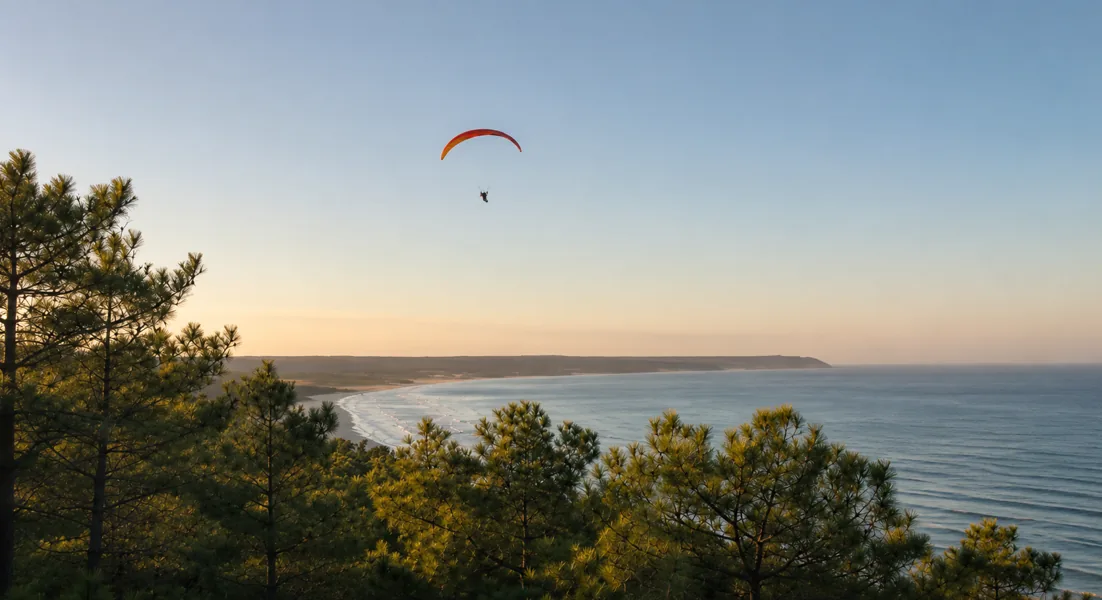
Most European paragliding locations stop flying between November and March. The Alps are buried in snow, the coast is battered by Atlantic depressions, and the pilots who care about their flying count down the weeks to spring. Portugal doesn't follow this pattern. Sesimbra's Atlantic ridge is wind-driven, not thermal-dependent, and the NW wind that makes it fly doesn't take a winter break. The question is not whether Portugal flies in winter — it does — but understanding what winter flying here actually feels like, what the realistic expectations are, and why some pilots deliberately choose a winter week over a summer one.
Why Portugal's Atlantic Ridge Doesn't Stop in Winter
Ridge soaring requires three things: a cliff or hill facing into the wind, sufficient wind speed to generate lift, and the absence of conditions that make the lift dangerous. At Sesimbra in winter, two of those three are essentially constant. The Arrábida ridge faces the Atlantic, and the Atlantic NW wind arrives year-round — driven by the semi-permanent Azores High pressure system, which strengthens in winter rather than weakening. Wind frequency at Sesimbra in December–February is often higher than in June–July, when the sea-breeze pattern can produce light, variable periods between cycles.
The third factor — manageable conditions — is where winter requires more selectivity. Atlantic depressions push through Portugal on an approximately weekly cycle in winter, each bringing 2–4 days of frontal rain and strong W or SW winds that make the ridge unflylable. In between depressions, high-pressure ridges establish for 3–6 days at a time, often bringing the clearest, calmest flying of the year. The key to winter flying in Portugal is monitoring the synoptic pattern rather than the daily forecast, and booking a week with enough flexibility to intercept the high-pressure windows when they appear.
Month-by-Month Winter Flying Guide
| Month | Expected conditions | Flyable days (est.) | Character |
|---|---|---|---|
| November | Variable — first Atlantic fronts arriving. Clear spells between them. | 10–14 days/month | Autumn shoulder. Often excellent. Lower crowds. |
| December | Active Atlantic pattern. Depression frequency peaks. Good highs between. | 8–12 days/month | Reliable 3–5 day windows. Holiday quiet. Short days. |
| January | Strongest Atlantic influence. Some weeks are almost entirely flyable; others not at all. | 8–12 days/month | High variance — patience essential. Best mid-month highs. |
| February | Pattern begins to stabilise. Longer clear spells start appearing from mid-month. | 10–16 days/month | Transition toward spring. Often the best winter month. |
What the Flying Actually Feels Like
Winter ridge soaring at Sesimbra is not a subtle, delicate experience. The NW wind in January is the same wind that drove Portuguese caravels across the Atlantic — direct, persistent, and unambiguous. Launch conditions in winter are often more textbook than summer: the wind is clean, the gradient is consistent, and the air is not complicated by thermals mixing into the ridge flow.
The flying style is pure ridge soaring: beat the face, exploit the best lift bands, practice precision figure-8s, work speed-to-fly. For pilots developing their wing handling and launch technique, winter sessions are often more educational than summer ones precisely because the conditions are less chaotic. The wind is the wind. Your inputs either work or they don't, and the feedback is immediate.
Temperature, Clothing, and Comfort
Air temperature: Typical December–February daytime temperatures are 12–17—C. At ridge height in 15–20 knot wind, the effective temperature is 4–8—C. This is jacket-and-gloves flying, not heroic cold — but pilots arriving from northern Europe and expecting Portuguese summer warmth should plan accordingly.
Essential additions over summer kit: Thermal base layer under your harness suit, thin liner gloves under flying gloves, warm socks. Your summer paragliding jacket is often enough over a fleece — you rarely need an expedition-grade suit.
Ground time: Post-flight café in the village is non-negotiable in winter. The temperature drop after an hour on the ridge is real. Pack something warm for the retrieve.
Hydration: Winter pilots often underestimate hydration needs — the cold suppresses thirst but the wind is still dry. Drink before launch even if you don't feel thirsty.
Advantages of a Winter Flying Week
Beyond simply getting flying time in months when most of Europe is grounded, there are specific advantages to choosing a winter Sesimbra week:
- No crowds. The sites are empty. In summer, popular launch windows can have queuing; in winter it's typically just our group, and sometimes we have the cliff to ourselves for hours. The unhurried atmosphere makes it easier to work on specific skills without traffic pressure.
- The village in winter. Sesimbra in December–January is a genuine fishing village rather than a beach resort. The restaurants are quieter, prices are lower, the fish is excellent, and there are no queues for anything. Many pilots who have come in both seasons prefer the winter atmosphere.
- Crisp, clear air. Winter high-pressure days often produce the best visibility of the year — 40–60 km clear air visibility is normal on good days. The Arrábida mountains look extraordinary in low winter light.
- More flying hours than you'd expect. A typical winter week at Sesimbra delivers 5–6 genuine flying days out of 7, and on depression days the village and Arrábida park provide an excellent consolation. The week rarely feels wasted.
Skill Level for Winter Flying
Winter ridge soaring at Sesimbra is flyable from P2 upward, but the conditions require honest self-assessment. A P2 pilot who has completed their training in benign inland sites and never flown in genuine Atlantic wind should not arrive in January expecting a gentle introduction. The wind is real, launch timing matters more than in light conditions, and there is no thermal safety net to save a poorly timed entry into the ridge band.
For pilots with at least a season of active flying and some coastal or ridge experience, winter Sesimbra is an excellent environment — challenging enough to develop skill, manageable enough that careful flying is rewarded consistently. For returning students or P2 pilots building confidence, I assess each individually and adjust the programme accordingly, including more ground-handling and observation time on stronger days.
Frequently Asked Questions
Is the Coastal Soaring Week programme available in winter?
Yes — the Coastal Soaring Week runs year-round, including December, January, and February. The programme content is identical; the weather pattern adaptation is the main difference. Winter weeks tend to have slightly more ground-handling and ridge observation time on variable days, compensated by longer individual sessions on the clean high-pressure days when the ridge is at its best. Groups are MAX 5 pilots, which gives more individual attention per session.
What happens during the stormy days?
A typical Atlantic depression brings 2–3 days of non-flying weather. During these days the programme pivots to: theory and weather pattern analysis, wing inspection and gear review, visits to Arrábida Natural Park (which is extraordinary in winter rain and clearing cloud), day trips to Lisbon or —vora, and meals that tend to get progressively more elaborate as the group settles in. The depression days are genuinely enjoyed by most groups — they're not dead time. And most winter weeks still see 5+ flyable days, which is more than pilots expect when they book.
Is XC possible in winter?
Thermal XC in the Alentejo corridor is not viable in December–January — the thermal height is too low and the high-pressure air too stable for meaningful cross-country distance. February begins to change this, and by March the thermal window is open. Winter is ridge soaring season at Sesimbra, and that's the programme we plan around. Pilots specifically seeking XC development are better served by the spring or autumn XC Coaching Week. That said, the ground-handling and wing-feel development from a winter ridge week translates directly into better XC performance in the following season.
Fly when everyone else is grounded
The Coastal Soaring Week runs every month of the year. Message me about December–February dates — quieter weeks, the same Atlantic ridge.