

After 25 years of XC flying and coaching at Sesimbra, I can tell you that the gap between a pilot who soars the ridge well and one who genuinely goes cross-country is almost never about the glider. I have watched pilots on A-class wings outfly C-class pilots in the Alentejo, every time, because they understood the air. Reading thermals before you enter them, committing to a glide when it's not obvious, making a clean route decision under pressure — these are the things that open up XC flying. This guide is what I cover with every pilot on an XC coaching week here in Portugal, from the first thermal briefing to the last evening debrief.
What XC Flying Actually Is
Cross-country paragliding is flying from point A to point B using rising air — thermals and ridge lift — to stay aloft and cover distance. Unlike soaring, where you're flying back and forth on one ridge, XC requires you to leave the security of the lift band, cross terrain in between climbs, and find the next thermal before you run out of height.
The fundamental cycle of XC flying:
- Find lift — a thermal, a ridge, a convergence zone
- Climb — circle in the core to gain altitude
- Transition — fly on a heading toward your next likely lift source, trading height for distance
- Find the next lift — at or before your minimum safe altitude for the terrain
- Repeat — for as long as conditions last or until you reach your goal
Everything in XC flying revolves around these five steps. The complexity comes from executing them well — particularly the judgement calls in steps 3 and 4.
Understanding Thermals
A thermal is a column of warm air rising from the ground. It forms when the sun heats certain ground surfaces faster than others — bare soil, dark asphalt, rocky hillsides, or ploughed fields all heat more quickly than forest or water. The warm surface heats the air above it; when that air becomes buoyant enough, it detaches and rises.
What triggers thermals
Thermals don't trigger continuously — they tend to come in pulses. Common triggers:
- Trigger points: a ploughed field, a car park, a dark rocky outcrop, a south-facing slope in direct sun
- Wind-assisted triggering: light wind causes warm air to accumulate against a windward slope and release periodically
- Convergence: where two air masses meet — a sea breeze front meeting an inland flow — thermals often release strongly along the line
- Time of day: thermals typically start 1–2 hours after sunrise, peak in mid-afternoon (typically 12–15:00 solar time), and weaken toward evening
Thermalling technique
Finding the core and circling efficiently is the single biggest skill difference between plateau-level pilots and pilots who consistently go far. The key principles:
- Enter the thermal facing upwind — you'll be swept through the core on the first pass; this gives you information about its size and centre
- Turn toward the strong side — when one side of your turn climbs faster, tighten your turn toward that side to keep the core
- Consistent bank angle, not variable — a consistent 30–40— bank with appropriate airspeed is more efficient than a waddling, variable circle
- Work the whole bubble, not just the core — a thermal is wide at its base and narrower higher up; as you climb into cleaner air the core becomes tighter and more well-defined
- Leave on the right heading — don't just exit when the vario drops. Plan your exit to be already on your transition heading.
Transitions — the Decision-Making Heart of XC
The transition is where most intermediate XC pilots lose distance. The common errors:
- Leaving too low: leaving the thermal before you've built enough altitude for a safe glide to the next one
- Wrong heading: flying toward a plausible but wrong trigger, missing the actual thermal source
- Too slow: flying at min-sink during transitions instead of best-glide speed, maximising time in the air but not distance over ground
- Tunnel vision: fixating on one potential trigger and ignoring unexpected lift along the way
How to plan a transition
Before you leave your current thermal, you should already know:
- Your current altitude above the terrain below your glide path
- Your glide ratio at cruise speed (typically 8–9:1 for a modern B-class glider in clean air)
- Where your next likely trigger is — based on the terrain below, the sun angle, cloud streets above, and what you can see ahead
- Your bail-out height — the minimum height at which you still have options to land safely
Never begin a transition that would bring you below your bail-out height without a known landing field in range. For open Portuguese terrain, bail-out height is typically 300–400m above the highest obstacle in your glide path. In the mountains, considerably more. Pushing below bail-out height waiting for a thermal is one of the most common causes of XC accidents.
Reading the Sky — Cloud Indicators
Cumulus clouds are your best visual indicator of active thermals. Learning to read them transforms your XC decision-making:
| Cloud indicator | What it means | Action |
|---|---|---|
| Building cumulus, sharp edges | Active thermal beneath it, thermal still producing | Fly toward the upwind edge of the cloud base |
| Dissipating cumulus, fuzzy edges | Thermal has stopped, cloud remnant decaying | Don't fly under it — look for the next building one |
| Cloud street | A line of cumulus aligned with the upper wind — indicates a ribbon of rising air | Fly under the street heading with the wind, letting the glider climb continually |
| Blue sky, no clouds | Thermals still exist but evaporate before forming cloud — a "blue day" | Read terrain more carefully; listen to the vario; track triggers on the ground below |
| Overdeveloped, dark base cumulonimbus | Convection is too powerful, potential thunderstorm | Land immediately and stay clear |
Essential Instruments for XC Flying
XC flying without instruments is possible for very short flights, but even modest distances require:
Variometer (vario)
Your most important instrument. Measures your climb and sink rate in real time, with an audible tone. Modern varios also display GPS speed, altitude, glide ratio, thermal strength, and track. Without a vario, you cannot consistently find and core thermals efficiently. This is non-negotiable equipment for XC.
GPS with mapping
Integral in modern varios or as a separate unit. Allows you to see your ground track, measure glide ratio over ground (accounting for wind), navigate to waypoints, and log your flights. Flight analysis post-flight is one of the most productive learning tools.
Radio
During coached XC flights with Fly with Behrooz, you need a two-way transceiver — I guide you through decisions in real time from the ground or from the air alongside you. The radio coaching debrief after each flight accelerates progress dramatically.
The Mental Skills — Decision-Making Under Pressure
What separates experienced XC pilots from intermediate ones is not knowledge — it's the ability to make good decisions quickly, under the mild stress of being in the air with falling altitude and an uncertain next thermal.
The most common decision errors:
- Confirmation bias: being so committed to reaching a destination that you ignore signals telling you to land
- Get-there-itis: pushing further than your reserve safety margin allows because you want to see what's over the next ridge
- Anchoring to the launch: staying near the launch because it feels safe, missing the thermal that would have taken you 20 km
- Over-relying on radio: checking in with the coach instead of making your own call in the moment
A coached XC environment addresses all of these by creating a space where you make the decisions but with a safety net — the coach can see what you can't, has experience you haven't built yet, and can suggest without instructing. The goal is to gradually remove the training wheels so the decisions become automatic.
Why Portugal Is an Exceptional XC Training Ground
Five things make the Sesimbra and Arrábida region — and Portugal more broadly — one of the best places in Europe to begin XC flying:
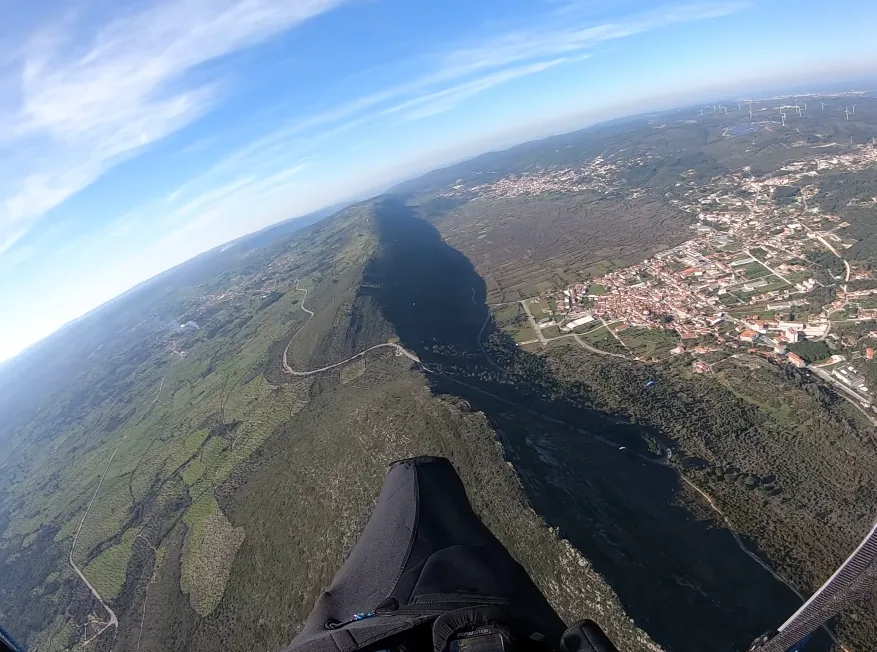
- Varied terrain within range: coastal cliffs, limestone ridges, rolling Alentejo plains, and forested inland hills — all within 1–2 hours of Sesimbra. Each provides different thermal character.
- Reliable September–October XC season: Atlantic influence moderates the thermals — they're strong enough to provide real XC opportunities but not the violent convective conditions of high summer in inland Europe.
- Open landing fields everywhere: the Alentejo in particular is agricultural land with vast, flat fields. Outlandings are straightforward. This means you can push further than you would in more populated terrain.
- Sea breeze convergence: the Atlantic sea breeze meets inland thermal flow in a convergence zone that often produces the best XC lift of the day. Identifying this convergence and positioning correctly for it is a skill I teach over the course of an XC week.
- Low airspace complexity: compared to Central Europe, Portugal has relatively simple airspace. Most XC routes near Sesimbra are in uncontrolled Class G airspace with predictable CTR boundaries around Lisbon.
The XC Coaching Week and XC Coastal Combo programmes build on all of this: coastal soaring in the morning to build confidence and airtime, then XC attempts from inland sites in the afternoon when thermals are peaking.
What You Need Before Your First XC Week
To get the most from a coached XC week at Fly with Behrooz, you should arrive with:
- Licence: P3/CP2 (BHPA Club Pilot) or international equivalent minimum
- Hours: at least 50 hours logged, with a demonstrable ability to soar independently
- Thermalling experience: you should have found and circled in thermals on your home hill — even if you've never completed a cross-country flight
- Instruments: a variometer and GPS. If you have only one, bring the vario.
- Radio: two-way transceiver on 143.9 MHz (standard paragliding frequency in Portugal)
If you're not sure whether your background is sufficient, message me and describe your experience in detail — I'll tell you honestly whether an XC week will be productive or whether a confidence-building coastal week first would serve you better.
Frequently Asked Questions
What's a realistic first XC distance?
On a good XC day during a coached week, pilots who are genuinely ready for XC often complete their first true cross-country of 15–30 km. By the end of the week, 40–60 km days are achievable for the right pilot in the right conditions. The goal isn't distance — it's learning to make good decisions. A 15 km flight where every decision was correct is more valuable than a 60 km flight where you got lucky twice.
How do I get retrieved after an outlanding?
I track all pilots by GPS during flights and organise retrieval from wherever they land. You call or message me with your location (a GPS share from your phone is easiest), pack your wing, and wait. In the Alentejo, the longest retrieval drives from our typical XC routes are 1–1.5 hours. Outlandings are a normal part of XC flying — don't let the logistics of retrieval stop you from pushing your limits.
Do I need a B-class or higher glider for XC?
No. Plenty of pilots fly impressive XC distances on A-class gliders. A modern A-class glider has a glide ratio of 8.5–9:1 — adequate for most XC tasks. What matters far more than your glider's certification is your ability to core thermals efficiently and make good transition decisions. I'd rather coach a pilot on an A-class they fly confidently than a B-class they're not comfortable in. Fly what you know.
Can I do the XC Coastal Combo if I've never flown XC before?
Yes — this is actually the most common scenario. The Combo starts with coastal soaring sessions to build confidence and airtime, then introduces XC elements gradually as conditions and your progression allow. Your first XC task might be a short 10 km hop followed by a retrieval, before we attempt longer flights. By the end of the week, most pilots on the Combo have completed their first proper cross-country flight.
Ready to start flying cross-country?
The XC Coastal Combo week combines coastal soaring confidence with progressive XC training — the ideal programme for pilots ready to make the transition.