


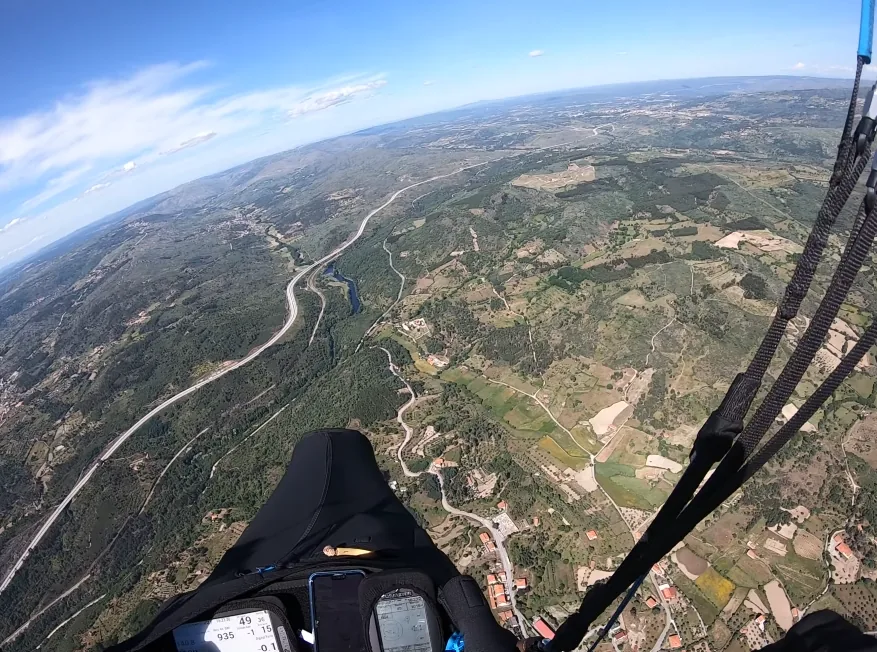
The moment that separates a competent soaring pilot from a capable cross-country pilot is not a single dramatic breakthrough. It is a gradual accumulation of sky-reading ability — the capacity to look at a field, a cloud, a time of day, and know whether a thermal is forming there, peaking there, or already gone.
Thermic conditions are both the engine and the challenge of XC paragliding. When you read them well, distances open up and flights extend far beyond the home valley. When you misread them, you land in a field wondering what happened. This guide covers the full picture: what thermals are, where they come from, how to find them in the sky and on the ground, and what Portugal's Atlantic climate does to the thermal picture that differs from what you might expect from an Alpine or inland experience.
What a Thermal Actually Is
A thermal is a column of air that has been heated by the ground and is rising through the surrounding cooler atmosphere. The ground absorbs solar radiation at different rates depending on surface type — dark asphalt heats faster than forest, which heats faster than water — and when a patch of ground becomes significantly warmer than the air above it, it releases that heat in a rising bubble or column.
The physics are straightforward: warm air is less dense than cool air. When a surface patch heats enough air above it to create a meaningful density difference with the surrounding atmosphere, the bubble detaches and rises. It continues rising as long as it remains warmer than the air it is moving through.
As the thermal rises and cools at the dry adiabatic lapse rate (about 1—C per 100 metres), it eventually reaches the dew point of the air — the temperature at which water vapour condenses. At that point, a cumulus cloud forms. The cloud base marks the top of the convective layer; the white cauliflower-shaped top shows where moisture is condensing. The thermal itself extends from the ground trigger up to that cloudbase.
Ground Trigger Types — Where to Look for Lift
Every thermal starts on the ground. Before you are in the air, you can already identify where the strongest thermals of the day are likely to form by reading the landscape.
During morning briefing, I always ask pilots to look at the satellite map with me and identify the top five thermal triggers between launch and our planned waypoint. Do this before you take off. Once you're in the air, working the wing in turbulence, you have less cognitive bandwidth to analyse the landscape systematically. The analysis should already be done on the ground.
Reading Cumulus Clouds — What the Sky Is Telling You
Cumulus clouds are the most legible information source in the XC sky. Once you understand what their shape, size, and development rate mean, the sky becomes a real-time map of where lift is, was, and is about to be.
Healthy cumulus — what you want to see
- Firm, clearly-defined edges — a sharp base and clear top indicate an active thermal still feeding moisture into the cloud. Fly toward it.
- Flat, level base across the sky — consistent cloudbase height across an area means the convective layer is well-developed and reliable.
- Moderate size — cauliflower tops of 500–800m height. Active, growing, but not overdeveloping. These are the ideal markers for XC routing.
- Slow, steady growth — a cloud visibly building over several minutes tells you the thermal feeding it is still active.
Decaying cumulus — avoid flying under these
- Ragged, fuzzy edges — the cloud is losing definition. The thermal that created it has cut off. Lift has moved downwind of this marker.
- Flattening top — the cloud is spreading sideways (anviling). The thermal is weakening or blocked by an inversion layer.
- Lightening or thinning — the cloud is evaporating. Lift beneath it is gone. This is a marking cloud only — the source of thermals has moved elsewhere.
Overdeveloping cumulus — the warning sign
- Towering tops growing rapidly upward — the convective layer has broken through and is feeding deep cumulus. This is overdevelopment (OD). The lifting is too strong, widespread, and uncontrolled for safe XC flying.
- Dark bases — the cloud base darkening indicates increased moisture loading. Precipitation may follow.
- Anvil shapes at the top — cumulonimbus is developing. Land immediately.
The Thermal Day Cycle — When to Launch and When to Land
Thermals follow a predictable daily arc driven by solar heating. Understanding this cycle is not optional for XC flying — it determines your launch time, your planned distances, and your turnaround decision.
How to Centre in a Thermal
Finding a thermal and staying in it are two different skills. Most pilots can find lift — the wing tells them. Centring efficiently — staying in the strongest part of the core — separates pilots who climb slowly from pilots who climb fast and gain altitude quickly.
The basic centring technique:
- Feel the entry — before you see any cloud above, you will feel the thermal as increased brake pressure and a rising sensation. One wing often enters the thermal first, causing a roll.
- Turn toward the rising side — if your right wing lifted, the thermal core is to your right. Turn right. This is the most important and most-missed rule: beginners often turn toward the lower wing, which feels more stable but actually turns them away from the core.
- Bank 30–45 degrees — a tight bank circle keeps you inside a narrow core. A flat turn lets you drift out. Learn to feel the bank angle through your harness rather than watching the wing.
- Adjust circle position by vario tone — as you circle, the vario rises and falls. When the tone peaks, you're passing through the strongest part of the core. Tighten your circle around that point by shifting your weight in the sector where the vario is loudest.
- Climb consistently — once centred, resist the urge to exit and re-enter. Consistent circles in a good core gain more altitude than interrupted attempts to recentre.
If you haven't felt consistent lift for 30 seconds after entering what seemed like a thermal, exit the turn and fly straight toward your planned trigger point. A thermal that doesn't climb you within 30 seconds either has moved with the wind, decayed, or was weaker than the wing movement suggested. Burning altitude searching a dead thermal is one of the most common reasons pilots land short on their first XC attempts.
Blue Thermals — Flying Without Cloud Markers
On days with very low humidity or a strong temperature inversion, thermals reach their maximum height without producing cumulus clouds. The sky is blue. This is called blue thermal flying, and it is significantly more demanding than cloud-marked flying — the thermal is still there, but without a cloud to mark it, you must find it entirely through terrain reading and wing feel.
How to fly blue days:
- Use your trigger map more intensively — without cloud markers to confirm where thermals are releasing, fall back completely on your pre-flight ground analysis. Route from trigger to trigger.
- Watch other pilots — pilots circling or climbing elsewhere are your only real-time cloud substitute. Route toward climbing pilots and accept you'll arrive after their thermal has already drifted downwind.
- Trust your vario without visual confirmation — on blue days you can't look up at a cloud to decide whether to circle. If the vario says you're climbing, turn and stay in it.
- Watch birds and raptors — eagles, buzzards, and storks circle in thermals. In the Alentejo, white storks are almost always present in summer and make reliable thermal markers.
- Fly conservatively on altitude — without cloudbase as a ceiling reference, be more cautious about how low you get before committing to a search.
How Thermic Air Feels on the Wing
Before you interpret the sky visually, the wing will already be telling you information. Learning to read the wing in thermic conditions is the tactile side of XC flying — sensitivity through the brake toggles and harness that complements the visual information from clouds and terrain.
| Wing Sensation | What It Likely Means | Your Response |
|---|---|---|
| Increased brake pressure, wing accelerates forward | Entering the leading edge of a thermal bubble | Turn toward the side with stronger pressure |
| Wing surges forward, then pitches back | Passed through the thermal core — it's behind you | U-turn and re-enter from the same direction |
| One wing tip drops suddenly | Asymmetric entry — one side in thermal, one outside | Turn toward the lifted side; don't over-correct the drop |
| Rapid pulsing in the risers, harness shaking | Turbulent thermal — punchy, strong, near the edge | Stay active on brakes; consider exiting if below safe altitude |
| General softness, loss of brake resistance | Entering sinking air between thermals | Speed up, head toward the next trigger, don't circle |
Overdevelopment Warning Signs — Know When to Land
Overdevelopment (OD) is the most common cause of serious accidents in XC paragliding. When cumulus clouds grow uncontrolled into cumulonimbus, the air beneath them becomes violently unstable and can pull wings upward at rates no pilot can resist. The window between "good XC day" and "OD developing" can be 45 minutes. Learn these signals and act on them without hesitation.
Warning signs to watch throughout your XC flight:
- Cloudbase dropping — the height of cloud bases is falling rather than stable or rising. The convective layer is spreading downward and OD risk rises.
- Cloud tops growing rapidly upward — if a cumulus top is visibly climbing while you watch it for 60 seconds, it's overdeveloping. Do not fly under it.
- Bases darkening — grey-darkening cloud bases indicate increased moisture loading and likely precipitation beneath the cloud.
- Clouds spreading laterally — individual cumulus losing separation and merging into larger masses is an early OD signal.
- Sudden increase in thermal strength — thermals becoming significantly stronger and more turbulent than earlier in the day can signal an inversion breaking, often preceding rapid OD development.
- Any anvil or cauliflower tower above 3,000m — a confirmed cumulonimbus is present. Land immediately regardless of where you are in your flight.
The correct response to OD development is always the same: land before conditions deteriorate, not when they already have. The time pressure of finishing an XC distance is never worth the risk. My rule on every coaching day is simple: if we see OD beginning to build anywhere in the flying area, we call the landing and drive to the pilot. No exceptions.
Portugal's Thermal Characteristics
Flying XC in Portugal is different from Alpine or Mediterranean thermal flying in ways that matter for how you approach the sky.
Atlantic influence — smoother thermals
Portugal's thermal air mass is Atlantic in origin. Even in deep Alentejo, the air has passed over several hundred kilometres of ocean before reaching the Portuguese interior. This Atlantic moisture content gives Portuguese thermals a characteristic smoothness — they're less mechanical and sharp-edged than Alpine thermals triggered by rocky mountain terrain, and less aggressive than the dry, intense thermals of Spain's central plateau.
For pilots arriving from Alpine schools or used to inland continental thermal flying, this can require adjustment: the thermals are real and strong, but the wing feedback is more gradual. Learning to trust quieter signals is part of adapting to the Portuguese thermal style.
The coastal vs inland divide
The Portuguese coast — including Sesimbra and the Setúbal Peninsula — experiences the Atlantic sea breeze (the nortada) from late morning onward in summer. This sea breeze replaces thermic conditions with laminar ridge lift on the cliffs, making the coast consistently flyable but not thermic from roughly 11:00 onward in July and August.
For thermal XC, you need to be inland — Alentejo is the key region. Here, away from the moderating influence of the Atlantic, ground temperatures reach 38–42—C in summer afternoons, cloudbase climbs to 1,200–1,400m, and XC distances of 60–120km are achievable on strong days.
Afternoon sea breeze shut-off
The XC window in Alentejo typically closes earlier than in purely continental locations because the afternoon sea breeze eventually penetrates inland. In summer, this arrival is signalled by a shift in wind direction from N/NE (thermal day) toward SW or W (sea breeze advancing inland). When this happens, thermals become short-lived and the thermal day effectively ends — sometimes abruptly. Monitoring wind direction at low altitude during afternoon XC is essential.
Putting It Together: A Typical Alentejo XC Morning
At 10:00 on a May morning in the Alentejo, the forecast shows CAPE of 350 J/kg, a weak NE gradient wind, cloudbase predicted at 1,300m by 13:00, and no OD risk flagged. This is a good XC day.
On the ground at launch, I brief the group on our planned route: five waypoints, each anchored on identifiable trigger zones — a village, a dark quarry, a south-facing eucalyptus ridge, another village, and the landing field at —vora. We identify the likely sea breeze arrival window (15:00–16:00 at our most easterly point) and plan a turnaround accordingly.
By 11:30 the first thermals are cleanly established. We launch in pairs, holding the ridge until the first thermal takes us above launch. From that point on, the flying is terrain reading, vario listening, and patient centring — no dramatic decision-making required if the briefing was correct.
This is what thermic XC flying is at its best: methodical, informed, and deeply satisfying. The drama, when it comes, comes from a pilot who skipped the briefing, trusted an old thermal longer than they should have, or ignored the darkening cloud to the south-west. The goal of every coaching week is to make the systematic approach feel natural, so that it's what pilots do automatically without needing to be reminded.