


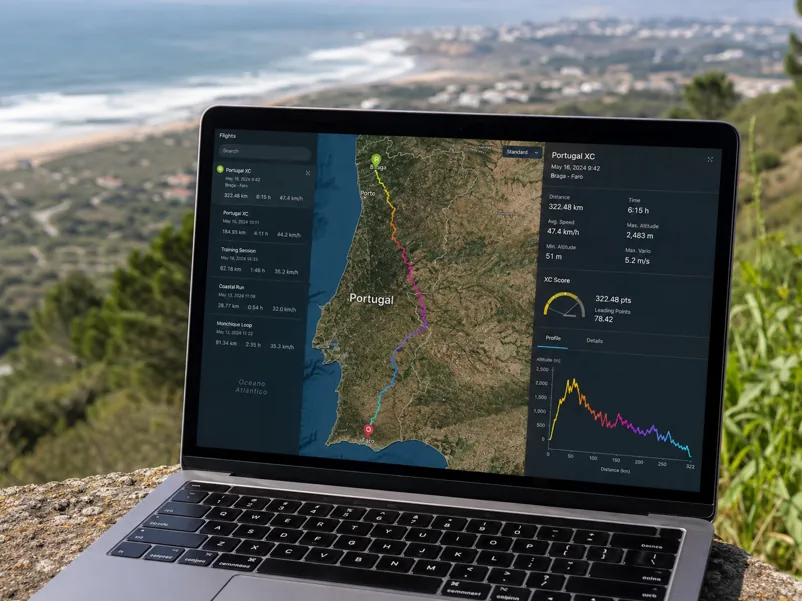
Flying more hours is the obvious path to improvement in XC paragliding. It's also insufficient on its own. I've coached pilots with 300 hours who were making the same mistakes they made at 80 hours — not because they weren't trying, but because they had no feedback loop. Track-log analysis is how you build one: turning a raw GPS file into a specific, reviewable account of every decision you made in the air and what it cost or gained you. On my XC weeks, we do this every evening. It's the part most pilots tell me changed their flying the most.
What a Track Log Actually Contains
Every GPS vario records the same basic data: your latitude, longitude, and altitude at regular intervals (typically every second). That's it. From those three numbers, repeated several thousand times per flight, every piece of useful analysis can be derived.
The IGC file format is the standard: a plain text file that most analysis platforms can read directly. When you export from a vario or download from a tracker device, you'll typically get an .igc or .gpx file. Both work with the main analysis tools, though .igc is preferred because it includes barometric altitude rather than GPS altitude — barometric is significantly more accurate for vertical analysis, which is the whole point.
Recording Instruments — What Goes on Your Wing
Before you can analyse anything, you need to record the flight. The three instruments I see most often on my coaching weeks are the XCTracer, the Syride SYS'Nav, and the FlySkyHigh tracker. Each records a clean IGC file and handles barometric altitude correctly.
- XCTracer Mini — tiny, lightweight, clips to the riser or chest. Accurate barometric variometer, excellent IGC output. No screen, so you pair it with XCTrack on a phone or a separate display. My go-to recommendation for pilots who want clean data without the weight.
- Syride SYS'Nav — has its own screen, so it works as a standalone vario and GPS unit. Slightly heavier than the XCTracer but self-contained. Records good IGC files and exports directly to AirScore.
- FlySkyHigh — primarily a live-tracking device that family and retrieve crews can follow in real time, but it also logs the flight. The live-tracking function is genuinely useful on long XC days when you land 80 km from where you started.
A smartphone running XCTrack will produce a usable file for map analysis, but phone GPS altitude is GPS-based rather than barometric — noisy and less accurate for the vertical data that matters most. For debrief-quality analysis, a dedicated instrument is worth the investment.
The Main Analysis Platforms — What Each One Is For
XContest
XContest is primarily a scoring and ranking platform — pilots submit tracks from flights to claim distance and score points relative to other pilots worldwide. But its analysis viewer is genuinely useful: it shows your track overlaid on a map, altitude profile over time, and thermalling statistics. If you fly XC seriously, having an XContest account is worth it purely for the post-flight map view and speed-to-fly data it surfaces. The portal is free to use for track upload and viewing.
AirScore
AirScore (airscore.aero) is specifically designed for flight analysis rather than competition scoring. It calculates your effective glide ratio between thermals, identifies thermal cores (where you were gaining height vs where you were circling without climbing), and compares your track against the declared task or optimal XC route. For coaching purposes, AirScore is the most immediately useful tool because it surfaces the specific moments where the flight was won or lost.
Leonardo / XContest Live
Leonardo is the Italian platform that XContest acquired and integrates with. Its main value is the social layer — you can see other pilots' tracks from the same day and same location, which is enormously useful for answering the question "was there a better thermal elsewhere that I missed?" Comparing your track against a higher-scoring pilot who flew the same day, in the same conditions, reveals the decisions that separated your outcomes.
Paragliding Map (pgmap.de)
A German-run tool that superimposes your flight track against an overlay of known thermal sources (south-facing slopes, dark fields, industrial rooftops, villages). Useful for pattern recognition: after several flights in an area, you start to see which triggers you're reliably finding and which ones you're consistently missing.
What to Look for When You Review a Track
Altitude profile: the shape of the day
The altitude graph over time tells you the macro story of the flight before you look at anything else. A good XC flight has a clear sawtooth pattern: climb steeply in the thermal, glide, find another thermal, climb again, glide further. Deviations from this pattern are the first thing to look at:
- A long flat section with no altitude gain — circling in weak or broken lift, failing to commit to a glide
- A steep early descent after a promising climb — either the thermal topped out lower than expected, or you left it before it was done
- Height arriving at a ridge or waypoint — arriving 200 m too low forces a conservative line; arriving with height to spare opens options
Average climb rate — your real thermalling efficiency
AirScore and XContest both calculate your average climb rate across all thermalling in a flight. This number is more honest than any single climb you remember. A pilot who reports "I had a 4 m/s thermal" but averaged 1.2 m/s across the full flight wasted a lot of time in weak or broken lift that should have been abandoned earlier. The benchmark question is: what's the minimum climb rate worth staying in? For most intermediate pilots flying en-B gliders in moderate conditions, leaving anything under 1 m/s average and pressing on is usually the better call.
Not: "What was my best climb?" — that number feels good but doesn't inform decisions.
Ask instead: "What percentage of my time in circles actually produced height?" If you were thermalling for 40 minutes and your net height gain during that time was the equivalent of 15 minutes of climbing, you spent 25 minutes circling without climbing. That time is the problem.
Glide ratio between thermals — your speed-to-fly execution
The effective glide ratio on each inter-thermal glide is one of the most revealing numbers in the flight. Your glider's certified best glide at trim speed in still air might be 9:1 or 10:1. In real conditions — with headwind or sink during the glide — you'll rarely achieve this. But the number you're aiming at is the glide ratio your glider is capable of in the actual conditions you flew through.
Consistently poor inter-thermal glides (5:1 or 6:1 when 8:1 is achievable) usually point to one of three things: flying too slow through sink, flying too slow when reaching lift (anticipating a thermal instead of pressing through), or flying too high into a headwind when going lower and faster would have been faster overall.
Missed thermals — the alternative track
This is where comparing your track to another pilot's from the same day becomes extremely instructive. Load both tracks in XContest or Leonardo's compare view. Find the point where your tracks diverged. Look at what the other pilot did that you didn't: did they turn 200 m earlier and catch a thermal you flew straight through? Did they push south when you stayed north and find the ridge that worked? Did they use a cloud street you avoided?
The missed thermal is the hardest thing to see in isolation — you can't know what you didn't find. But a comparison track makes it visible.
How Evening Debrief Works on an XC Coaching Week
On the XC Coaching Week and XC Coastal Combo, the evening track-log review is a core part of each day. It typically runs 45–60 minutes and follows a consistent structure:
- Load tracks: Both pilot and coach tracks loaded into AirScore or XContest, overlaid on the same day and location.
- Pilot narrates first: The pilot describes what they remember about each major decision — where they found thermals, where they struggled, what they were thinking at the key choice points. This is important: the analysis has to match the memory, not replace it.
- Compare altitude profiles: Where did the tracks separate in altitude? When did the coach's track start climbing while the pilot's was still descending? That timing difference is usually where the thermal was found vs missed.
- Identify 2–3 specific moments: Not an exhaustive critique — two or three moments that changed the flight's outcome. Trying to discuss everything produces nothing actionable; discussing two things precisely produces something the pilot can act on tomorrow.
- Frame for tomorrow: Based on the analysis, one or two specific things to watch for or try differently in the next flight.
The track-log debrief is not a review of whether the flight was "good" or "bad." It's a tool for making explicit what was implicit — the decision-making process that happened partly consciously, partly not, and what the data says it produced.
Track Log Analysis Tools Compared
| Tool | Best for | Key feature | Free? |
|---|---|---|---|
| AirScore | Flight analysis, coaching debrief | Thermal efficiency, inter-thermal glide | Yes |
| XContest | Scoring, competition, map replay | Track map, speed stats, world ranking | Yes (basic) |
| Leonardo | Social comparison, regional leaders | Compare multiple tracks same day | Yes |
| Paragliding Map | Thermal source mapping | Overlay track on thermal trigger map | Yes |
| OLC (Online Contest) | Scoring, German-speaking community | Point scoring, badges, distance claims | Yes |
Frequently Asked Questions
Do I need a vario to record a useful track log?
A smartphone running XCTrack will produce a usable map track for basic route analysis. However, smartphone GPS altitude is less accurate than barometric altitude — the vertical data (altitude profile, climb rate, glide ratio) can be noisy or misleading without a proper barometer. For coaching-quality analysis, a dedicated GPS vario like the XCTracer, Syride, or FlySkyHigh is strongly recommended. Entry-level instruments that record clean IGC files start from under €150 and make a noticeable difference to analysis quality.
How often should I review my track logs?
After every XC flight, the same evening, while the memory of decisions is fresh. The analysis is useless if you can't remember what you were thinking at 11:23 when you turned away from that cloud. After a week, the specific memories fade and the track log becomes just a data file. Five minutes of honest analysis the same evening is worth more than an hour of reconstruction a week later. On a coaching week, we do this together as a group every evening — the structure and shared context accelerate the learning significantly.
What's the most common thing pilots discover when they first analyse their track logs?
That they spent far more time circling in weak lift than they remembered. In the air, circling in a 0.5 m/s thermal feels productive — you're gaining height, something is happening. On the track log, it looks like 12 minutes of nearly flat altitude gain that a better choice would have converted into height elsewhere. The second most common discovery is arriving at critical waypoints — a ridge crossing, a valley transition — lower than they thought, because they left a thermal too early to "beat the airmass" and the airmass was slower than expected.
Learn to read your flights in real time, not just afterwards
Evening track-log debriefs are a core part of the XC Coaching Week and XC Coastal Combo. Message me to discuss whether a coaching week is the right next step for your flying.