


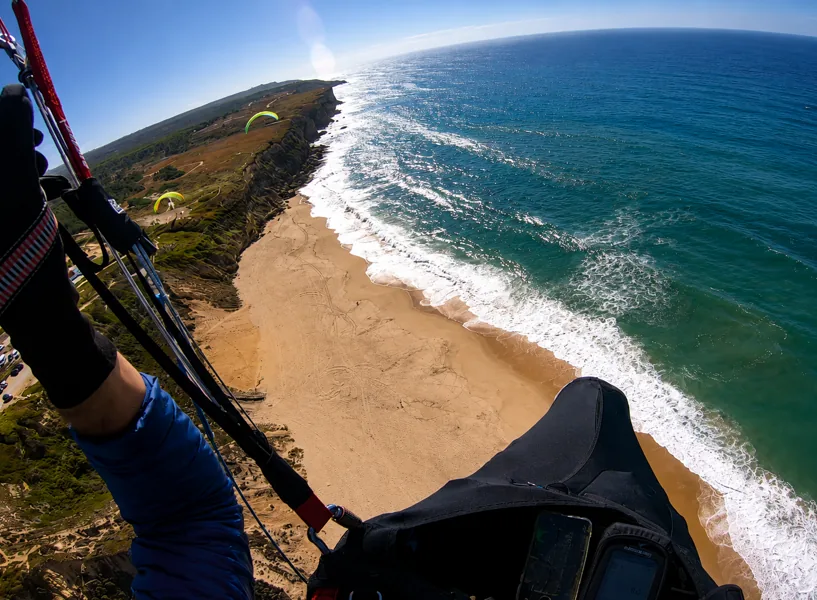
The Setúbal Peninsula juts into the Atlantic south of Lisbon — a wedge of limestone and schist about 50 km across, pinned between the Tagus estuary to the north and the open ocean to the south. It contains some of the most varied paragliding terrain in southern Europe: sea cliffs, pine-forested ridges, exposed headlands, and the edge of the Alentejo plain inland. All of it accessible from Sesimbra in under 40 minutes by car.
The Three Main Flying Areas
Sesimbra — The Coastal Ridge
Sesimbra sits at the western end of the Arrábida range, where the ridge meets the sea. The cliffs here face south-west — precisely the direction of the summer nortada and the Atlantic swell. The result is reliable ridge lift from late spring through early autumn, with typical soaring heights between 80 and 300 m depending on wind strength. This is the primary site for the coastal soaring week, with multiple launch options at different heights and exposures.
The main launch at Sesimbra gives access to a 6 km ridge run west toward Cabo Espichel — one of the longest unbroken coastal soaring routes on the peninsula. On good days, pilots can ridge-run the full length and thermal back.
Arrábida Natural Park — Inland Thermals and Elevated Ridges
Moving east from Sesimbra, the terrain rises into the Arrábida range — a protected natural park with dramatic limestone peaks reaching 500 m. The Arrábida flying sites are used primarily in spring and autumn when thermal conditions allow inland flights above the protected cliffs. The scenery from height over Arrábida — turquoise coves, white limestone, dark pine — is unlike anywhere else in Portugal.
Arrábida sites are more technical than the coastal ridge. They are used selectively based on wind direction and thermal timing, and always with a guide who knows the complex airflow around the limestone cliffs.
Cabo Espichel — The Atlantic Headland
Cabo Espichel is the westernmost point of the peninsula and one of the most dramatic flying sites in Portugal. A 70 m cliff faces directly into the Atlantic swell, generating powerful, consistent ridge lift in west and south-west winds. The site flies when Sesimbra is too strong — Espichel's elevated plateau gives more room to manoeuvre before the cliff edge, making it usable in conditions that close Sesimbra's lower launches.
On any given day, the peninsula typically offers at least two or three flyable sites. Behrooz monitors conditions across all sites from 06:00 and selects the day's location by 08:00. The driving distance between Sesimbra, Cabo Espichel and the Arrábida sites is 20–35 minutes, so relocating mid-week as wind direction shifts is completely practical. A week on the peninsula is rarely limited to a single site.
Seasonal Conditions Across the Peninsula
Spring (March–May)
Variable and interesting. Thermals are active in the Arrábida range; coastal conditions range from calm sea-breeze days to strong south-westerlies. The best spring weeks combine morning XC flights inland with afternoon coastal soaring as the sea breeze fills in. Crowds are low, accommodation is cheap, and the wildflowers on the Arrábida slopes are spectacular.
Summer (June–September)
The nortada dominates — a steady north to north-west trade wind that brings reliable ridge lift to the coastal sites. Inland thermals weaken under the maritime influence, but coastal soaring is consistent and repeatable. This is the easiest season for new XC pilots to build hours, because the coastal ridge keeps pilots up even when they are not centering thermals efficiently.
Autumn (September–November)
The best thermal season on the peninsula. As the nortada fades, south and south-west flows become more common, activating Cabo Espichel and generating cross-country thermals inland toward the Alentejo. The combination of Atlantic light, warm thermals and empty skies makes October a favourite month for experienced pilots visiting from northern Europe.
Winter (December–February)
Flyable in windows between frontal systems. The peninsula's south-facing aspect means it catches winter sun, and the cliffs at Sesimbra and Espichel generate ridge lift in south-west winds associated with Azores high-pressure extensions. Not as reliable as the other seasons, but mild temperatures and empty sites are genuine advantages.
Getting Oriented — The Peninsula in Context
For pilots considering the Setúbal Peninsula as part of a broader Portugal paragliding trip, the key thing to understand is what it offers that other Portuguese destinations do not: reliable coastal ridge lift within 30 minutes of a major international airport, combined with access to thermal flying in a protected natural landscape.
The Alentejo coast to the south offers more remote XC flying but no ridge-soaring infrastructure. The Sintra coast to the north has lower cliffs and less consistent winds. The Setúbal Peninsula is the most complete flying destination in southern Portugal — coastal, thermal, and within easy reach of Lisbon.
Planning a Trip to the Peninsula
The practical details of a week on the peninsula are straightforward. Fly into Lisbon, pick up a hire car, drive 30 minutes to Sesimbra, and message Behrooz. Beyond that, he handles site selection, daily briefings, radio coaching in the air, and track log debriefs in the evening. The peninsula's variety means the week adapts to what the weather provides — and the weather here provides something most days.
For site-specific information, the Sesimbra site guide, Arrábida guide and Cabo Espichel guide each cover launch procedures, conditions, and what to expect at each location. For the full regional context, this article is the starting point — then follow the specific sites to plan in detail.