


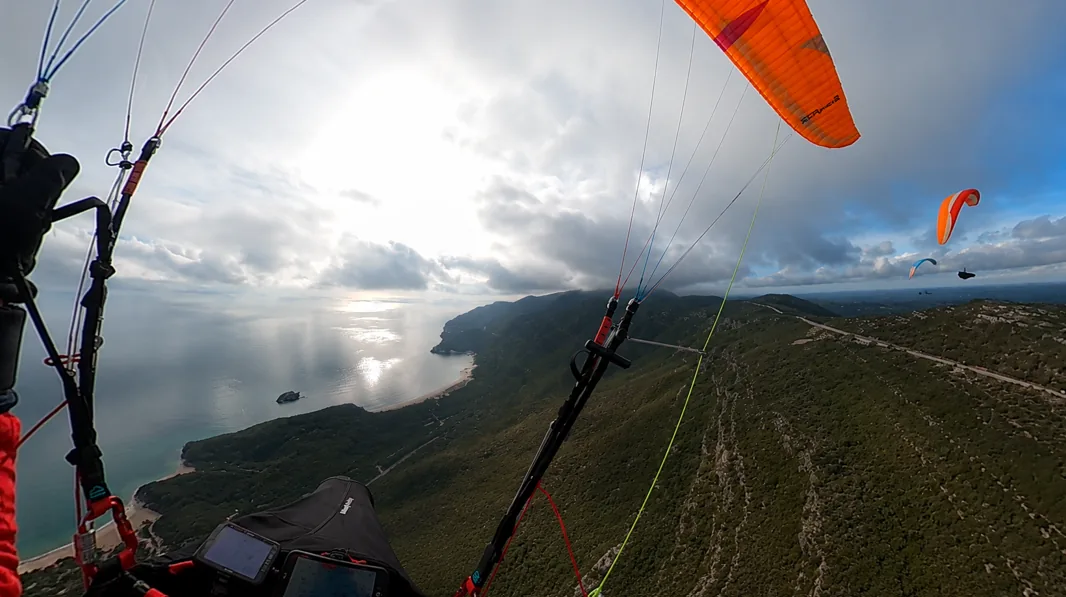
I've been flying Arrábida for 15 years and I still drive those 20 minutes east from Sesimbra with the same anticipation. The Arrábida Natural Park limestone ridgeline runs 7 km above crystal water on the Setúbal Peninsula — and from the ridge launches, you're not choosing between coastal soaring and XC. You can do both on the same flight. The south face acts as a thermal engine: heat the limestone, generate the climb, then decide whether to stay on the Arrábida cliff or push northeast into 60+ km of Alentejo thermals. This guide covers how the site works, what conservation access actually permits, and the skill level it requires.
The Geography of Arrábida
The Arrábida range is the high spine of the Setúbal Peninsula, running roughly east to west for about 35 km between Setúbal in the east and Cabo Espichel in the west. The ridge rises steeply from the coast, with the highest point at around 500 metres above sea level, before dropping into the gentler interior terrain of the Alentejo. The southern face — looking toward the sea — is covered in Mediterranean macchia and limestone outcrops with a vertical coastal face in places, creating a dramatic visual environment with the turquoise Arrábida bay below.
For paragliders, this geography creates two distinct types of flying that can often happen on the same flight. The south-facing slopes generate thermal activity from the sun-warmed limestone, which combines with the sea breeze to produce reliable lift from mid-morning. Once you're above the ridge, you can either work the coastal side (ridge soaring along the Arrábida cliffs with the sea below) or push northeast onto the inland thermic side and transition into XC flying toward the Alentejo plains.
How Flying at Arrábida Differs from the Bicas Coast
The key difference is altitude and thermal access. At Praia das Bicas, you launch from 120 metres above the sea and soar in the ridge lift band just above cliff height — typically 150–350 metres above sea level. It's laminar, consistent, and relatively low-energy. At Arrábida, you're launching from 300–450 metres above sea level from a site with a proper thermal trigger. The lift here is thermal, not pure ridge — which means it's more dynamic, more demanding, and more rewarding for pilots who know how to use it.
On a standard Arrábida day in spring or autumn, a pilot can expect to:
- Launch from the ridge into light thermal activity as the sun warms the south face
- Work up to cloudbase (typically 1,200–1,800 metres in spring/autumn)
- Make a decision: return to the coastal ridge or push northeast toward the Alentejo
- If going inland — follow the thermal street east, with the Alentejo plains opening up below
This is very different to a Bicas soaring day. Pilots who've only flown coastal ridge will find Arrábida a significant step up. That's not a reason to avoid it — it's a reason to do it with a guide the first time.
The XC Transition — From Coast to Alentejo
The most distinctive thing about Arrábida in the context of Portuguese paragliding is the XC transition it makes possible. On days when the thermal trigger is reliable and cloudbase is reasonable — typically spring and autumn — the Arrábida launches allow a pilot to start a coastal soaring day and end up 60–100 km to the east without having done anything unusual. The ridge is effectively the departure ramp for the Alentejo plains.
The route east from Arrábida typically follows the A2 motorway corridor toward —vora. The terrain is gentle and the Cork oak forest provides consistent thermal triggers. Outlanding options are plentiful — a dirt track or tarmac road every kilometre or two. On the best spring days, experienced pilots have made the Spanish border from an Arrábida launch on a single flight. The XC Coaching Week specifically uses Arrábida for pilots making their first extended XC attempts.
Conservation and Access Rules
Arrábida is a protected natural park, and this has practical implications for paragliding access. The park has flight restrictions in certain areas and seasons — primarily to protect nesting raptors (including Bonelli's eagle) during the breeding season. These restrictions are enforced and I take them seriously. As a guide operating in this area for 15 years, I have current knowledge of which launches are available at which time of year.
Independent pilots wishing to fly the Arrábida launches should contact the Parque Natural da Arrábida before arriving to confirm current access rules and any seasonal restrictions. The situation changes annually. Flying in restricted zones risks substantial fines and contributes to the removal of paragliding access entirely — which harms the whole community. Flying with a guided programme resolves this — access is managed as part of the week's planning.
Best Time to Fly Arrábida
The Arrábida sites fly best in spring (March–May) and autumn (September–November). These windows combine good solar angle for thermal development on the south face, reasonable cloudbase (1,200–1,800 m), and stable upper-level patterns that allow XC without the risk of overdevelopment. Summer at Arrábida is possible but the nortada suppresses thermal development on the coastal side by mid-morning, limiting the XC window to early launches. Winter is flyable on calm days but the flying is more purely coastal.
The best single month for Arrábida XC from my experience is October. The thermal cycle is honest and predictable, the cloudbase is clean, the Alentejo colours are at their best, and the conditions are typically more consistent than the variable weather of March.
Skill Level Requirements
Arrábida is an intermediate-to-advanced site. A minimum of P3 (BHPA) / DHV B or equivalent is appropriate — pilots who are comfortable thermalling, reading their vario, and making XC route decisions. Club Pilot level pilots who want to experience Arrábida under supervision can do so with me present and coaching, but the site is not appropriate for first-season pilots flying independently. The combination of stronger thermals, higher altitude, and the XC transition option introduces complexity that requires a solid foundation before arriving here.
Frequently Asked Questions
Can I fly Arrábida on a Coastal Soaring Week programme?
Occasionally, yes — if the forecast on a given day shows good thermal development and a pilot has shown they're ready for the step up from Bicas. I don't include Arrábida as a standard part of the Coastal Soaring Week because the programme is specifically designed around the coastal ridge flying at Sesimbra, which is what most pilots at that level need to develop. For pilots specifically seeking Arrábida XC flying, the XC Coaching Week is where it's built in.
How long does it take to fly from Arrábida into the Alentejo?
On a strong spring or autumn day, it's not unusual to be 40 km inland within 90 minutes of launch — the first thermal cycle from the ridge is often powerful and the transition to the Alentejo plains is fast once you're established above the ridge. From launch to the —vora area (80 km) on a good day is a realistic 2.5–3.5 hour flight. From launch to 100+ km is possible on the best days in spring. The key variable is the wind component — a light tailwind on the XC task significantly changes what's achievable.
Is top-landing at Arrábida possible?
Yes, at the main launch areas on the ridge. Top-landing at Arrábida requires solid top-landing technique and wind awareness — the wind gradient on the ridge can be significant and you're landing on grass over limestone rather than a flat beach. I assess pilots' top-landing confidence before an Arrábida session and brief the approach and abort criteria specific to the site on the day. On days when the wind is above the comfortable top-landing threshold, we plan for valley/beach landings instead.
Ready for the XC transition?
The XC Coaching Week is where Arrábida flying fits. Built for pilots making the step from coastal soaring to cross-country. Message me to talk through your level and what's achievable.