


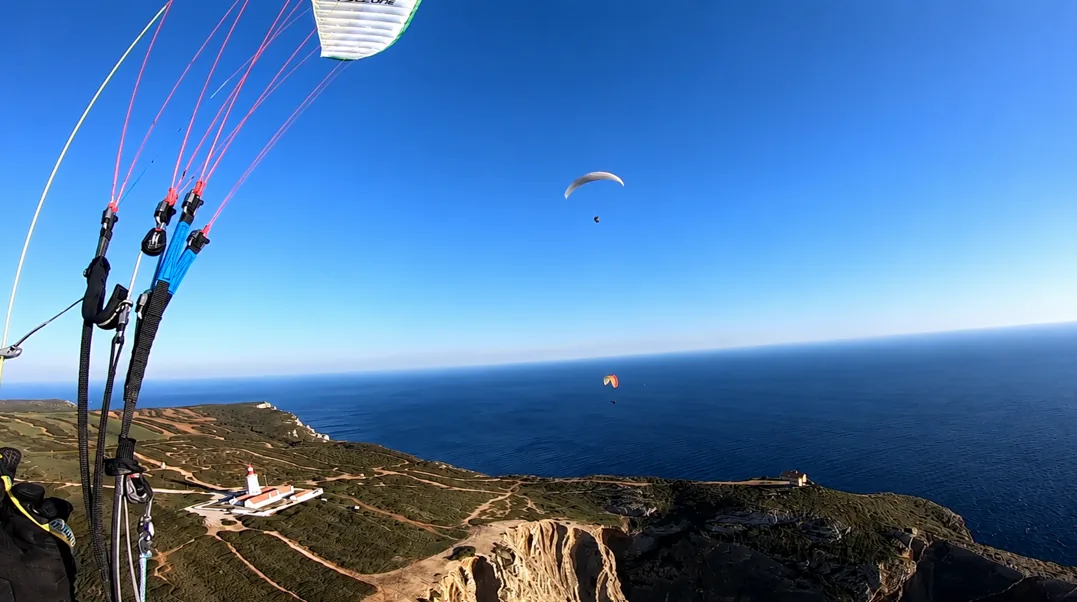
Cabo Espichel is the southwestern tip of the Setúbal Peninsula — a promontory where the land stops abruptly at vertical cliffs that drop 100 metres straight into the Atlantic. There is an 18th-century pilgrimage sanctuary on the plateau above the cliffs, abandoned for most of the year and half-restored by a persistent Atlantic wind. For paragliders, Cabo Espichel is a site with a very specific appeal: it is the most dramatic top-landing spot in southern Portugal, a place where the flying is shaped entirely by the ocean wind and where getting the conditions right is both the challenge and the reward.
The Headland Geography
The cape sits at the western end of the Arrábida peninsula, about 25 km west of Sesimbra by road. The plateau above the cliffs sits at around 100–120 metres above sea level — modest elevation, but the vertical cliff face below creates a sharp, clean wind gradient that produces excellent ridge lift when the Atlantic northerly fills in. The main cliff face runs roughly north-south, with the strongest lift concentration on the section between the sanctuary and the cliff edge.
Unlike the Bicas coast — where the cliff face is more gradual and the ridge soaring more forgiving — Cabo Espichel is abrupt. The wind accelerates around the headland, the rotor zone behind and below is more pronounced, and the landing options on the plateau above the cliff are finite. This is not a site for pilots who haven't flown top-landing before.
Wind Conditions Required
Wind direction: NNW to NW is ideal, putting the wind cleanly onto the cliff face. Pure N or NW-N creates slight cross-shore components that increase the top-landing challenge. W or WNW angles reduce lift quality on this section.
Wind strength: 12–22 knots at cliff height. Below 12 knots the lift band is thin and inconsistent. Above 22–24 knots the conditions become demanding for top-landing — the approach gets fast and the rotor behind the plateau edge intensifies.
Gust factor: Cabo Espichel frequently has a higher gust factor than the nearby Bicas sites — the headland concentrates and redirects the wind. A clean, steady forecast matters more here than at Sesimbra. Check gust ratio on Windguru, not just mean wind.
Day type: Pure sea-breeze or synoptic NW days work best. Thermal-influenced afternoons often bring gusty, variable surface wind on the plateau that complicates top-landing.
Top-Landing at Cabo Espichel — The Technique
Top-landing here involves descending from the lift band over the cliff face, transitioning back over the cliff edge, and landing on the plateau surface. This sounds simple and can be — but several factors make it more demanding than a typical top-land:
- Rotor awareness: The cliff edge creates a rotor in the lee of the plateau. Pilots must fly the approach in the clean wind on the ocean side and commit to the landing transition decisively. Hovering in the shear zone is not an option.
- Landing surface: The plateau is grass over limestone rubble. It's firm and landable, but there are rocks and the occasional vegetation patch to avoid. A clear spot selection before beginning the approach is important.
- Wind shadow from the sanctuary: The sanctuary buildings create a local wind shadow on the southern section of the plateau. Pilots who drift too far south in their approach may find the wind drops out in the final seconds.
- Abort criteria: If the approach doesn't feel clean, going back out to the sea side and losing altitude for a beach landing below is always the safer choice. There are accessible beach landings to the south of the headland.
I always brief the Cabo Espichel top-landing approach with pilots the first time they fly there, standing on the plateau and walking through the circuit visually before launch. That preparation removes most of the uncertainty from the execution.
The Abandoned Sanctuary
The Santuário de Nossa Senhora do Cabo Espichel is one of the more extraordinary places in the Setúbal Peninsula — a 17th/18th century pilgrimage complex with a baroque church, a procession square flanked by long colonnaded pilgrim dormitories, and a lighthouse at the cliff edge. For most of the year it is deserted, maintained by a small resident caretaker. The pilgrim dormitories are roofless, the church is locked, and the wind is a constant presence.
Flying into this landscape and top-landing next to a 300-year-old sanctuary complex that is otherwise completely empty is one of those experiences that stays with pilots long after the wing is packed away. It's not the flight that makes Cabo Espichel memorable — it's arriving on the plateau, laying down your wing on the grass, and standing in the wind 100 metres above the Atlantic next to a place that was built for people seeking something extraordinary.
Access and Logistics
Cabo Espichel is about 25 km from Sesimbra by road — roughly 30 minutes via the IC4. There is a public car park at the sanctuary complex. The site is free to access. On good days I drive out from Sesimbra to Cabo Espichel when the Bicas wind angle is slightly suboptimal — sometimes the cape catches a cleaner line to the NW while Bicas runs cross-shore. It's a natural extension of the Sesimbra flying day rather than a separate destination.
Frequently Asked Questions
Is Cabo Espichel part of the Coastal Soaring Week programme?
Occasionally, yes — when the conditions are right and pilot top-landing confidence is appropriate. Cabo Espichel is not in the standard weekly plan because the top-landing requirement limits who can safely fly there independently. For pilots who have demonstrated solid top-landing technique during the week, it becomes an option when the forecast lines up. Pilots who are not confident with top-landing fly the Bicas or Meco sites instead on those days, with no loss of flying time.
Can I drive to the cliff edge?
Yes — the car park at the sanctuary is within walking distance of the cliff edge and the launch area. You don't need to carry a wing bag far. The cliff is not fenced and the approach to the edge is unrestricted, but obvious care is required — the drop is vertical and immediate at several points. Stay well back from the edge unless you're actively doing a site reconnaissance or about to launch.
What happens if the top-land attempt doesn't work out?
There are beach landing options on the south coast below the cape — accessible but requiring a carry-out up the cliff path (about 20 minutes). The landing itself is straightforward, the walk out is the inconvenience. On Cabo Espichel days I always note the beach landing options at the briefing and confirm pilots are clear on the abort criteria before we launch. A missed top-land approach is not a problem — it just means a longer walk back to the car.
Fly the wildest cliff on the peninsula
Cabo Espichel appears in the Coastal Soaring Week when conditions and pilot level align. Message me — I'll tell you whether it fits your week.