


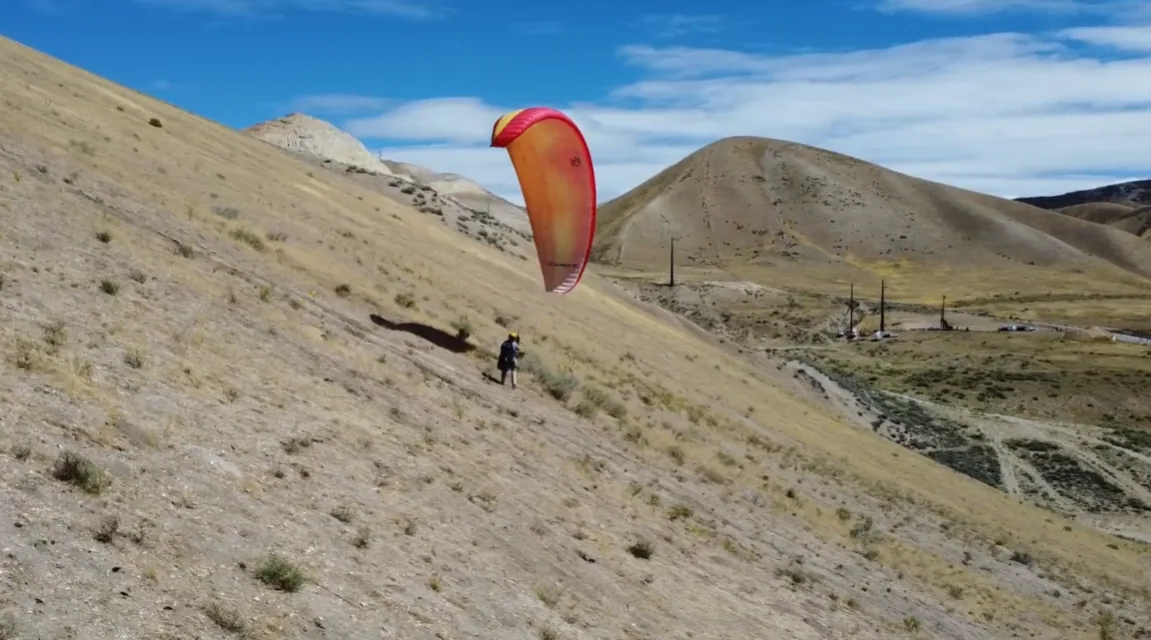
Hike and fly paragliding is exactly what it sounds like: you carry your wing to the top under your own power and fly down. No cable car, no shuttle, no road to the launch. Just a pack on your back, a trail in front of you, and the reward of a flight earned rather than driven to. The discipline has grown rapidly over the past decade, drawing in trail runners, alpinists, and paragliders who want to strip flying back to its most elemental form.
What Hike and Fly Actually Is
In its simplest form, hike and fly means hiking to a launch point with your paraglider packed into a rucksack, then flying from the top. The reverse — landing at the base and hiking back up to fly again — is the full loop that practitioners call "laps." The discipline ranges enormously in scale: a 20-minute walk up a coastal ridge is hike and fly; so is a 10-hour alpine approach to a 3,000-metre peak.
The key constraint is weight. A conventional paragliding setup — wing, harness, reserve, helmet, instruments — weighs 15–20 kg, which becomes very uncomfortable over a long approach. Hike and fly equipment is designed around this constraint: total kit weight of 8–12 kg for a serious setup, with dedicated competition/hike-and-fly wings weighing just 3–5 kg compared to 8–10 kg for a normal EN-A or B wing.
Why the Discipline Is Growing
Several things are driving rapid growth in hike and fly. The equipment has improved dramatically — modern lightweight wings are far more refined and safer than the early experimental mini-wings of the 1990s. The trail running community has discovered paragliding as a natural extension of their sport. Events like the Red Bull X-Alps, which combines racing across the Alps with paragliding, have brought massive global attention to the discipline. And for many experienced pilots, the purity of hike and fly — no reliance on a vehicle, no queue at a commercial launch, no fixed schedule — is a genuine philosophical draw.
There is also a practical side: hike and fly opens terrain that simply isn't accessible any other way. Coastal paths that reach headlands too steep or narrow for a car, mountain ridges far from any road, remote hills with no infrastructure at all. The wing becomes your exit route from places you'd otherwise have to walk back down from.
The Equipment Picture
Choosing hike-and-fly equipment involves a series of trade-offs between weight, performance, and safety. The lighter the wing, the more it typically demands from the pilot.
| Item | Standard setup | Hike & fly setup | Saving |
|---|---|---|---|
| Wing | 8–10 kg | 3–5 kg | ~5 kg |
| Harness | 4–6 kg | 1–2 kg | ~4 kg |
| Reserve | 1.5–2 kg | 1–1.5 kg | ~0.5 kg |
| Helmet | 0.4–0.8 kg | 0.3–0.5 kg | ~0.3 kg |
| Total | 14–19 kg | 6–10 kg | ~8–9 kg |
Wings: Competition and Hike-and-Fly Categories
The market has converged on two categories worth understanding:
Full hike-and-fly wings (e.g. Advance Lightness 2, Niviuk Skin 2, Ozone Ultralite): 3–4 kg, high aspect ratio, no internal frame rods, folds into a very compact pack. These are demanding wings — typically equivalent to a high-EN-B or low-EN-C in handling requirements. They are not beginner wings in any sense. They pack small because their structure is minimised, which means they require more active pilot input to manage in turbulence.
Packable EN-B wings (e.g. Advance Iota, Ozone Rush 6 in a smaller size): 5–7 kg, designed for standard flying but packable into a smaller bag than a competition wing. A sensible middle ground for pilots who want to hike occasionally but still want the forgiveness of a regular EN-B. These make far more sense for intermediate pilots.
Harnesses and Reserves
Hike-and-fly harnesses (e.g. Woody Valley Exocet, Advance Lightness) integrate the rucksack into the harness body, so the same piece of equipment carries the wing on the approach and becomes your flying seat in the air. They are significantly less protective in a hard landing than a conventional harness — worth considering for your risk calculus.
Reserve parachutes for hike and fly are typically lighter models. Some pilots flying very light setups use a front-mounted reserve rather than a rear pod. The reserve must be sized correctly for the all-up weight of the system.
How Hike and Fly Differs from Normal Paragliding
Beyond the equipment, hike and fly changes the flying experience in several important ways:
- Smaller wings are faster to react. A conventional EN-B at 10:1 glide will feel sluggish compared to a competition lightflight wing at 9:1 that also pitches sharply in thermals. The feedback loop is faster and the pilot needs to be more attentive.
- Launch sites are often improvised. You are not taking off from a manicured commercial launch with a windsock and a clear run-in. You're launching from wherever the trail reaches a suitable ridge, which demands good terrain assessment and launch skills.
- Landing zone planning is your responsibility. Without a designated landing field at the bottom, you need to pre-plan your landing options from the map before the approach and assess them from the air.
- Retrieval is your problem. There's no driver with a van. Your flight plan needs to end somewhere you can walk or hitchhike out from.
Prerequisites — Who Is Ready for Hike and Fly?
The discipline has a clear prerequisite level that is worth stating plainly: you need to be a solid, confident pilot before using a dedicated hike-and-fly wing.
The minimum reasonable threshold:
- 50+ hours total flight time
- Comfortable in moderate thermic conditions on your regular wing
- Confident at top landings in variable conditions
- Have done an SIV course — understanding how your wing recovers from collapses is more important when the wing has less passive safety margin
- Comfortable reading unfamiliar launch sites and making a go/no-go decision independently
If you meet those criteria but have not flown a dedicated hike-and-fly wing before, the transition needs to happen carefully — in smooth conditions, at safe altitude, with plenty of margin. The first flight on a new lightweight wing is not the moment to be at 200 metres over a rocky hillside.
Before moving to a dedicated hike-and-fly wing, I ask pilots one question: can you consistently land precisely in a small field in variable conditions, using top-landing technique? If there's any uncertainty about that — if landing still requires a large, clear field with margin for error — a lighter, faster, more demanding wing will not improve matters. Build the skill on forgiving equipment first.
Portugal Hike-and-Fly Terrain
Portugal offers several natural hike-and-fly environments that reward the approach on foot:
Sesimbra and the Arrábida coast: The coastal ridge above Sesimbra is accessible by trail from the town itself — a 45-minute walk gains 200+ metres of altitude and reaches the limestone cliff edge above Praia das Bicas. The flight from here is the same Atlantic ridge soaring that conventional coaching weeks use, but the approach is earned on foot. The trail continues west through the Arrábida Natural Park, where longer approaches reach higher launches with more XC potential.
Serra da Arrábida interior: The Arrábida range reaches 500 metres above sea level, with trail systems connecting the interior to multiple ridge launches. A longer approach here opens thermal flying over the Setúbal Peninsula.
Linhares da Beira: The medieval village at Linhares da Beira sits on a granite cliff with a classic XC launch directly above the rooftops. The village can be reached on foot from the valley on an ancient path — a short but steep approach. It's one of the most atmospheric hike-and-fly environments in Portugal, even if the flight destination is XC rather than local ridge soaring.
For serious multi-day hike-and-fly touring in Portugal, the Alentejo is less useful — the terrain is flat. The mountain regions of Serra da Estrela and Serra do Larouco in northern Portugal offer more serious altitude and longer approaches for pilots who want an alpine feel without leaving the country.
Risk Management — What Makes Smaller Wings Different
Lightweight hike-and-fly wings are quicker to collapse and quicker to recover than standard EN-A or B wings. They are also typically higher-loaded at a given pilot weight, which means higher flying speeds and less time between perturbation and wing response. The main risk management considerations:
- Fly in calmer conditions when starting out. Morning smooth air before thermals develop is ideal for building familiarity with a new light wing.
- Height is your margin. Never press into uncertain conditions at low altitude on a wing you're still learning — altitude buys you recovery time.
- Reserve deployment is more likely to work over a flat landing zone. Choose your flying routes with this in mind.
- Never adjust kit in the air. Hike-and-fly setups sometimes have less polished ergonomics than full harnesses. Check everything before launch.
Who Hike and Fly Suits
Hike and fly is not for everyone, and it doesn't need to be. The discipline suits pilots who:
- Already enjoy trail running, hiking, or alpinism and want to add a flying dimension to their mountain days
- Are frustrated by access constraints at commercial launches and want more freedom in site selection
- Have the base flying skills to manage more demanding wings safely
- Value the physical approach as part of the experience, not just a means to an end
If you are a newer pilot still building hours on an EN-A or low-EN-B, hike and fly will wait. The foundation skills developed on forgiving equipment — precise landings, thermal centering, reading unfamiliar sites — are exactly the skills that make hike and fly safe and enjoyable later. There is no shortcut through that progression.
For pilots who have the base and are curious about the discipline, the XC Coaching Week provides the skill-building context that makes the transition to lightweight wings a natural next step rather than a premature leap.