


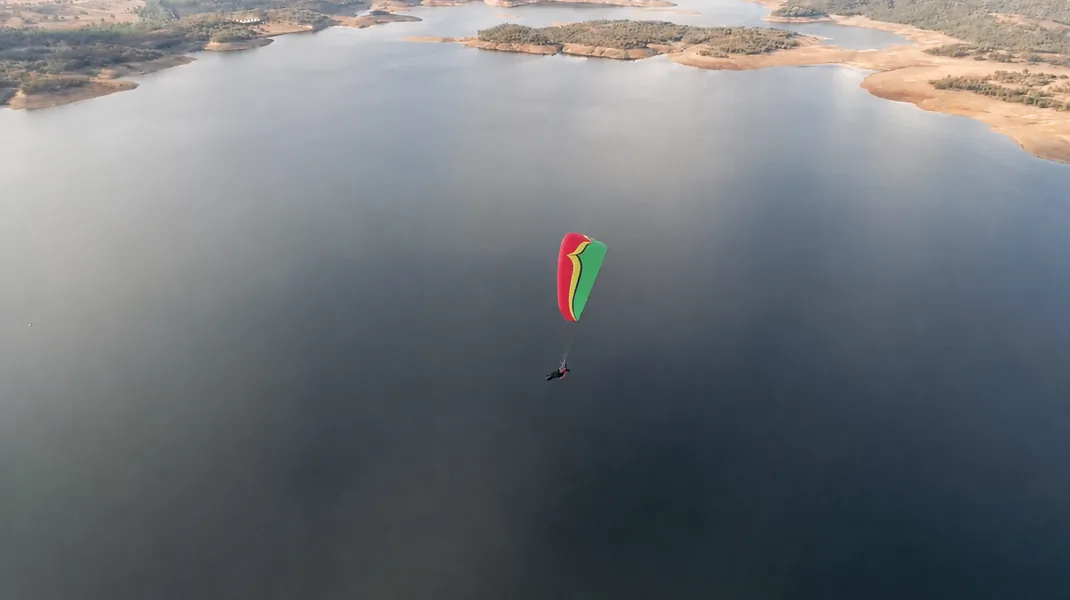
SIV stands for Simulation d'Incidents de Vol — French for simulated flight incidents. It is the advanced safety training that every serious paraglider should do at least once, and most experienced pilots do repeatedly throughout their flying career. The premise is straightforward but the implications are profound: instead of waiting to experience a collapse or stall in the air by accident, you deliberately practise these manoeuvres in a controlled environment over water, with a safety boat below you and an experienced instructor guiding you by radio throughout. What was frightening becomes familiar. What was an emergency becomes a managed situation.
What SIV Stands for and Why It Exists
The SIV concept emerged from the French paragliding community in the late 1980s, when the sport was young and the accident rate reflected it. Pilots were encountering collapses and stalls they had no framework for handling, and the standard training courses of the era simply did not prepare them. French instructors began taking students over water — specifically mountain lakes — and inducing these incidents deliberately at safe altitude, giving pilots the chance to experience and recover from them before encountering them by chance in terrain.
The logic is the same as any simulation training: the first time you experience a frightening event should not be the first time you need to respond to it correctly. A pilot who has practised 20 asymmetric collapses knows what the wing looks and feels like in the first half-second after it happens. The surge, the turn, the drag from the deflated side — all of it is already stored in their body. Their response is calibrated, not panicked. That difference, in terms of outcomes, is not trivial.
Today, SIV courses are conducted by certified instructors at dedicated venues worldwide. They are not mandatory in most licensing systems, but they are strongly recommended — and regarded by virtually every experienced pilot and national federation as the single most impactful safety investment a pilot can make after their initial qualification.
What You Practise in an SIV Course
The manoeuvres covered in an SIV course are taught progressively, starting from the simplest and building in complexity and intensity. A well-structured course will not throw you into a full frontal collapse on day one. The sequence typically follows the logic of what a pilot might encounter, from the most common incident type to the most severe.
Asymmetric Collapse (One-Sided Tuck)
The most common incident in paragliding. One side of the wing folds inward — from a gust, a thermal edge, or turbulence — reducing lift on that side and causing the wing to surge and turn toward the collapsed cell. The pilot's task is to apply weight shift and opposite brake to counter the turn, then pump the collapsed side open. SIV teaches you exactly how much input is needed — enough to recover without overshooting into a stall on the good side. The first time you feel the wing drop away on one side and the world tip, it is alarming. By the fifth time, it is routine.
Full Frontal Collapse
Both leading edges fold back simultaneously, causing the wing to pitch nose-down and surge forward. The correct response — releasing the brakes completely and allowing the wing to reinflate — is counterintuitive. Every instinct says pull. The right answer is to let go. SIV gives you the muscle memory to override that instinct before it matters.
B-Stall
A deliberate stall of the entire wing achieved by pulling down the B risers (the second row of lines). The wing collapses into a stable, descending configuration that loses very little forward speed but descends rapidly — around 7–10 m/s. It is used in competition and XC flying to descend quickly through a band of bad air. The exit requires careful, progressive release of the B risers to avoid a parachutal stall. This is a manoeuvre with a precise technique that benefits enormously from supervised practice.
Spiral Dive Entry and Exit
A controlled spiral is the most effective way to descend rapidly in an emergency — significantly faster and more controllable than a B-stall in most wings. Entry is straightforward; exit is not. Releasing the brake and coming out of a steep spiral incorrectly can result in a cravat (a line caught over the wing) or a surge that leads to a frontal collapse. The exit technique — gradual brake release, weight shift, patience — is one of the most important things an SIV course teaches.
Reserve Parachute Deployment (Many Courses)
Not all SIV courses include a reserve throw, but many do — particularly the better-structured ones. The sequence (locate the handle, pull cleanly and fully clear of the harness, throw into clear air) takes about two seconds in a real emergency and has to be entirely automatic. There is no time to think. SIV over water is the only context outside of an actual emergency where a pilot can practice this for real.
Who Should Do an SIV Course
The short answer: any pilot who intends to fly regularly beyond the basic soaring and thermalling stage. More specifically:
- Any pilot planning to fly XC — cross-country flying involves thermal conditions, potential turbulence, and the need to make rapid decisions. Flying XC without SIV training is a choice to encounter collapses for the first time in real conditions rather than in a controlled environment.
- Any pilot stepping up from an EN A to an EN B wing — EN B wings are more performance-oriented and less passively safe than EN A wings. They recover well, but they require more active pilot input. SIV on your new wing gives you a calibrated understanding of its actual behaviour, not just the theoretical profile from the certification test.
- Any pilot who has been flying for 2+ years without one — experience without SIV is not the same as SIV. Pilots who have accumulated 100+ hours without ever deliberately practising collapses have built habits on the assumption that everything will always stay inflated. That assumption is eventually incorrect.
- Pilots returning after a long break — skills fade and muscle memory deteriorates. An SIV course is an effective way to rebuild confidence and currency at the same time.
SIV is emphatically not appropriate for the first 50 hours of solo flying. You need a stable skill base — reliable launch and landing, comfortable thermalling, good speed-bar usage — before an SIV course gives you full value. Go too early and you spend much of the course managing the basics rather than absorbing the safety information.
When in Your Progression Does SIV Make Sense
The timing question is one of the most common things pilots ask before booking. The honest answer is: after your Club Pilot qualification and 50–80 hours of solo airtime, and before you step up your wing to anything more demanding than an EN A.
Specifically, the window that makes the most sense for most pilots looks like this:
- Complete EP course and earn Club Pilot (CP/P2) qualification
- Accumulate 50–80 hours on an EN A wing, flying varied sites and thermal conditions
- Do your first SIV course — this is the ideal moment, when your skills are stable enough to absorb the manoeuvres but your wing is forgiving enough to make the exercises clean
- Based on the SIV results and your instructor's assessment, decide whether to continue on EN A or step up to EN B
- If stepping up to EN B, do a second SIV on the new wing within the first 20–30 hours on it
Many pilots delay their first SIV until they feel "ready." This is a reasonable instinct but can be counterproductive: the pilots who benefit most from SIV are those who are competent enough to execute the manoeuvres cleanly but have not yet been flying long enough to have developed fixed habits around collapse responses. Earlier is better than later, within the 50–80 hour window.
| Day | Focus | Manoeuvres Covered |
|---|---|---|
| 1 — Morning | Briefing, equipment checks, site orientation | Theory: anatomy of a collapse, recovery principles |
| 1 — Afternoon | First flights over water — getting comfortable | Small asymmetric collapses (25–30%), weight shift recovery |
| 2 — Morning | Building collapse depth | Full asymmetric collapses (50%), pumping technique, spiral entry |
| 2 — Afternoon | Full frontal collapses | Full frontal, release timing, reinflation recognition |
| 3 — Morning | B-stall technique | B-stall entry, hold, progressive exit, parachutal stall avoidance |
| 3 — Afternoon | Spiral dive | Spiral entry and exit, G-force familiarisation, controlled descent |
| 4 — Morning | Reserve deployment (if included) | Handle location, throw technique, landing under reserve |
| 4 — Afternoon | Consolidation flights | Pilot-chosen manoeuvres, assessment, debrief |
| 5 | Advanced consolidation + weather permitting | Combined scenarios, cravat recovery, cascade prevention |
The shift in how pilots experience turbulence after completing an SIV course is well-documented and consistently reported. What was alarming becomes recognisable. A wing that surges after a thermal exit, or tucks slightly on one side in broken air, no longer triggers the same adrenaline response — because the pilot has felt it before, deliberately, and knows exactly what it means and what to do. The nervousness that many pilots carry through their first years of flying often does not disappear with hours alone. It disappears specifically with SIV. The difference between a pilot who has done it and one who has not is visible from the outside: one is managing their wing, the other is hoping it stays inflated.
How SIV Works in Practice
The logistics of an SIV course are built around the overwater requirement. You fly at altitude — typically 600–1000 metres above the water surface — with your instructor either flying above you or observing from a boat, maintaining radio contact throughout every manoeuvre. The radio protocol is precise: the instructor calls the manoeuvre, confirms your altitude and position over clean water, you execute, and they talk you through the recovery if needed. You land in the designated zone on shore after each flight, not in the water — but the water is there as the safety margin that makes the whole exercise possible.
A typical day involves 3–6 flights, depending on conditions, equipment changes, and the depth of debrief after each session. The flights themselves are often shorter than regular flights — 15 to 30 minutes of intentional manoeuvring — but the mental density is high. Most pilots find SIV days considerably more tiring than regular flying days, not physically but cognitively. Plan for quiet evenings and good sleep.
Course duration is typically 3 to 5 days. Three days gives you a solid introduction to all the core manoeuvres. Five days allows consolidation, reserve deployment, and more complex combined scenarios. First-time SIV students generally benefit from the full 5-day format. Cost varies by location and instructor, but €400–700 is the typical range in Europe for a 4–5 day course including instruction and safety boat.
Sesimbra's Setup for SIV
The Sesimbra area has a well-suited venue for SIV training in the Lagoa de Albufeira — a large freshwater coastal lagoon located approximately 20 minutes north of Sesimbra. The lake sits at sea level, surrounded by low coastal terrain, with consistent morning calm before the afternoon sea breeze develops. This gives a reliable morning window of stable air — critical for SIV, where you want smooth, predictable conditions rather than the thermal activity that develops over land as the day warms.
The Lagoa de Albufeira offers sufficient open water to position pilots safely, good altitude clearance from the surrounding hills, and water temperatures that are genuinely swimmable in the summer months — relevant because a water landing, while never the goal, is a realistic possibility in any SIV course. The Atlantic proximity keeps the air moist and the temperatures moderate from May through October, which extends the usable SIV season well beyond what is possible at many Alpine venues.
Is SIV Dangerous?
The risk profile of a well-run SIV course is considerably lower than most people assume before doing one. The overwater format, the safety boat, the radio guidance from an instructor who has run hundreds of these sessions, and the progressive nature of the manoeuvre sequence all combine to make the controlled version of these incidents significantly safer than encountering them by accident in terrain.
That said, SIV is not risk-free. The realistic risks include:
- Reserve deployment — occasionally necessary when a manoeuvre develops unexpectedly. The reserve lands the pilot safely in the water; the safety boat recovers them. This is uncommon but occurs.
- Water landing — even without reserve deployment, a recovery that goes wrong at low altitude can result in a water landing. The boat is there specifically for this.
- Cravat — a line ending up over the wing during a collapse. A skilled instructor can talk most pilots through a cravat recovery, but it requires calm and altitude.
The incidents that genuinely threaten injury in SIV are extremely rare in professionally run courses and are predominantly associated with pilots who arrive underprepared or who ignore the progressive structure of the programme. SIV is not appropriate for day-1 pilots, students still on training courses, or pilots who have not yet developed stable solo flying skills. The qualification prerequisites exist for good reasons.
What to Bring and How to Prepare
Unlike an EP course, SIV requires you to arrive with your own equipment:
- Your own wing — school equipment is not appropriate for SIV. The manoeuvres need to be practised on the wing you actually fly, so that the muscle memory translates directly to your real flying situation.
- Your harness — properly adjusted to your body. Harness fit affects reserve handle accessibility, which is critical if deployment practice is included.
- Your reserve parachute — checked and repacked within the last 24 months. Some instructors will refuse to fly with students whose reserve is overdue for inspection. Don't leave this until the week before.
- A helmet with radio capability — the radio is the communication link for every manoeuvre. Most SIV providers rent radios, but confirm in advance.
- Basic XC or soaring experience — you should be comfortable with thermal flying, speed-bar use, and site assessment before arriving for SIV. The course assumes this foundation.
Mentally, the best preparation is to arrive with accurate expectations: the first manoeuvres will feel more dramatic than they look from the outside, and the first full asymmetric collapse will take your breath away. That is normal. By day two, the same manoeuvre will feel controlled and familiar. That transition — from alarming to routine — is precisely what the course is designed to produce, and it is the most valuable thing you can bring home from it.