


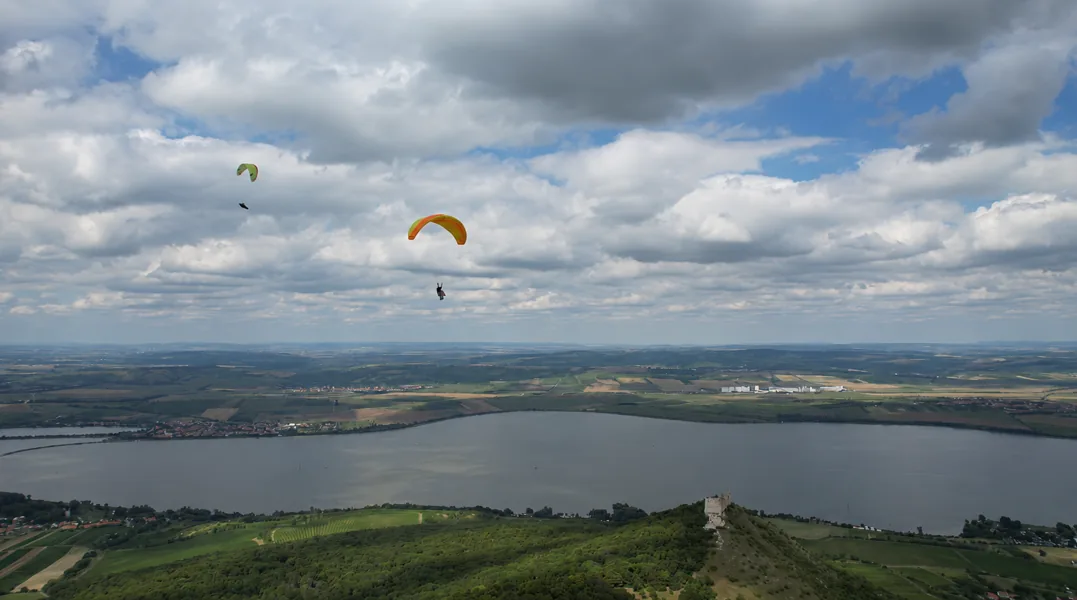
The question comes up every week on site: "Am I ready for an EN-B?" Sometimes the pilot asks it themselves after 80 hours. Sometimes a friend suggests it, or a shop does. As a coach who has watched this decision go wrong more times than I'd like, my honest answer is usually the same: not yet — and here is the framework that tells you when that actually changes.
What the EN Certification Actually Tests
The European EN 926-2 standard is a flight test protocol, not a marketing classification. Test pilots deliberately induce specific in-flight scenarios — frontal collapses, asymmetric collapses, stalls, high-speed dives — and score the wing on how quickly and reliably it recovers, and how much input the pilot needs to assist the recovery.
The certification produces a letter grade:
- EN-A — The wing recovers spontaneously with no or minimal pilot input required. Designed to tolerate and recover from incidents without demanding immediate and correct pilot response.
- EN-B — The wing still recovers from tested incidents, but may require timely pilot input and may have more pronounced initial reactions. Performance is higher; the margin of error is smaller.
- EN-C — Requires prompt, skilled pilot input for recovery. For experienced pilots with SIV training and significant logged hours.
- EN-D — Competition and high-performance wings. Unforgiving. For expert pilots.
Crucially, the EN tests are conducted at specific loading points and in controlled test conditions. A wing certified EN-A at one weight may behave more like an EN-B at the top of its certification range. Loading your wing at the top of its stated weight range always moves the behaviour up the risk scale slightly.
EN-A — What It's Like to Fly One
A modern EN-A is not a compromise wing. It is a precision instrument designed to forgive the mistakes that pilots with 10–100 hours inevitably make: flying too close to stall speed, entering thermals aggressively without anticipating the entry, or failing to weight-shift through a turn correctly.
The typical EN-A characteristics are:
- High surface area relative to pilot weight — large, stable air-scooping geometry
- Lower aspect ratio (typically 4.8–5.3) — wider and shorter tips, making collapse recovery faster and more self-correcting
- More damped pitch feedback — the wing doesn't swing forward aggressively in accelerations, giving the pilot time to react
- Generous stall margins — significant buffeting warning before the wing enters a full stall
Top EN-A wings in 2025: Advance Alpha 7, Dudek Colt 2, Ozone Mojo 7, Gin Bolero 7. These are not beginner toys — they are serious wings that will carry pilots well into their first 150–200 hours without becoming a limiting factor.
EN-B — The Spectrum Nobody Talks About Enough
Here is the single most important thing to understand about the EN-B class: it is not a single performance tier. The B certification spans the widest range of any class, from wings that handle almost identically to a high-end EN-A, all the way to wings that demand active, skilled piloting in thermic conditions.
Industry practitioners often talk about "low-B," "mid-B," and "high-B" wings:
- Low-B — e.g. Ozone Mojo 8, Niviuk Koyot, Dudek Hadron — fly with forgiving, dampened handling barely distinguishable from a quality EN-A. The performance gain is modest; the safety buffer is still generous. These wings are appropriate for pilots with 50–80 hours who fly regularly and have completed supervised thermal flying.
- Mid-B — e.g. Ozone Rush 6, Advance Epsilon 9, Gin Explorer — a meaningful step up in performance and aspect ratio. These wings reward active piloting and will be more dynamic in turbulence. Appropriate for pilots with 100–200+ hours and SIV training.
- High-B — e.g. Advance Iota 3, BGD Base — approaching EN-C handling in demanding air. These require genuine skill to fly safely in thermic conditions. For experienced pilots pursuing XC distance.
| Wing | Class | Aspect Ratio | Good for |
|---|---|---|---|
| Ozone Mojo 7 | EN-A | ~5.0 | 0–100 hours, all conditions |
| Advance Alpha 7 | EN-A | ~5.0 | 0–150 hours, coaching weeks |
| Ozone Mojo 8 | EN-B low | ~5.3 | 60–120 hours, smooth to moderate |
| Ozone Rush 6 | EN-B mid | ~5.8 | 100–300+ hours with SIV |
| Advance Epsilon 9 | EN-B mid | ~5.6 | 100–250 hours, active pilot |
| Advance Iota 3 | EN-B high | ~6.1 | 200+ hours, XC-focused pilots |
When to Make the Move from EN-A to EN-B
There is no universal hour count that unlocks EN-B readiness. Hours alone are a poor indicator because an hour spent soaring coastal ridge in smooth sea breeze is not the same as an hour spent thermalling inland in punchy summer air. What instructors and coaches actually look for is a set of flying habits and situational awareness markers:
- You are consistently flying at the correct speed — not flying too slowly through thermic transitions without realising it
- You can identify the feel of a strong thermal core vs. a weak, broken one before you're fully inside it
- You've experienced and correctly managed at least some wing disturbances — frontal tucks, asymmetric tucks — whether on an SIV course or in genuinely turbulent conditions, with clear recollection of what happened
- You have completed SIV training — this is close to non-negotiable for a move to mid- or high-B
- Your ground handling is instinctive, not deliberate. You can inflate a wing and manage it in variable wind without thinking consciously about where your hands are
On my coaching weeks I assess B-readiness by watching how a pilot responds to the first rough thermal of the session. If their instinctive response to an unexpected surge or deflation is correct and calm — weight shift, look up, correct input, continue thermalling — that tells me more than their logbook. If their first response is to reach for the brakes too deep or to freeze, the EN-A is exactly where they should be for now, and that's a position of strength, not failure.
The Most Common Mistake — Ego-Driven Progression
In paragliding communities, both online and at flying sites, there is a persistent background pressure to progress. People post their new EN-B on forums. Instructors who sell wings (not all of them, but some) benefit from progression. And the EN-A, despite being an excellent aircraft, carries an unfortunate cultural connotation of being a "beginner" wing.
This is wrong, and it costs pilots their safety margin.
The data from European accident reports consistently shows that the highest injury-rate category is intermediate pilots on EN-B wings in thermic conditions they are not yet equipped to read. The wing doesn't cause the accident — the mismatch between the pilot's skills and the conditions does. An EN-B in unexpected strong turbulence, flown by someone whose instincts are not yet fast enough, produces an outcome that the same pilot on an EN-A would have walked away from.
The Role of SIV Before Moving Up
An SIV course (Simulation d'Incidents en Vol — simulated in-flight incidents over water) is the single most valuable investment a pilot can make before stepping from EN-A to EN-B. Over two to three days above a lake, with an instructor on radio and a safety boat below, you deliberately induce every significant wing incident your EN-B might produce in the real world: asymmetric collapses at various percentages, full frontal collapses, stalls, spirals, and the cravat scenario.
The goal is not to graduate an SIV course. The goal is to build instinctive motor memory — so that when a 50% asymmetric tuck happens 200 metres above a ridge on a lively day, your hands and hips respond correctly before your conscious mind has caught up.
An SIV course also reveals a great deal about your current skill level in an environment where the consequences of error are a dunking in a lake rather than a ground impact. Many pilots discover, mid-SIV, that they are not yet as close to EN-B readiness as they imagined. That is the most valuable possible lesson to learn in that context rather than over rough terrain.
What Behrooz Recommends at Each Level
- 0–50 hours: Stay on your EN-A. No discussion. Fly it in every condition you encounter, learn to read every nuance of its feedback, and resist any pressure to upgrade. This wing is not limiting your progress — it is enabling it.
- 50–120 hours: Consider a coaching week focused on thermalling skills and active-flight development. Book SIV. Only consider a low-B wing at the higher end of this range if you have SIV certification, fly at least twice a month, and your coach has assessed you as ready.
- 120–250 hours with SIV: A mid-B wing in the hands of a regularly flying, SIV-trained pilot who understands active piloting is appropriate. Do not buy the highest-performing mid-B on your first EN-B upgrade — go one rung lower than your ego suggests.
- 250+ hours, regular thermal pilot, multiple SIV sessions: High-B territory opens up, and the performance gains become genuinely meaningful for XC distance flying.