


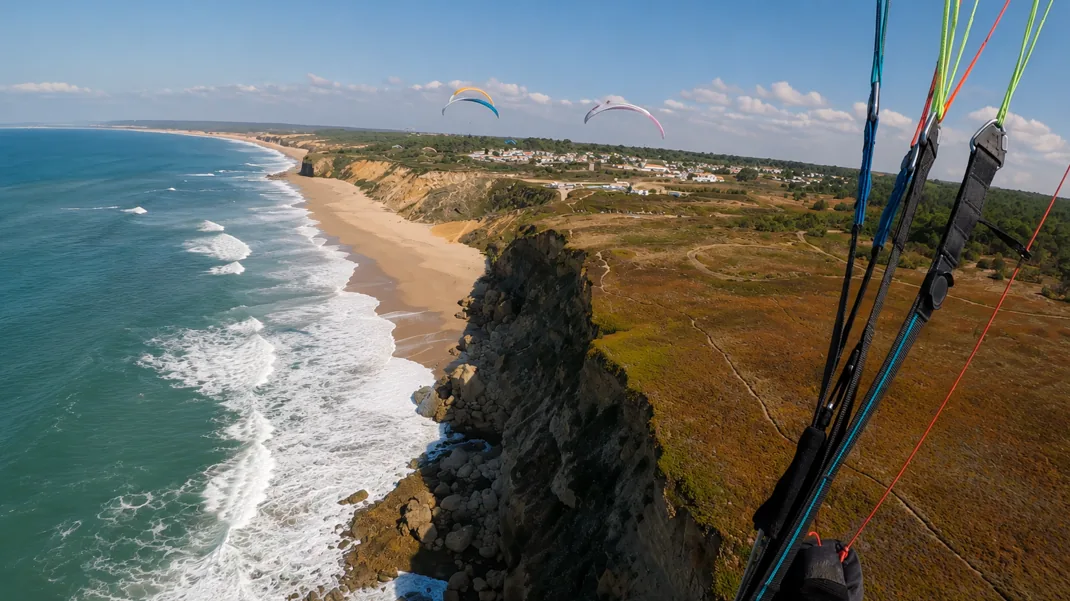
Portugal is small on the map but enormous in its flying variety. In a country barely wider than Wales from coast to border, you have Atlantic sea cliffs that produce laminar ridge lift for most of the year, open plains where pilots regularly fly 100 kilometres XC on a spring afternoon, granite mountains with panoramic thermals, and Atlantic sand dunes for pure ground handling. These are the best paragliding sites in Portugal — covered in the level of detail you'll actually find useful, from someone who has flown all of them for 15 years.
The Setúbal Coastal Sites — Where Most Pilots Begin
The Setúbal Peninsula, 30 minutes south of Lisbon, is the hub of Portuguese paragliding for visiting pilots. The limestone cliffs face northwest to northeast — directly into the prevailing Atlantic wind — producing some of the most consistent and laminar ridge lift in Western Europe. The main sites are all within 15 minutes of Sesimbra town, which means no long transfers and the flexibility to read the wind and choose the best launch for the day.
Praia das Bicas — The Flagship Coastal Site
Bicas is my home site and the one I use most in the Coastal Soaring Week. A 120-metre sea cliff above a long Atlantic beach, with a wide and accessible launch on the clifftop. The soaring band at Bicas is wide and generous — you can fly anywhere from 30 metres above cliff-top to 300 metres in a strong northwesterly — and the landing beach below is long enough to accommodate a relaxed approach even in strong wind. The cliff wraps slightly northward at the Meco end, giving you a back corner to explore on days with a north component to the wind.
- Best wind direction: NW through N-NE (220—€360—)
- Wind strength: 10–22 knots at the clifftop
- Skill level: Club Pilot / DHV A and above
- Season: Year-round; best Sept–June
- Coordinates: 38.437—N, 9.107—W
Cabo Espichel — Portugal's Most Dramatic Site
Cabo Espichel is the headland at the southwest tip of the Setúbal Peninsula — a vertical limestone cliff falling 150 metres to the open Atlantic, with an 18th-century pilgrimage sanctuary on the clifftop and nothing visible to the west but ocean. Top-landing on the clifftop grass is part of the experience here; the landing area is constrained by the sanctuary buildings and requires a precise approach. The soaring band is powerful and the views are extraordinary, but this is a technical site. You need a confident reverse launch in marine air, comfortable top-landing on a short field, and no hesitation in committing to a high approach over the cliff edge. I introduce pilots to Espichel on the XC & Coastal Combo week once they've demonstrated solid top-landing at Bicas.
- Best wind direction: W through NW (240—€340—)
- Wind strength: 12–20 knots (stronger winds rotate off the headland — assess carefully)
- Skill level: Intermediate / DHV B and above, top-landing experience required
- Season: Sept–June; avoid July–August when nortada is at maximum strength
- Coordinates: 38.413—N, 9.220—W
Arrábida Natural Park — Ridge to XC Gateway
The Arrábida hills are the highest point on the Setúbal Peninsula, rising to 500 metres above the sea in a wall of limestone covered in Mediterranean macchia. The flying here crosses a threshold: you start on the ridge in the morning, but as the day heats up and thermals start to fire off the south-facing limestone, you can transition from pure ridge soaring into proper thermal cross-country. On good spring and autumn days, pilots launching from Arrábida's upper sites thermal up past 1,500 metres and push southeast into the Alentejo plains, covering 80–120 km before outland and pickup.
The natural park status means launch access is managed — no casual strangers driving up to launch. It's a site I use on guided weeks where I know the access protocols and have the relationships with the local clubs.
- Best wind direction: NW through NNE for ridge; S-SE thermals for XC transition
- Skill level: Intermediate / DHV B and above for thermal flying
- Season: XC days mainly April–June, September–October
Praia do Meco
Meco is 8 minutes north of Bicas — a lower cliff (60–80 metres) with a rougher launch area but excellent flying in strong northwesterlies when Bicas is at the upper edge of comfortable. On days when the Bicas launch is seeing 20+ knots, I'll shift the group to Meco where the slightly lower cliff provides a cleaner wind gradient and a softer entry into the soaring band. The landing beach is wide and forgiving.
- Best wind direction: N through NNW
- Wind strength: 14–28 knots (stronger wind site)
- Skill level: Club Pilot and above
Praia de Fonte de Telha — Atlantic Dune Soaring
Fonte de Telha is a different kind of flying — a long sand cliff 15–20 metres above an Atlantic beach, stretching for nearly a kilometre. The soaring here is low and intimate: you're working the tiny dune lift band at 20–40 metres, landing directly on the beach, and launching again from a running forward launch on the sand slope. It's ideal as a ground handling and dune soaring session for pilots who want to work on their launch technique in forgiving conditions, and it's where I start the Ground Handling Week before moving to more exposed beach sections further north.
- Best wind direction: W through NW
- Wind strength: 8–18 knots (light to moderate — the dune needs consistent wind but doesn't work well in strong)
- Skill level: All levels including beginners with supervision
The Atlantic Dune Sites — Alberta Nova and Costa Caparica
North of Sesimbra, between the Setúbal Peninsula and Lisbon, a long strip of Atlantic coastline runs from Costa Caparica to Alberta Nova. Here the cliffs drop to dunes — low, sandy ridges above wide beaches — and the flying is entirely different from the limestone sea cliffs to the south.
Alberta Nova
Alberta Nova is a prominent dune headland about 40 minutes north of Sesimbra. At 25–30 metres high, it's the tallest of the local dune sites and offers genuine soaring in the right conditions — not just ground handling practice. The beach below is massive and forgiving, and the approach to the dune launch is simple. It's an excellent site for intermediate pilots working on their reverse launch in a forgiving environment, and it's where I run the intensive kiting and cobra-launch sessions on the Ground Handling and Parakite Week programmes.
Costa Caparica
The long beach south of Lisbon has scattered dune ridges used by local pilots for ground handling and dune soaring. Less spectacular than the Sesimbra sites but convenient for pilots based in Lisbon and useful for windy-afternoon sessions when the sea cliffs are too strong.
Alentejo — Portugal's XC Heartland
The Alentejo is what surprises most visiting pilots. Drive 90 minutes east from Sesimbra and the limestone hills dissolve into the wide open plains of Portugal's interior — cork oak forests, wheat fields, olive groves, and a sky that seems twice the size of anywhere near the coast. This is Portugal's cross-country country.
—vora and the Central Alentejo Plains
The Alentejo plain around —vora (90 km east of Sesimbra) is the classic Portuguese XC destination. The thermals here are wide-based and reliable from April through October — they trigger over the darker soil patches and cork oak edges, reaching 1,800–2,500 metres on strong days. The landscape is almost completely open, which means outlandings are a phone call and a quick drive rather than a helicopter retrieval. Pilots flying XC from the Arrábida heights often have the —vora area as their first turnpoint before pushing further east or southeast.
- Best months for XC: April–May, September–October
- Typical distances from coastal launches: 60–120 km
- Cloudbase: 1,500–2,800 m on strong thermal days
- Outlanding terrain: Flat, open, excellent. Farm tracks every 1–2 km.
Montemor-o-Novo and the Setúbal Inland
The area between the Arrábida hills and the main Alentejo plain — the Setúbal interior — is a transitional zone that fires well on spring mornings. Pilots launching from inland Sesimbra sites (rather than the cliffs) can be in thermals within 15 minutes, using the warming south-facing hillsides as trigger points before crossing into the plains. This is where the XC Coaching Week focuses its early XC sessions.
Serra da Estrela — Mountain Flying in Portugal
Portugal's highest mountain range occupies the central interior, peaking at Torre (1,993 m). The flying here is genuinely different from anything on the coast or the plains: you're in real mountain terrain, with ridge systems, valley thermals, and a decidedly un-Atlantic feel.
The season window for Serra da Estrela is March–May and September–October. Summer convection becomes too aggressive by midday; winter is cold and wind-affected. Cloudbase sits around 1,200–1,700 metres above the launches in spring and autumn. The XC routes from Serra da Estrela can extend north or south along the mountain spine, and on strong days pilots have reached the Alentejo plains far below. This is intermediate-to-advanced territory: thermal flying, XC navigation, and comfort in mountain weather are all required.
- Best months: March–May, September–October
- Typical cloudbase: 1,200–1,700 m above launch
- Skill level: Intermediate/Advanced; XC experience required
- Highest point: Torre, 1,993 m
Linhares da Beira — Portugal's Most Famous XC Launch
Linhares da Beira is a medieval village perched on a granite escarpment above the Mondego river valley, roughly 280 km north of Sesimbra. It is, without question, the site I'd recommend most to any XC pilot who finds themselves in Portugal with a free day and a strong forecast. The launch is right above the medieval castle walls — you inflate your paraglider above 700-year-old stone fortifications and step off into a valley that opens southeast toward the Beira plains.
The XC potential from Linhares is exceptional. On strong days in spring or autumn, pilots regularly achieve 100–150 km flights south into the Alentejo or east into Spain. The valley thermals are honest and well-spaced, the terrain is dramatic without being dangerous, and there are very few quality English-language guides to the site — which is precisely why it offers an opportunity to rank well on Google for visitors searching for it.
The village itself is a medieval time capsule — granite houses, cobbled streets, a 14th-century castle, and a population of about 150 people who have coexisted with passing paragliders for decades. Launching above the castle walls and looking southeast over the Mondego valley on a clear spring morning is one of the most memorable moments in Portuguese flying. I include Linhares da Beira in the custom Design Your Tour week for pilots who want to see the north as well as the coast.
- Best months: March–May, September–October
- Typical XC distance: 80–150 km
- Skill level: Intermediate+, XC experience essential
- Location: 40–33'N, 7–25'W — near Guarda, central Portugal
Northern Portugal — Penacova, Caldelas, Braga
The north of Portugal has its own flying identity: greener, wetter, more Atlantic-influenced, with sites built around river gorges and granite hillsides rather than limestone sea cliffs.
Penacova
Penacova sits above the Mondego river gorge south of Coimbra. The launches here produce ridge lift from the valley wind channelling through the gorge — a different dynamic from sea-cliff soaring but with a similar laminar quality. Works in northeast winds, which makes it complementary to the Sesimbra sites (which work in northwesterlies). A popular site with the Coimbra club and an interesting addition to a multi-site Portugal trip.
Caldelas (Minho Region)
Caldelas is a thermal site in the Minho region of northwest Portugal — green hills, Atlantic-influenced weather, and a well-established local club. The flying season here is more weather-dependent than the south, but when conditions align in late spring and autumn, the mountain landscape is striking. Included in the northern extension of the Iberian XC Tour.
The Andalusia Extension — Southern Spain
The Iberian XC Tour crosses the Portuguese border into Andalusia in southern Spain, accessing sites that work in different conditions from the Atlantic-influenced Portuguese sites. The Jerez / Sierra de Cádiz area is the main target: high cloudbase (often 2,500–3,500 m in summer), reliable thermals from the Sierra Nevada mountains funnelling west, and dramatically different landscape from the cork oak plains of the Alentejo.
Andalusia fills out the Iberian XC Tour's second half, providing a counterpoint to the Portuguese coastal and plain flying — more Mediterranean in character, with more aggressive thermals and higher cloud bases. The combination of Portugal's Atlantic sites with Andalusia's Mediterranean-influenced conditions in a single week is what makes the Iberian XC Tour genuinely unique.
Site Summary — All Regions at a Glance
| Site | Type | Skill Level | Best Season | Typical Flying |
|---|---|---|---|---|
| Praia das Bicas | Coastal ridge | Club / DHV A+ | Year-round | Ridge soaring, 1–4 hrs |
| Cabo Espichel | Coastal ridge | Intermediate / DHV B+ | Sept–June | Ridge soaring, top-landing |
| Arrábida | Ridge + thermal XC | Intermediate / DHV B+ | Apr–Jun, Sep–Oct | Soaring ? XC, 60–120 km |
| Praia do Meco | Coastal ridge | Club / DHV A+ | Year-round | Ridge soaring (strong wind) |
| Fonte de Telha | Dune soaring | All levels | Year-round | Low soaring, ground handling |
| Alberta Nova | Dune soaring | All levels | Year-round | Ground handling, dune soaring |
| Alentejo Plains | Thermal XC | Intermediate / DHV B+ | Apr–Oct | XC, 60–130 km |
| Serra da Estrela | Mountain thermal | Advanced | Mar–May, Sep–Oct | Mountain XC |
| Linhares da Beira | Mountain XC | Intermediate+ XC | Mar–May, Sep–Oct | Long XC, 80–150 km |
| Penacova | River gorge | Club / DHV A+ | Year-round (NE wind) | Gorge soaring |
| Andalusia (Spain) | Thermal XC | Intermediate+ XC | Apr–Oct | Long XC, high cloudbase |
Which Sites Will You Fly on a Guided Week?
The sites you fly depend on the programme you choose and what the forecast delivers. Here's how they map to the Fly with Behrooz programmes:
- Coastal Soaring Week: Praia das Bicas, Praia do Meco, Cabo Espichel, Fonte de Telha, Arrábida — all 5 Setúbal coastal sites, chosen day-by-day based on conditions.
- XC Coaching Week: Arrábida thermal launches, Alentejo plains, inland Setúbal sites. Days on the coast when thermals aren't available.
- XC & Coastal Combo: Split between coastal ridge and XC thermal days. Best option for pilots who want both disciplines in a single week.
- Ground Handling Week: Fonte de Telha, Alberta Nova, and other dune sites. Occasional soaring days at Bicas when conditions allow.
- Iberian XC Tour: Arrábida, Alentejo, Serra da Estrela or Linhares, Andalusia. A different site every 1–2 days.
Want to fly these sites with a local guide?
Every Fly with Behrooz programme includes private transfers to the launch, site briefings, and radio coaching in the air — at all the sites described above.