

Parakite flying in Portugal — a new relationship with flight.
Parakite is paragliding turned inside out. Smaller wings — typically 14–18 m² — with higher loading, faster responses and a completely different relationship with the terrain below. If you've watched pilots doing ground-proximity runs along dune faces and wondered what that discipline actually requires, this is where you start.
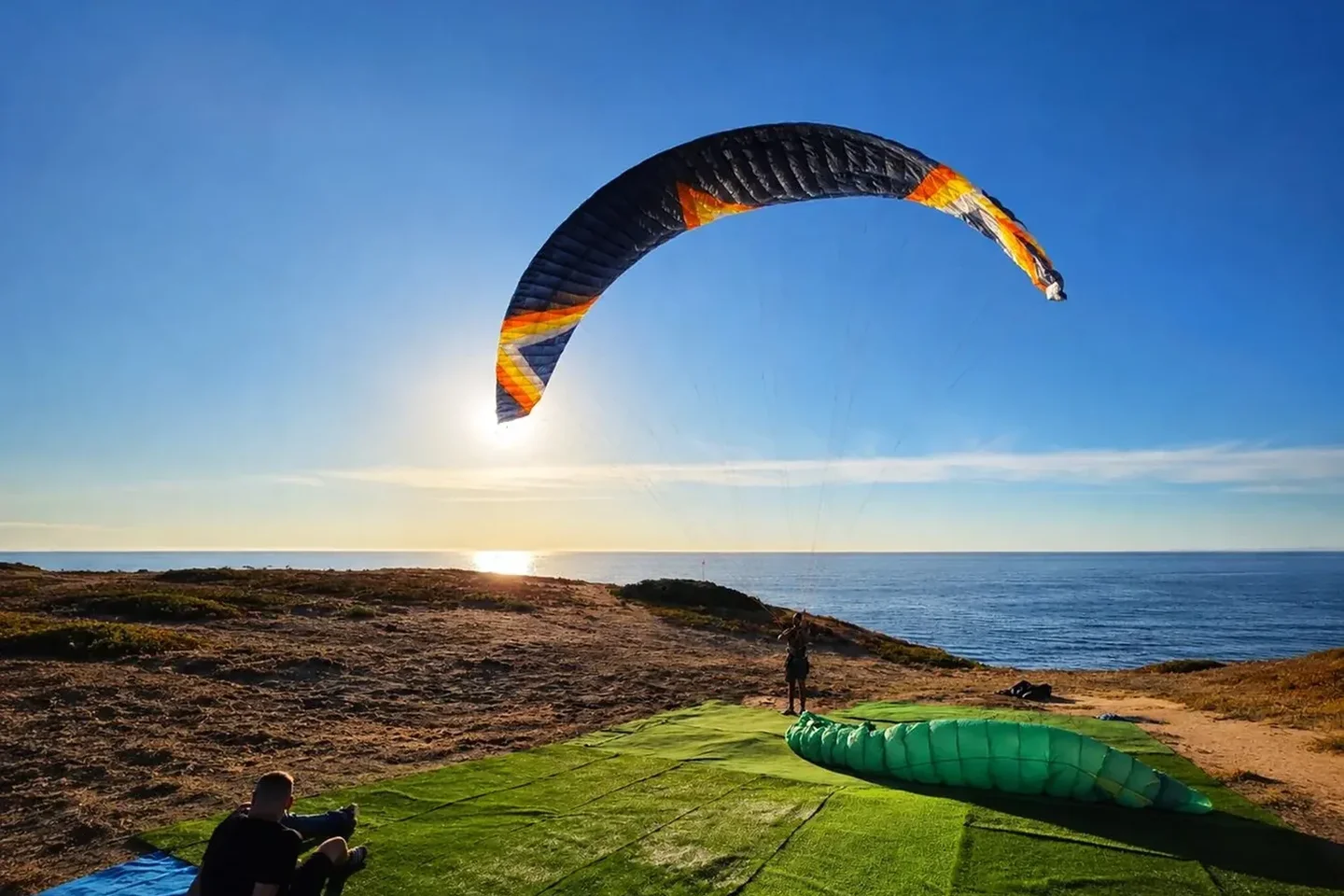
The Parakite Week builds from the ground up, deliberately. Day one is kite control — learning how a loaded small wing behaves, what the brake inputs feel like, how its response differs from your regular glider. Days two and three progress through low hops, dune soaring and short ground-proximity passes under Behrooz's direct supervision. By the end of the week, depending on your progression and the conditions, you'll be flying supervised dune runs and low coastal flights at sites Behrooz selects specifically for safety and learning curve.
This is not a programme for nervous pilots. It is a programme for confident, well-rounded, experienced pilots who want to enter a different discipline with proper coaching from someone who has flown parakite at a serious level. Behrooz will be direct about whether conditions and your progression justify any given flight — safety is not negotiable. Maximum 6 pilots.
Prerequisite: A valid paragliding licence, a minimum of 150 hours airtime, and a brief conversation with Behrooz before confirming. Send a WhatsApp with your licence level, hours and experience — he'll tell you honestly whether this programme is right for you now.
Parakite flying — also referred to as speed riding — uses smaller, faster wings than a standard paraglider, flown at low altitudes along ridge lines, dune faces and cliff edges. The Atlantic dunes at Costa Caparica and the ridge lines above Sesimbra rank among the best parakite training environments in southern Europe: consistent laminar coastal wind, clean run-ins and predictable sea-breeze development. Portugal's year-round flying window means the parakite programme runs from September through June without seasonal restriction.
What's included
- Daily kite control sessions on coastal terrain
- Progression from ground work to low flights
- Video review of every session
- Radio coaching on every supervised flight
- Small-wing ground-proximity technique coaching
- Private transfer to every site, daily
- Video & photos of your sessions
- Daily honest assessment of your progression
- Coastal dune soaring (conditions permitting)
- Theory sessions on bad-weather days
Before you come
Parakite is a specific discipline — a few things to confirm before you arrive will make the week go smoothly.
Confirm your experience
Parakite requires strong ground-handling skills and comfort in dynamic, low-level air. Message Behrooz with your background before booking — he'll confirm whether the programme suits your current level.
Licence & documentation
Bring your national paragliding licence or IPPI card. Behrooz keeps records for every participant — a photo on your phone is sufficient.
Your glider
Bring a glider you know well — ideally one you've been actively ground-handling. Parakite on an unfamiliar wing takes time away from the actual programme. Let Behrooz know what you're bringing when you confirm dates.
Physical condition
Parakite sessions are demanding — sustained ground proximity work requires quick reactions and good body awareness. Arrive rested and in reasonable physical shape. This isn't a passive week.
What to wear
Protective clothing is recommended — knee pads and gloves are worth bringing. Sturdy shoes with ankle support. Behrooz will brief you on kit specifics when you arrive, but come prepared for contact with the ground.
Getting here
Fly into Lisbon (LIS) — Sesimbra is 45 minutes away. Behrooz can arrange an airport pickup; ask when you confirm your dates.
What is parakite and how does it differ from paragliding?
A parakite (also known as a speed wing) is a smaller, higher-loaded wing that flies faster and closer to the ground. It requires much more precise handling than a standard paraglider and is flown at low altitudes — along ridges, dune lines and coastal sites. It's not a step above paragliding; it's a completely different discipline with its own techniques and risk profile.
What exactly is the 150-hour airtime prerequisite?
150 hours of logged paraglider airtime, a valid licence, and confident kite control in high wind. Before confirming your place, Behrooz will have a brief conversation with you about your flying background. The prerequisite is not negotiable — the programme is genuinely demanding and the sites in Portugal require reliable ground-handling skills before you fly.
Do I need to bring my own parakite to Portugal?
If you already have a parakite, bring it. If you're new to the discipline, message Behrooz before the course — he can advise on suitable equipment and may be able to arrange a demo wing for initial sessions. Come with your own paraglider harness and helmet regardless.
What sites in Portugal are used for parakite flying?
The Atlantic dunes at Costa Caparica and the ridge lines above Sesimbra are the primary training sites. Both offer consistent coastal wind, clean run-ins and safe landing areas — exactly the conditions parakite's low-altitude, high-speed approach demands. Behrooz plans the site based on the forecast and adapts if conditions shift.
Is private transport to the parakite sites included?
Yes — daily transfer from your accommodation to the training site and back is included. Given that the optimal site shifts daily with the forecast, Behrooz handles all transfers to wherever the conditions are best — it's part of how the week works. No rental car is needed.
How does payment work?
Payment is made directly to Behrooz — no booking platforms, no agencies, no middlemen. No deposit is required to reserve your place; a WhatsApp message or email locks it in. Payment details are sent once your reservation is confirmed.
What is the cancellation policy?
Free cancellation on all programmes. If you've already paid ahead of your tour, cancellation is free of charge in full — nothing is deducted. Just send a WhatsApp message or email and Behrooz will take care of it personally.
What happens if the weather doesn't cooperate?
Behrooz knows every flying site in Portugal and always has a backup plan — if one site is out, we move to wherever is flyable. On any day nothing can be flown, you're not charged the full rate, only reasonable administrative or transport costs. Because of this, payment is handled flexibly: depending on the week, Behrooz may take payment before or after the tour, so you only ever pay for the days you actually flew.