

Most people who sign up for an EP course have already spent weeks watching paragliding videos and reading contradictory things online. Some articles make it sound like a weekend hobby anyone can pick up. Others make it sound like years of rigorous training before you're airborne. Neither is accurate. A well-structured EP course needs 8–12 good flying days — weather permitting, that typically spans two to three calendar weeks — and takes you from your first ground handling session to solo soaring flights. It leaves you with a qualification and a very clear picture of how far you've come and how far there is still to go. This guide covers what actually happens during those days, what the physical requirements are, and why the location you choose makes a significant difference to how quickly and safely the skills develop.
What an EP Course Actually Covers
The Elementary Pilot (EP) course — sometimes called the P1 course depending on the country — is the entry-level qualification for paragliding. It is recognised internationally and is the foundation on which every subsequent certification builds. A typical EP course requires 8–12 good flying days — in practice, allowing for weather, that means two to three calendar weeks when completed as an intensive, though some schools spread it over several weekends for students who cannot commit to a continuous block.
The curriculum is more comprehensive than most beginners expect. You are not simply learning to launch and land. Over the course, you will cover:
- Ground handling and kiting — controlling the wing on flat and sloped ground in various wind conditions, which forms the majority of the early days
- Meteorology basics — how to read the sky, understand wind patterns at the coast, identify conditions suitable for flying and conditions that are not
- Equipment familiarisation — understanding your wing, harness, reserve parachute, helmet, and instruments, and how to pack, check, and maintain them
- Flight theory — how the wing generates lift, how to use brakes correctly, stall awareness at a conceptual level
- Slope and ridge flying — progressive flights building from short training slope runs to genuine ridge soaring under radio guidance
- Landing pattern and approach — setting up a landing approach, reading the field, executing a flare
By the end of the EP course, you will have completed your first solo soaring flights. You will not be an independent pilot — that comes with the subsequent Club Pilot qualification — but you will have enough understanding to know exactly what the next steps are and why they exist.
Phase 1 — Ground Handling (Days 1–3)
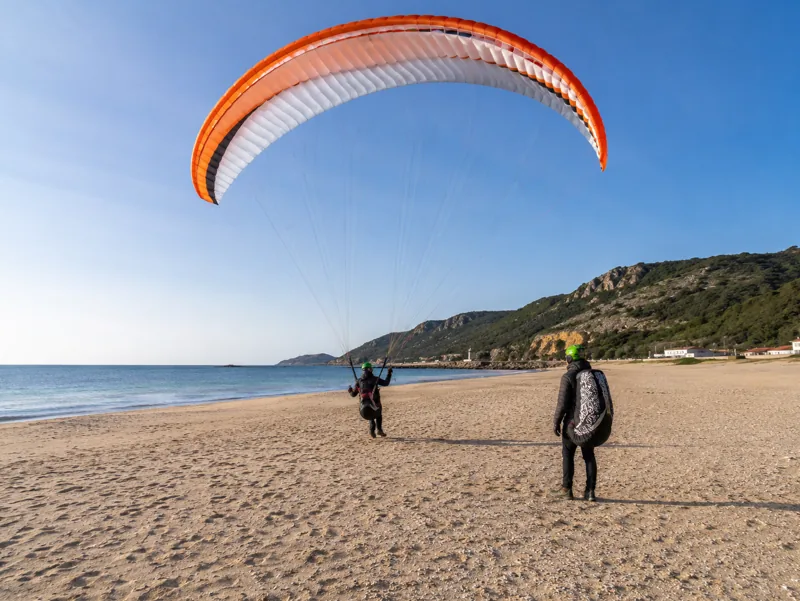
The first few days of any well-run EP course are spent entirely on the ground, and this surprises almost every student who arrives expecting to fly immediately. Ground handling — often called kiting — is not a warm-up. It is the most important skill in paragliding, and the hours you invest in it at the beginning will determine how safe and capable a pilot you become.
Kiting means holding the wing above your head and keeping it stable in the air while you walk, turn, and respond to gusts. It sounds simple. It is not. The wing is alive — it reacts to every shift in the wind, every change in your body position, every millimetre of brake input. Learning to read the wing through your hands before you ever leave the ground is what allows you to launch reliably and react correctly in the air.
In the early sessions, you will practise forward inflation (running into the wing from behind) and reverse inflation (facing the wing and pulling it up, which is the standard technique for launching into wind). You will learn to centre the wing directly overhead, feel the moment it becomes stable and pressurised, and understand what the controls feel like when something is going wrong before it develops into a problem.
On a coastal site like Sesimbra, where the Atlantic northwesterly creates a consistent and predictable training breeze, this phase goes particularly smoothly. The wind arrives steadily rather than in turbulent bursts, which means the wing behaves predictably and students can build accurate muscle memory without fighting erratic gusts.
Phase 2 — Training Slope Flights (Days 3–6)
Once you can reliably inflate the wing and hold it overhead in light to moderate wind, you begin flying. The first flights are very short — typically 5 to 15 seconds of air time from a shallow training slope. They feel anticlimactic to some students. They should not. These brief runs are doing essential work: connecting the ground handling skills to the sensation of the wing lifting you, your feet leaving the ground, and the controls responding to your inputs while you are actually airborne.
The flare — the firm downward brake input you apply just before touchdown to slow the wing and cushion your landing — is introduced in this phase. Getting the timing right takes repetition. Too early and you sink through dead air into a hard landing; too late and you run through your landing rather than stopping cleanly. The training slope lets you practise this 10, 20, sometimes 30 times in a single day, which is simply not possible from a full-height launch.
As the days progress, you will move to slightly higher and longer slopes, extending your flight time to 30–90 seconds and beginning to fly in more varied wind angles. Your instructor will be watching every launch and landing, adjusting your technique, and deciding when you are ready to move to the next stage. There is no fixed timeline — some students progress through this phase in three days, others take five. Patience here pays dividends later.
Phase 3 — First Soaring Flights (Days 7–14)
The shift from training slope to a proper ridge or coastal soaring site is the most significant step in the EP course. For the first time, you will feel the wing climb in ridge lift — the air deflected upward by a hillside or cliff — and extend your flight to minutes rather than seconds. It is during this phase that paragliding stops feeling like an exercise and begins feeling like what it actually is.
Your instructor will fly alongside you or observe from the ground, maintaining radio contact throughout every flight. The radio is not a crutch — it is a teaching tool. When your instructor says "look at where your left brake is sitting" or "turn now and start your approach," those prompts are building the decision-making habits that will eventually become automatic. Most students find the radio guidance reassuring rather than intrusive, especially when they are learning to read the landing field from height for the first time.
By the end of the soaring phase, you will have completed flights of 10–20 minutes, practised figure-eight turns to maintain your position on the ridge, and begun to understand how the wing responds to shifting wind direction. You will have made real decisions — about when to turn, where to position yourself, when to come in to land — under supervision that gradually becomes less directive as your confidence grows.
| Day | Focus | Milestone |
|---|---|---|
| 1 | Equipment orientation, wing layout, forward inflation | First successful forward inflation |
| 2 | Reverse inflation technique, centring the wing, brake awareness | Stable reverse kiting in light wind |
| 3 | Kiting in stronger wind, first very short slope flights | First time feet leave the ground |
| 4 | Slope flights with turns, flare practice, landing approach | First clean flare and soft landing |
| 5 | Longer slope flights, consistent launch technique | Independent launches from slope |
| 6 | Theory: meteorology, reading clouds, sea breeze mechanics | Site briefing and weather assessment |
| 7 | First flights from full-height launch site with radio guidance | First soaring flight in ridge lift |
| 8–9 | Building flight time, figure-eight patterns, position on ridge | 10+ minute solo soaring flights |
| 10–11 | Landing approach patterns, field selection, wind reading | Consistent accurate landings |
| 12–13 | Assessment flights, equipment checks, theory revision | EP qualification flights completed |
| 14 | Reserve parachute briefing, next steps discussion, debrief | EP certificate awarded |
Physical Requirements
This is where many prospective students hold back unnecessarily. The physical requirements for learning to paraglide are genuinely modest. You do not need to be athletic. You do not need upper body strength. You do not need to be able to run fast. What you do need is enough general fitness to walk uphill with your equipment — typically 15–25 minutes per flight on a training site — and the basic coordination to operate two brake toggles independently while responding to your instructor.
The practical parameters that most schools use as guidelines are:
- Weight: Modern EN-A wings are available in multiple sizes covering pilots from 55 kg to 130 kg — the correct size is simply selected for your weight. If you are outside this range in either direction, it is worth a conversation with the school before enrolling, but the vast majority of adults are covered without any special arrangement.
- Age: Most schools accept students from age 14 or 16. There is no upper age limit. Paragliding is regularly enjoyed by pilots in their 60s and 70s who started the sport late.
- Fitness: Able to walk uphill for 20–30 minutes without significant distress. No special cardiovascular requirement beyond this.
- Coordination: Basic — the ability to move two hands independently and respond to verbal instruction under mild time pressure.
There are some health conditions that warrant discussion with your doctor before enrolling — certain heart conditions, epilepsy, some medications that affect balance or reaction time. Your school will provide a health declaration form. Fill it honestly. The goal is to fly safely, not to gatekeep.
Most EP courses in Europe take place in Alpine environments — valleys, grass slopes, mountain winds. These are excellent sites, but they come with variable weather, thermal activity that begins early in the morning during summer, and conditions that can change quickly. Sesimbra's Atlantic coast operates differently. The northwesterly sea breeze arrives predictably in the mid-morning, builds steadily through the afternoon, and dies off in the evening. It is laminar, consistent, and forgiving — exactly what a student wing needs. There are no thermals at the training sites, no valley wind reversals, no mountain weather. The conditions that make coastal Portugal pleasant for visitors are the same conditions that make it an unusually good environment for learning to fly.
What Happens After the EP Course
The EP course is a beginning, not a destination. After completing it, most pilots pursue the Club Pilot (CP) qualification — known as P2 in some national systems — which adds cross-country navigation, flight planning, and more complex site assessment. The Club Pilot certification is what allows you to fly at new sites independently, join flying clubs, and begin accumulating the solo airtime that develops real competence.
The typical progression from EP looks something like this: 30–50 hours of supervised and solo soaring flight, then the Club Pilot course, then the gradual building of airtime and site experience, then — for pilots who want to develop further — an SIV course to practise handling collapses over water, and eventually the Senior Pilot (P3/XC) qualification that opens up cross-country flying.
Equipment purchase usually happens after 20–30 hours of flying. Before that point, most pilots do not have enough experience to make a well-informed wing choice, and school equipment is perfectly adequate for learning. When you do buy your first wing, you will already know enough to understand what EN A certification means, why an experienced instructor's recommendation matters, and which harness suits your flying style.
Common Questions Before Signing Up
Can I try it before committing to a full course?
Yes — and for most people, a tandem flight is the right first step. Flying with an experienced pilot before your EP course lets you experience the sensation of paragliding without the pressure of learning. You will know within the first few minutes whether this is something you want to pursue. Most EP students have done at least one tandem flight beforehand, and it genuinely helps: the first time you get airborne on the training slope, the sensation is familiar rather than shocking.
Do I need my own equipment?
No. Good schools provide everything — wing, harness, helmet, reserve parachute, radio. You do not need to buy anything before starting your course, and you should resist any pressure to do so. The decision about what equipment to purchase is much better made after you have 20–30 hours of flying experience and a clear sense of what kind of flying you want to do.
What if I'm afraid of heights?
This is more common than you might expect, and it is worth understanding what fear of heights actually is and is not. The clinical fear — standing on a balcony edge or looking down a stairwell — is triggered by the proximity of a hard edge and the absence of support. In the air, under a wing, that trigger is largely absent. A very high proportion of students who describe themselves as afraid of heights find that the sensation in the air is completely different. The ground handling phase is a natural desensitisation: by the time you make your first slope flight, the wing has already become something that feels like support rather than a void. That said, if you have a severe phobia, speak to your instructor honestly before the course begins.
Can I learn in a week?
Technically possible if conditions are perfect every day and you pick up skills quickly. Practically, a 10–14 day course is significantly better. Flying is a skill that consolidates overnight — what feels uncertain at the end of Day 3 often clicks naturally on the morning of Day 4. Compressing the course into fewer days reduces the number of those consolidation cycles and typically produces less confident pilots. If you can only commit to a week, a good instructor can still give you a strong foundation, but plan to return for a continuation course rather than treating it as a complete qualification in itself.
Portugal's Atlantic coast offers one of the most natural environments in Europe for learning the skill — predictable wind, accessible launches, warm temperatures from April through October, and the kind of scenery that makes the time between flights as enjoyable as the flights themselves. The Sesimbra area specifically benefits from a geography that channels the northwesterly sea breeze reliably onto training sites that face the right direction at the right angle. It is not an accident that experienced pilots keep returning here to fly. It is a place that works, meteorologically and practically, in a way that not many European coastal sites manage.
If you have been considering learning to paraglide for a while, the straightforward advice is to stop considering and start asking questions. The course structure is well-established, the progression is clear, and the experience of flying your first ridge soaring flight — even under radio guidance, even with all the caveats of a supervised environment — is genuinely unlike anything else you are likely to do on a hillside in Portugal.