

The honest answer is: an EP course needs roughly 8–12 days of actual flying to complete, and by the end of it you can fly solo in appropriate conditions. When you book a two-week block, you're building in buffer for the weather days that don't fly — because you will have them. What comes after that — the progression to confident, safe, independent flying — takes longer, and is more interesting. Most pilots describe the EP course as the beginning of something rather than the acquisition of a finished skill, and after 15 years of teaching this coast, I'd say that's exactly right.
The EP Course: 8–12 Flying Days
An Elementary Pilot course is the first qualification in paragliding. It covers the foundations: ground handling, basic flight manoeuvres, site assessment, weather awareness, and emergency procedures. By the end of a well-run EP course in good conditions, you have made multiple independent soaring flights and can continue flying at suitable sites with appropriate oversight.
The figure of 8–12 flying days is what matters — actual days in the air, not calendar days. If you book two weeks and three of those days are too strong or too calm, you still get your flying days in, they just fill out the fortnight differently. Student aptitude is the second variable — not intelligence, but the particular spatial and kinaesthetic sensitivity that ground handling demands. Some people feel the wing above them from day two. Others take until day five before the feedback loop clicks. Instructor ratio matters too: a one-to-one or one-to-two setup gives more radio coaching per student per flight than a large group course.
What "completing the EP course" actually means is worth being precise about. You can make independent soaring flights in suitable, uncomplicated conditions. You understand the principles of what is happening. You can assess a basic site and make a go/no-go call with support. You are not — and should not expect to be — a fully independent pilot at this stage. You are a beginner pilot who has covered the foundations safely and earned the right to keep building. The distinction matters, and I tell every student the same thing on their last day.
What Happens in the First 3 Days
The first phase of an EP course is almost entirely ground handling — learning to inflate, control, and feel the wing while your feet are on the ground. There are no flights in this phase, or at most very short bunny-hill hops to understand the transition from ground to air.
Ground handling is the part of learning that most students find simultaneously frustrating and revelatory. It is frustrating because the wing does not behave as expected: it overshoots, collapses, twists, surges forward. It is revelatory because when it starts to feel right — when the line pressure through the brakes starts to make sense as information rather than just force — everything that follows becomes more navigable.
The honest observation — and I've watched hundreds of students go through this — is that the ones who struggle in ground handling and push through it anyway tend to become more careful pilots than those who found it easy. They've already encountered the wing's capacity to surprise them, which is exactly the right thing to learn before altitude gets involved.
Days 3–7: First Flights
The transition to actual flying typically begins on day two or three with short training slope runs — launching from a low hill, flying for 20–30 seconds, landing, walking back up. These early flights are about connecting the ground handling muscle memory to the live environment. The brake inputs you practiced on the ground now have altitude under them.
By days five to seven, most students have made their first proper soaring flight: launching from the main training ridge, finding the lift band, and flying for more than a few minutes. The specific experience of extending a flight by finding lift — of realising that you are staying up not because you launched high but because you are actively working the air — is one of the pivotal moments in the learning arc. It is the first time the skill feels like a skill rather than a procedure.
Days 7–14: Building the Skill Set
The second half of an EP course is about accumulating flight time and making the basic skill set more reliable. Multiple flights per day replace the single daily flight of the earlier phase. Radio guidance becomes lighter as the instructor watches rather than directs. The student begins making their own launch timing decisions — reading the wind, choosing the moment — rather than waiting for instruction.
Site reading starts to develop in this phase. You begin to notice patterns: which part of the ridge produces the best lift at what time of day, how the wind shadows behind obstacles affect the approach, what the cloud shadows on the sea tell you about the air above. This is not something that can be taught directly. It is absorbed through repetition and attention, and it begins here.
The EP sign-off at the end of the course is not a pass/fail exam in the conventional sense. It is a qualified instructor's assessment that you have covered the required content and demonstrated safe, competent flight at the elementary level. You leave with a logbook, a qualification, and a clear picture of where you are in a much longer progression.
After the EP Course: What Next?
The EP course gets you into the air independently. The subsequent progression is what makes you a pilot. The typical path looks like this:
The Club Pilot / P2 qualification (or equivalent depending on your national federation) comes typically three to six months after the EP, assuming you have been flying regularly. It covers a broader range of conditions, cross-country navigation basics, and a more developed understanding of meteorology. It is the qualification that opens most club flying sites to you without an instructor present.
50 hours of solo flight time is the milestone that most experienced pilots identify as the point where something changes qualitatively in the flying. Below 50 hours, most pilots describe their flying as effortful — each decision requires conscious thought, each site is slightly unfamiliar, the wing's feedback requires interpretation. Above 50 hours, the interpretation starts to become more automatic. Site reading improves. Launches feel easier. The wing's behaviour under varying conditions starts to have predictability that it lacked before.
An SIV course — a skills and incidents training session over water, where an instructor coaches you through deliberate wing collapses and recovery — fits into most pilots' progression at some point in the first or second season. It teaches you what the wing does when it misbehaves, removes the fear of the unknown, and gives you the recovery skills to handle situations that would otherwise end a flight badly. It is not required for EP or Club Pilot but is strongly encouraged before moving into more advanced flying.
Cross-country flying — leaving the site on a thermal, navigating terrain, covering distance — becomes realistic from around 30 to 50 hours onward for pilots who are actively seeking that progression and have taken SIV. Some pilots reach this point in their first season. Others take two or three years. Both timelines are normal.
| Stage | Typical Duration | What You Can Do | What's Next |
|---|---|---|---|
| EP Course | 10–14 days | Solo flights in simple conditions, basic site assessment, ridge soaring | Continue flying regularly; work toward Club Pilot |
| Club Pilot / P2 | 3–6 months post-EP | Wider range of conditions, unsupervised club flying, basic met reading | SIV course, expand site portfolio, start XC prep |
| 50 hours solo | First season to 18 months | Skills beginning to feel intuitive; site reading improving; more condition range | XC flying if not already started; advanced sites |
| Confident independent pilot | 2–3 years | Full site range, XC capable, weather-confident, thermalling in benign conditions | Advanced ratings, competition, instructor training |
Most pilots describe the first 50 hours as uncertain and the subsequent 50 as transformative. The skill that felt deliberate becomes intuitive. Site reading that required effort becomes automatic. Weather that looked confusing starts to have patterns. The wing's behaviour — which in the early hours could feel random and slightly threatening — starts to make sense as a continuous stream of information rather than a series of surprises.
This is the horizon worth aiming for in the early stages. Not the EP sign-off, but 50 hours. The EP gets you there safely. The 50 hours is where the flying actually begins.
Factors That Speed Progress
The single most important factor in learning pace is frequency of flying. Consecutive days of flying are dramatically more effective than one or two sessions per week separated by gaps. The reason is simple: the kinaesthetic feedback loop — the connection between what you feel through the brakes and what the wing is doing — degrades over gaps and rebuilds with practice. A student who flies every day for two weeks will progress faster than one who flies the same number of hours over three months.
- Good conditions — consistent, predictable wind makes feedback cleaner and errors less consequential
- Radio coaching — real-time feedback during the flight, rather than debrief afterward, accelerates skill acquisition significantly
- Physical coordination baseline — pilots who have done surfing, kitesurfing, or other activities involving dynamic balance and edge control tend to pick up ground handling faster
- Attention and curiosity — students who watch other people's flights, ask questions about what they see, and actively try to understand the physics of what is happening learn faster than those who just fly and go home
- Getting enough sleep — motor learning happens during sleep. This is not a small thing. Tired students on day eight often fly worse than they did on day five.
Factors That Slow Progress
- Infrequent flying — one or two sessions per week with long gaps between them means skills decay between sessions faster than they build. This is the most common reason EP courses that are spread over months produce pilots who feel less confident than those who did it in two consecutive weeks.
- Difficult site conditions — mountain sites with active thermal cycles are harder to learn on than coastal ridge sites with consistent sea breeze. Unpredictability in the early hours is not educational; it is overwhelming. Predictable conditions are better for beginners.
- Performance anxiety — students who are trying to impress or who are worried about being judged make different (worse) decisions than students who are simply trying to learn. The skill requires a relaxed attention. Tension in the hands communicates itself directly to the wing.
- Large group courses with high instructor-to-student ratios — if an instructor is managing eight students, the individual coaching time per student drops significantly. More students waiting on the slope means fewer flights per person per day.
Why Coastal Portugal Is Good for Learning
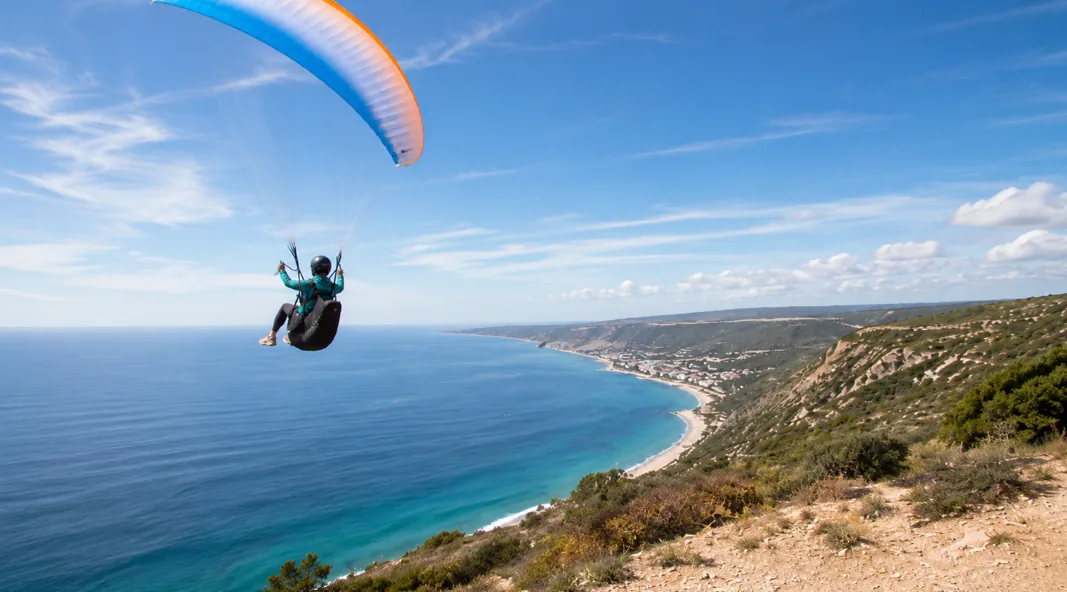
The northwesterly sea breeze that drives flying at Sesimbra from late spring through early autumn is one of the more reliable and learner-friendly wind systems in Europe. It arrives from the Atlantic, crosses the coast, and strikes the training ridge cleanly. The result is consistent, laminar lift — smooth, predictable, with minimal turbulence and a very clear lift band that students can learn to work without dealing with the variability that mountain thermal sites produce.
There are no mountain thermal cycles to contend with. No valley wind reversals in the afternoon. No sudden shade from summit cloud reducing the thermal trigger. The sea breeze turns on, builds to a flyable strength, and holds. Students who train here regularly remark on how much cleaner the feedback is compared to alpine or inland sites where the air is more complex.
The training ridge at Sesimbra also allows repeated flights with short walk-backs. A student can make five or six flights in a morning session rather than the one or two that a longer walk-back site allows. Volume of flights in the early hours is directly correlated with pace of learning. More flights, faster progress.
Portugal's climate adds to this: eight to nine months of reliably flyable conditions per year means EP students are not racing against a closing weather window. There is time to learn properly, at a pace that builds real skill rather than just accumulated hours in marginal conditions.
Learning to paraglide is not a quick thing, and it is not meant to be. Ten days to the first solo flight, a full season to build genuine confidence in the air, two to three years to feel truly at home across a range of conditions and sites. That arc is part of what makes it worth doing. You are not simply acquiring a skill — you are developing a way of reading the world, an attentiveness to air and weather and terrain that changes how you see the landscape even when you are not flying. The pilots who stay with it longest are the ones who found that the learning never quite stops, and came to understand that as a feature rather than a flaw.