


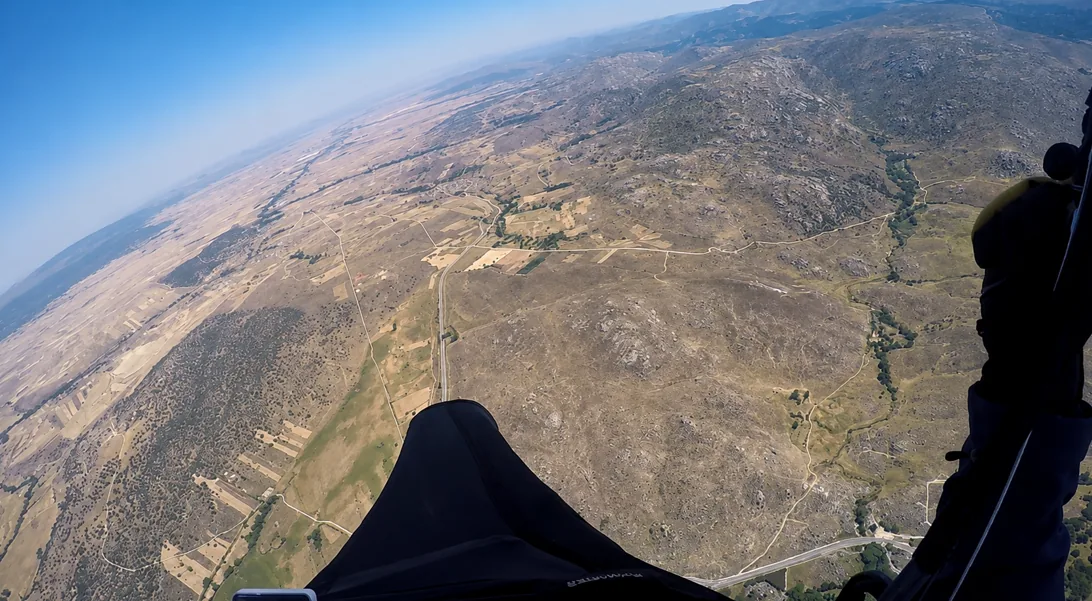
Ask any experienced XC pilot in Europe where they have had their best inland flights and Piedrahíta will come up early. The small town in the Salamanca province of Castilla y León has an outsized reputation in the paragliding world — not from marketing but from results. World championships have been held there. National records have been set there. The combination of terrain, airspace, and the particular thermal character of the Castilian interior makes it one of a handful of sites in the world where truly long XC flights are regularly possible from a low launch height. This guide explains what to expect at Piedrahíta, who it suits, and how it sits within a broader Iberian flying week.
Why Piedrahíta — The Geography and the Thermals
Piedrahíta sits at the foot of the Sierra de Béjar and the Sierra de Gredos, at approximately 1,000 metres above sea level. The town itself is unremarkable — a quiet agricultural settlement in the broad Castilian plain. But the terrain creates something unusual: the mountain ridges to the south and west heat quickly in the morning, generate strong, well-organised thermals that rise over the flat interior plateau, and allow pilots to glide for enormous distances without significant terrain obstacles.
The Castilian meseta — the vast inland plateau of central Spain — is one of the great XC flying environments in the world. On good days, the plateau is unbroken by mountains for 150 kilometres in every direction. Thermals rise to 2,500–3,500 metres and cloudbase follows. The limiting factor at Piedrahíta is not terrain or airspace but pilot skill and the weather window.
The Flying Season and Best Conditions
The classic season at Piedrahíta runs from late spring through early autumn — May to September, with June, July, and August being the primary XC months. Summer in the Castilian interior is hot; plateau temperatures reach 35–40 degrees Celsius in July. This heat drives the thermal engine that makes the site exceptional. Thermals start early — sometimes before 10 am — and can remain strong through the afternoon, though summer storms can cut the flying window short.
May and September offer more moderate temperatures and are often considered the most pleasant months to visit. The thermals are slightly less aggressive than peak summer but still produce cloudbase of 2,000+ metres. Spring competition season brings the main events to Piedrahíta.
Launch altitude: approximately 1,350 m. Typical cloudbase in summer: 2,500–3,500 m. Thermal strength: 3–6 m/s average on good XC days. Record flights: 200+ km out-and-returns have been flown. Typical XC day: 80–150 km is achievable for a well-prepared intermediate to advanced pilot. The site is not forgiving — strong thermals punish poor thermalling technique quickly.
Airspace and Infrastructure
The airspace over the Salamanca province is one of Piedrahíta's major advantages. Unlike coastal or urban sites, the Castilian interior has minimal controlled airspace at altitude. The main hazard is Salamanca civil airport's CTR and the Madrid TMA at higher levels — both well charted and easy to avoid on standard XC routing to the east and north. Military zones exist and are on the standard Spanish sectional charts; checking the NOTAM before each flight is essential.
Infrastructure at the site itself is basic but functional. There is a small school with rental gliders and several guides who are highly experienced at the site. The town has accommodation, restaurants, and the social infrastructure of a well-established competition venue. Spanish is essential outside the flying community — Piedrahíta is not a tourist destination and English is rare off the hill.
Who Piedrahíta Suits
Piedrahíta is an advanced site. The thermals are strong, the air can be turbulent in the afternoon, and the XC environment demands sound navigation and airspace management. P4 (BHPA) / Intermediate (DHV) level pilots and above get the most from the site. P3 pilots who are comfortable in strong thermals and have solid SIV experience can fly there safely in the right conditions, but should not expect a gentle introduction to XC.
For beginners or pilots building their first XC hours, Piedrahíta is not the right starting point. The site rewards experience, not enthusiasm.
Combining Piedrahíta with the Iberian XC Tour
For pilots visiting the Iberian Peninsula for a flying trip, Piedrahíta and Portugal's Atlantic coast offer genuinely complementary environments. The inland thermal power of the Castilian plateau is very different from the coastal soaring and Atlantic-influenced thermals of Sesimbra. Combining both in a single extended trip gives pilots a breadth of experience that neither destination alone provides.
The Iberian XC Tour with Fly with Behrooz is designed around exactly this logic. The tour combines XC flying days in the Portuguese interior with coastal soaring days at Sesimbra — and can be extended to include Piedrahíta or Algodonales in southern Spain as part of a longer Iberian circuit. The driving time from Sesimbra to Piedrahíta is approximately 3.5 hours — a reasonable day's transfer between flying venues.
| Factor | Piedrahíta | Sesimbra, Portugal |
|---|---|---|
| Primary flying type | XC distance, thermalling | Coastal soaring + Atlantic XC |
| Season | May–September (best Jun–Aug) | Year-round (all months flyable) |
| Typical cloudbase | 2,500–3,500 m | 1,200–2,000 m (XC days) |
| Thermal character | Strong, punchy, inland | Atlantic-influenced, smoother |
| Pilot level | P4 / Intermediate upward | P2 upward (all levels catered) |
| English coaching | Limited; school-based | Personal radio coaching (Behrooz) |
| Drive from Lisbon | ~3.5 hours | 40 minutes |
Planning a Piedrahíta Visit as a Foreign Pilot
The easiest access is via Salamanca city, 60 km to the north, which has limited direct connections from the UK and rest of Europe. Most pilots fly into Madrid (2 hours by car from Piedrahíta) or Lisbon (3.5 hours). Renting a car is essential — there is no public transport to the site.
Accommodation in Piedrahíta is basic. The pilot community tends to concentrate in the few small hotels and rural casas near the town centre in season. Booking ahead for June and July is advisable as competition periods fill quickly. There is a local school (Escuela de Vuelo Piedrahíta) that can arrange glider rental, guides, and retrieve for visiting pilots — contact them before arrival.
For pilots whose Spanish is limited, arriving with a plan rather than improvising on arrival makes a significant difference. If you are combining Piedrahíta with a Portugal week, talk to Behrooz first — he can advise on the best timing for a combined trip and what conditions to expect in each location.