


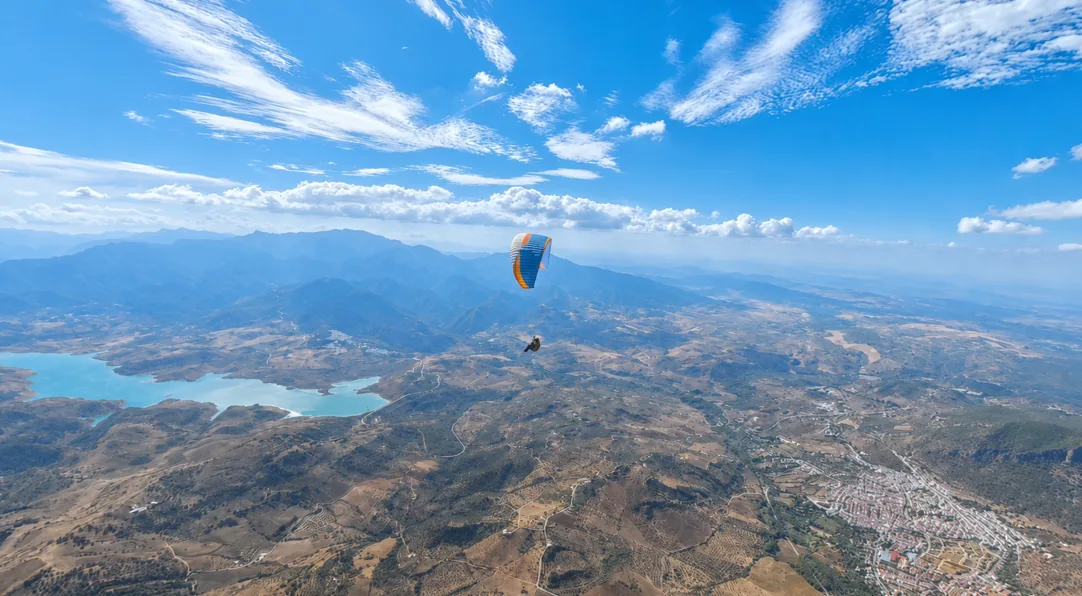
In the sierra behind the sherry towns of Cádiz province, a small whitewashed village has built an improbable reputation as one of Europe's finest thermal flying destinations. Algodonales is not famous for competitions or altitude records. It is famous for consistency — for long seasons, reliable morning thermals, and the kind of flying that intermediate pilots find genuinely transformative. This guide explains what the site offers, when to go, and how it fits into a broader Iberian flying week that includes Portugal's Atlantic coast.
Where Algodonales Is and Why It Works
Algodonales sits at the foot of the Sierra de Líjar, a limestone ridge in the province of Cádiz in southern Andalusia. The village is small — around 5,000 inhabitants — and perches at approximately 350 metres above sea level, with the flying hill rising steeply behind it to around 800 metres. The launch faces broadly east and north-east, and the valley below channels Atlantic air from the coast 60 kilometres to the west.
The thermal character here is driven by two factors. First, the limestone terrain heats very quickly in the Andalusian sun, producing reliable thermals from mid-morning through early afternoon on the majority of spring and autumn days. Second, the Sierra de Líjar acts as a trigger for the Atlantic air flowing inland — thermals form along the ridge predictably, and the landing field in the valley below is generous and easy to reach. The combination gives intermediate pilots a high success rate on XC days without the aggressive conditions that characterise higher-altitude Castilian sites like Piedrahíta.
The Season — When Algodonales Is at Its Best
Algodonales has one of the longest flying seasons in mainland Europe. Because of its southern latitude and the moderate influence of the Atlantic, it avoids the temperature extremes that shut down other Spanish sites. The season runs broadly from March through November, with the standout months being:
- March–April — Spring thermal season. Moderate temperatures, excellent visibility, the lightest crowds of the year. Very good for pilots building XC hours.
- May–June — Peak conditions. Thermals to 2,000–2,500 m, good cloudbase, XC potential towards the coast or inland towards Ronda. The busiest period for visiting pilots.
- July–August — Hot and reliable. Strong thermals develop early and can be aggressive in the afternoon. Not ideal for less experienced pilots; excellent for advanced XC.
- September–October — The second sweet spot. Cooling temperatures, stable thermals, lower visitor numbers, and the most pleasant conditions of the year for intermediate pilots.
- November–February — Reduced flying. Strong winds from the Atlantic are common; flyable days exist but are less predictable.
What the Flying Looks Like — Thermals, Routes, and Distances
A typical Algodonales XC day begins with pilots waiting on launch while the valley below heats and the first thermals start cycling through at around 10 am. The thermals at Algodonales are generally well-formed — not the sharp, punchy cores of an arid plateau but rounded, consistent spirals that give pilots time to work and find the centre. Cloudbase typically reaches 1,500 to 2,200 metres above sea level on good days.
XC routing from Algodonales most commonly goes one of three ways: north-east along the sierra towards Ronda (dramatic limestone gorge terrain, technically interesting but demanding), east towards Antequera and the Málaga interior (flat agricultural land, reliable thermals, easier XC for pilots building distance experience), or south-west towards the coast at Barbate or Tarifa (the classic downwind route on strong Atlantic days, with the famous Strait of Gibraltar visible from altitude on clear days).
Launch altitude: ~800 m. Landing field altitude: ~350 m (generous valley LZ). Typical cloudbase in season: 1,500–2,200 m. Thermal strength: 2–4 m/s average; rarely aggressive. Typical XC day: 40–80 km is achievable for intermediate pilots. The site suits P3/Club Pilot level and above — it is more forgiving than Piedrahíta and a better choice for pilots who are newer to XC.
Infrastructure — Visiting Algodonales as a Foreign Pilot
Algodonales has better English-speaking infrastructure than most Spanish flying sites. Several schools at the village cater to visiting international pilots, with glider rental, tandem flights, and guiding available. The main school — Escuela de Vuelo Algodonales — has an international reputation and can organise retrieve for XC flights.
The village itself is genuinely charming. Unlike some flying destinations that have been transformed by tourism into something generic, Algodonales remains an Andalusian agricultural village with proper tapas bars, a weekly market, and the social rhythms of rural southern Spain. Accommodation is modest but plentiful — rural houses and small hotels rather than international chains. The nearest international airport is Jerez de la Frontera (45 minutes) or Málaga (1.5 hours).
Algodonales and Portugal — The Southern Iberian Circuit
For visiting pilots, Algodonales and Sesimbra in Portugal make a natural pairing. The driving time between them is approximately 3.5 hours — almost exactly the same as Sesimbra to Piedrahíta in the north. But the character is different: Algodonales offers warmer, more Andalusian flying — inland thermal XC in a beautiful village setting — while Sesimbra offers Atlantic coastal soaring and a distinctly Portuguese coastal flavour.
The thermal character is also complementary. Algodonales thermals are moderate and well-formed — good for building technique. Portugal's Atlantic-influenced conditions train a pilot's feel for variable, coastal air. A week in each gives an intermediate pilot an unusually broad range of flying experience within a single Iberian trip.
| Factor | Algodonales | Sesimbra, Portugal |
|---|---|---|
| Primary flying type | Thermal XC, inland | Coastal soaring + Atlantic XC |
| Season | Mar–Nov (best May–Jun, Sep–Oct) | Year-round (all months flyable) |
| Thermal character | Moderate, well-formed, forgiving | Atlantic-influenced, variable |
| Cloudbase | 1,500–2,200 m | 1,200–2,000 m (XC days) |
| Pilot level | P3/Club Pilot upward | P2 upward (all levels catered) |
| Village character | Andalusian pueblo blanco | Portuguese Atlantic fishing town |
| Drive from Lisbon | ~3.5 hours | 40 minutes |
Who Algodonales Suits Best
Algodonales is one of the best sites in Europe for the pilot who is moving from recreational soaring into XC. The moderate thermals, the long season, the well-organised infrastructure, and the quality of local knowledge available make it a place where a P3 or Club Pilot can fly safely and return home with genuinely more XC experience than they arrived with. It is less aggressive than Piedrahíta and warmer and less windy than Portugal's Atlantic coast. That combination makes it a very useful stepping stone.
Advanced pilots and competition XC pilots will find it pleasant but may find the XC potential limited compared to Piedrahíta or Portugal's Alentejo interior. For a single-destination trip focused purely on maximising XC distance, Piedrahíta is the stronger choice. For a first proper XC trip to Spain, or for a mixed ability group, Algodonales is hard to beat.
Questions about combining Algodonales with a Portugal coaching week? Message Behrooz — he will tell you honestly whether the timing suits what you want to achieve.