


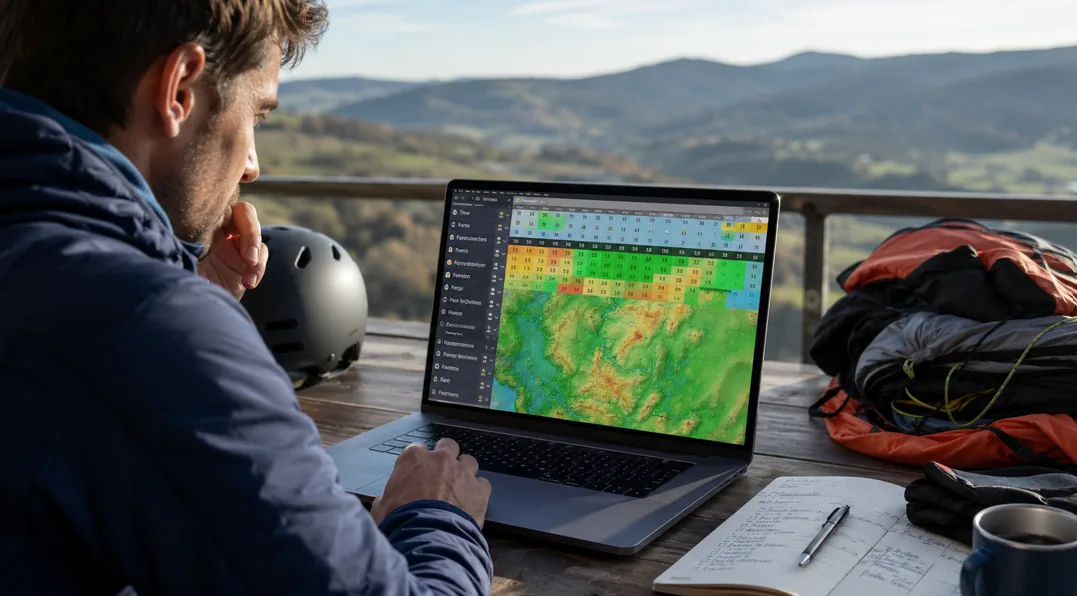
Weather reading is the skill that separates pilots who fly XC consistently from pilots who have a variometer and ambition but not yet the knowledge to use conditions correctly. The tools available to XC paragliding pilots today are remarkable — free, highly accurate, purpose-built for free-flight decision making. This guide explains which tools to use, in which order, and exactly what to look for in each one. There are also notes specifically for flying in Portugal, where the Atlantic sea breeze creates patterns that standard forecast models sometimes misread.
Three Scales of XC Planning
Effective weather planning for paragliding happens at three temporal scales, and the right tool changes at each one:
- 3–5 days out — synoptic scale. Is the general pattern favourable? Check the 850 hPa wind on Windy or similar tools. A high-pressure system centred over Iberia with light gradient winds is the foundation of good XC. Frontal systems, strong pressure gradients, or troughs moving in are disqualifying for most conditions regardless of lower-altitude details.
- 1–2 days out — site-scale planning. This is where Meteo Parapente and Skysight shine. You are checking thermal strength, cloudbase height, trigger time, cross-country potential, and whether the sea breeze or gradient wind will dominate at your site.
- Morning of the flight — go/no-go. A final check on Windy for surface winds, a re-read of the morning-updated Meteo Parapente, and your own assessment of conditions on the ground at the site.
Tool 1 — Meteo Parapente
Meteo Parapente is the most widely used paragliding forecast tool in Europe, and for good reason. It runs a high-resolution atmospheric model specifically tuned for free-flight parameters and presents the output in a colour-coded grid format that is quick to read at a glance.
Key parameters to check:
- Thermal strength — rated in m/s average climb rate. Anything below 0.5 m/s is weak and likely frustrating; 1–2 m/s is comfortably XC-flyable; above 3 m/s the air is vigorous and requires experience and respect.
- Cloudbase height (BL height) — the ceiling of the convective boundary layer. This is the practical altitude limit for thermal flying on that day. Higher cloudbase = more altitude to work with, longer glides between climbs, greater XC potential. In summer in Portugal's interior, cloudbase can reach 2,500–3,500m on strong days.
- Trigger temperature — the surface temperature at which thermals will begin forming. On days with a high trigger temperature, thermals start later in the morning. This affects your launch timing.
- XC potential (XC index) — Meteo Parapente's composite score for cross-country conditions. Useful for quick day comparison but should not be used alone — a high XC index with excessively strong thermals is still a decision requiring judgement, not a green light.
- Wind at various levels — check wind at 850 hPa (~1,500m altitude) and 700 hPa (~3,000m). Strong gradient wind at altitude can kill thermalling potential even when surface conditions look inviting.
Tool 2 — Skysight
Skysight is a premium (subscription) XC forecast platform originally developed for glider pilots and adopted extensively by the paragliding community. Its key advantages over Meteo Parapente are the cross-section view, the cloud depth visualisation, and the XC potential route overlay.
The cross-section view is the feature that justifies the subscription for serious XC pilots. It lets you draw a line along your intended route and see a vertical profile of the atmosphere along that track — where thermals top out, where there are dry gaps in the convection, where over-development is likely. This allows route planning that is qualitatively different from a flat map view.
What to look for on Skysight:
- Cloudbase and cloud depth along your planned route — thick cloud columns can indicate over-development risk
- Thermal top height vs. trigger height — a large gap between these values indicates strong, organised convection
- Boundary layer wind direction at altitude — helps identify where convergence lines may form (excellent XC lift sources)
- The XC task potential overlay — shows the geographic areas of highest XC potential for that day
Tool 3 — Windy
Windy is a general-purpose weather visualisation tool that happens to be extremely useful for paragliding. Its main value for XC pilots is in the 850 hPa wind layer view — the approximate altitude of the boundary layer on a typical paragliding day — and the surface wind forecast for launch timing.
For site-specific wind direction checks, set Windy to show wind at 925 hPa (roughly 700m above sea level) and 850 hPa. This shows the gradient-level wind that will influence upper-level drift during thermals, which in turn determines your XC direction and how aggressively you can push upwind versus downwind of track.
Windy's free-tier accuracy is excellent for 24–48 hour forecasts and degrades to general guidance beyond 5 days. Use it daily, not weekly.
Tool 4 — Paraglidable
Paraglidable.com overlays Meteo Parapente data on an interactive map of paragliding sites across Europe, including Portugal. Its key feature is that you can click on a specific hill or flying site and immediately see the XC potential parameters for that exact location, cross-referenced with the site's typical flight directions and known flight profiles from the community.
For pilots flying unfamiliar Portuguese sites during coaching week or during the Iberian XC Tour, Paraglidable is invaluable for quick site-to-site comparison — "Is Castelo Branco better than Setúbal today?" becomes a two-click question.
Reading the Emagram
The emagram (or skew-T log-P diagram) is the atmospheric sounding graph that atmospheric scientists use to visualise temperature and humidity at every altitude up to the stratosphere. For paragliding pilots, it is the most information-dense weather tool available — and the most intimidating to learn. Once you can read it, it replaces the need for multiple separate checks.
What you need to read on the emagram:
- The temperature curve (T) — plotted on the skewed axis, this shows ambient air temperature at each pressure level. Read it from bottom (surface) to top.
- The dewpoint curve (Td) — plotted beside the T curve. Where the two curves are close together, the air is humid. Where they diverge, the air is dry. The altitude where they meet is the theoretical cloudbase height for convective clouds (cumulus).
- The DALR (Dry Adiabatic Lapse Rate) line — a line plotted from the surface temperature at the same slope as the DALR. Where this line crosses the T curve above the surface, that altitude is the convective temperature limit — the top of the thermal boundary layer.
- Thermal tops — the altitude where the DALR line from surface temperature intersects the T curve. This is your practical ceiling for thermal flying on that day.
The CAPE index (Convective Available Potential Energy) summarises the total thermal energy available in the atmosphere. Values above 200 J/kg indicate a day with meaningful convective energy. Values above 1,000 J/kg can indicate thunderstorm risk and require careful monitoring of cloud development.
| CAPE Value | Convective Interpretation | XC Implication |
|---|---|---|
| 0–100 J/kg | Weak or absent convection | Coastal ridge/sea breeze only |
| 100–500 J/kg | Moderate thermals | Good XC for intermediate pilots |
| 500–1,500 J/kg | Strong thermals | Excellent XC; requires experience |
| 1,500+ J/kg | Risk of over-development | Monitor cloud development closely; go early |
Portugal-Specific Forecast Notes
Flying in Portugal requires awareness of two atmospheric patterns that don't appear as clearly in central European forecast models:
The Nortada (Atlantic sea breeze): Along the Costa Azul and particularly at Sesimbra and Cabo Espichel, the prevailing Atlantic northerly establishes a consistent ridge-lift system from spring through autumn. On days when the synoptic gradient produces north to northwest surface winds of 12–25 km/h, coastal ridge soaring is excellent regardless of what the thermal index shows. The Nortada and thermals operate on different schedules — the ridge often fires in the morning before thermals develop inland. This two-phase flying day is Portugal's signature coastal condition.
The sea-breeze front inland: On calm mornings, a thermal-driven sea breeze develops along the coast and pushes inland during the afternoon. The front between the cooler marine air and the warmer inland air creates a convergence line that can produce exceptional lift — sometimes 5+ m/s — but also marks the boundary beyond which conditions deteriorate for coastal pilots. Knowing where this line is on any given afternoon is the key skill for coastal Portugal XC.
On a typical coaching week morning: 6:30 AM — check Windy surface wind and 850hPa layer. 7:00 AM — open Meteo Parapente for the day's updated run; check thermal strength, cloudbase, and XC index for Sesimbra and the planned route. 7:30 AM — if the day looks flyable, check Skysight cross-section for the route to confirm no anomalous over-development risk. At launch — observe actual conditions (cloud development rate, surface wind, cumulus form) and make a final go/no-go that overrides the forecast if observation and forecast disagree. The forecast is a probability map. The sky is the ground truth.
Common Mistakes New XC Pilots Make with Forecasts
- Trusting the XC index number without reading the parameters behind it — a high XC index with 35 km/h gradient wind at 1,500m is not a flyable day for most pilots
- Checking the forecast once the evening before and not updating it — morning model runs often significantly revise the previous evening's output
- Ignoring cloud development rate at the site — a forecast showing moderate conditions can be overridden by fast-developing cumulus on the ground
- Not accounting for site-specific effects — Portugal's coast amplifies or dampens forecast conditions depending on wind direction, which generic model output doesn't fully capture
- Launching because the forecast is good, not because the conditions are good — the forecast and the conditions are not the same thing