


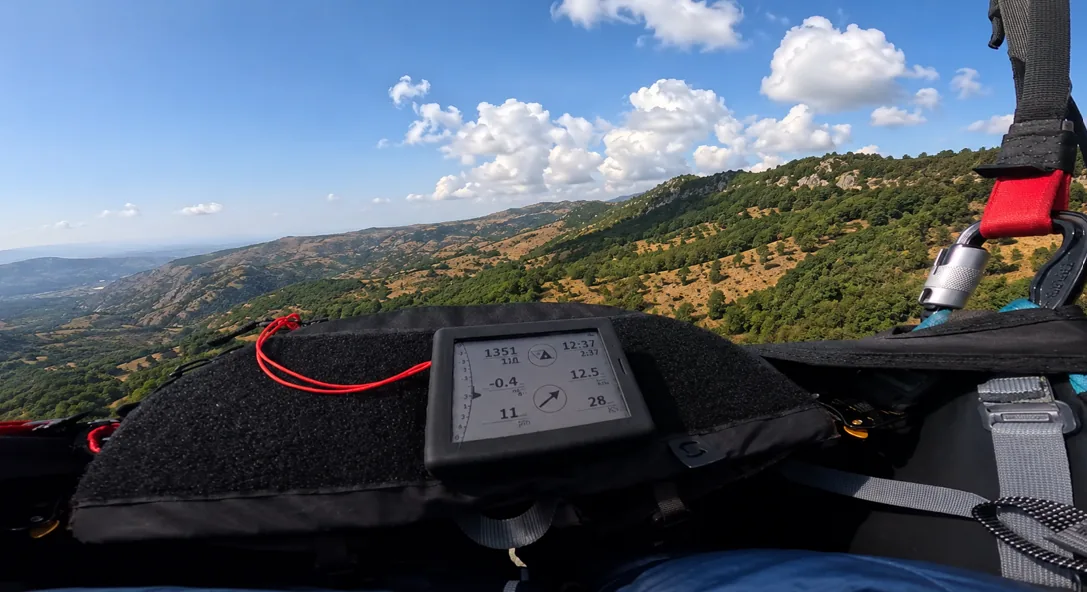
A variometer is the first instrument a paragliding pilot should own. Not a GPS, not a navigation tablet, not live-tracking — a variometer. It tells you whether you are climbing or sinking, and at what rate, in real time. That single piece of information transforms thermal flying from guesswork into craft. This guide covers the 4 best units available in 2025, with honest recommendations for each pilot profile, and a clear-eyed answer to the "what do I actually need right now?" question.
What a Variometer Does — and Why It Matters
A variometer (vario) measures vertical speed using a highly sensitive barometric pressure sensor. As you climb, air pressure drops; as you sink, it rises. A modern vario detects these changes with enough resolution to register a climb rate as gentle as 0.1 m/s — a rise so slow a human body cannot feel it without an instrument.
The output is delivered two ways: audibly (a rising beep tone when climbing, a deeper tone when sinking) and visually (a number and bar graph on a screen, if the unit has one). The audio output is the critical channel. Flying is a full-attention activity — good pilots develop the habit of listening to the vario while keeping their eyes on the wing, the air around them, and the terrain. Units with clear, responsive audio are therefore more valuable in the air than units with beautiful screens.
Unit 1 — Syride Air 3
The best all-round vario for most pilots
The Air 3 from French manufacturer Syride has become the default recommendation for pilots from beginner through intermediate cross-country. It is a dedicated audio variometer with a small graphic display, exceptional sensitivity, and a simple user interface that does not distract from flying.
- Weight: ~120g with battery
- Screen: small e-ink-style display showing altitude, climb rate, flight time
- Battery: 20+ hours flight time on a single charge
- GPS: no built-in GPS (connects to optional Bluetooth GPS module for track logging)
- Audio: excellent sensitivity; clearly distinguishable climb and sink tones; volume and tone curve are user-adjustable
- Price: ~€400
The Air 3's audio response is among the fastest and most musical in the class. In broken, punchy thermals — the kind you encounter at Sesimbra in strong sea-breeze conditions or inland on thermic afternoons — the responsiveness of the audio keeps you centred in weak columns that a slower-responding unit would lose. The interface is simple enough that pilots on day 3 of their first coaching week can use it effectively without a manual.
Unit 2 — XCTracer Maxx
The minimalist for pilots who hate clutter
The XCTracer Maxx from Swiss manufacturer XCTracer is the leanest vario on the market. It weighs approximately 60g — less than most smartphones — clips to your riser or chest strap, and delivers audio variometry via a small speaker or Bluetooth to earbuds or a helmet speaker. There is no screen.
- Weight: ~60g
- Screen: none — audio output only (or Bluetooth to earbuds/smartphone)
- Battery: 12–15 hours flight time
- GPS: no (pairs with smartphone app via Bluetooth for navigation and track logging)
- Audio: exceptional; widely regarded as the most acoustically responsive vario on the market
- Price: ~€320–350
The XCTracer is popular with pilots who prefer a minimalist setup and are comfortable using a smartphone app (XCTrack or Thermal Assistant) for navigation and visual data. For long XC flights where instrument setup on the riser must be lightweight and aerodynamically clean, the Maxx is hard to beat. Its limitation is that it relies on a separate device for visual data — which is a deliberate design choice, not an oversight.
Unit 3 — Skytraxx 5
The premium all-in-one for serious XC pilots
The Skytraxx 5 from German manufacturer Skytraxx is a full GPS navigation computer with an integrated high-quality variometer, live tracking, airspace warning, and a colour touchscreen — all in one compact unit.
- Weight: ~230g
- Screen: 3.5-inch colour touchscreen; readable in direct sunlight with auto-brightness
- Battery: 14–18 hours flight time
- GPS: integrated GPS with moving map, waypoints, XC task management, airspace display
- Live tracking: integrated — flight visible on Skytraxx Live and shareable with others in real time
- Audio: strong, clear tones; thermal assistant mode highlights thermal centre direction
- Price: ~€700–900 depending on SIM option for tracking
The Skytraxx 5 is what most serious XC pilots carrying one unit want. The moving map with airspace alerts removes a cognitive load that can otherwise cause pilots to stray into restricted zones. The live tracking is genuinely useful for solo XC flights where someone on the ground monitors your position. The variometer quality is excellent — not quite as audiophile-tuned as the XCTracer, but more than adequate for all practical flying including XC competition.
Unit 4 — Oudie N (Naviter)
The navigation specialist for XC route planning
The Oudie N from Slovenian manufacturer Naviter is a tablet-format GPS navigation device designed primarily for cross-country route planning and competition flying. The variometer functionality is secondary to the navigation capability.
- Weight: ~320g
- Screen: 5-inch colour display; high-resolution XC mapping
- Battery: 10–14 hours flight time
- GPS: full XC navigation with task management, airspace, weather overlay via companion app
- Navigation: integrates with SeeYou cloud for pre-flight planning, task upload, and post-flight analysis
- Price: ~€800–1,200
The Oudie N is favoured by competition pilots and high-XC-distance pilots who plan complex multi-waypoint flights and want detailed analysis afterwards. For recreational pilots doing day XC flights from a fixed site, the Skytraxx 5 at a lower price point typically provides equivalent or better value.
Comparison Table
| Unit | Weight | Screen | GPS | Tracking | Price | Best for |
|---|---|---|---|---|---|---|
| Syride Air 3 | ~120g | Small display | Optional BT | Via app | ~€400 | 0–200 hrs, coaching, thermalling |
| XCTracer Maxx | ~60g | None | Via phone | Via app | ~€330 | Minimalist pilots, light setups |
| Skytraxx 5 | ~230g | 3.5" colour | Integrated | Integrated | ~€800 | XC pilots wanting one unit |
| Oudie N | ~320g | 5" colour | Integrated | Via SIM | ~€1,000 | Competition / long-distance XC |
What Behrooz Recommends by Pilot Level
First instrument purchase (any level): Buy the Syride Air 3 or XCTracer Maxx. Both deliver exceptional variometry at the budget that makes sense before you know what flying discipline you'll commit to. The Air 3 is easier to learn on due to its display; the XCTracer is better if you already use a smartphone and want the lightest possible rig.
100+ hours, flying XC regularly: Pair your audio vario with the Skytraxx 5, or replace the audio vario with it entirely if you want a consolidated setup. The integrated airspace warnings alone pay for the upgrade several times over.
Competition or 200+ km XC goals: The Oudie N makes sense at this level, where task management and post-flight analysis become meaningful parts of your training.
On all coaching weeks with Fly with Behrooz, radios are provided. You do not need to bring or buy a radio for the week. The first personal instrument worth buying is a variometer — not a radio, not a GPS, and certainly not a full navigation suite. Get the vario first, fly at least 100 hours with it, and you will know exactly what you want next.
What You Don't Need as a Beginner
The paragliding instrument market is full of sophisticated products that are genuinely excellent — and genuinely wasted on a pilot with fewer than 50 hours. A thermal assistant mode is most useful when you understand thermal structure well enough to interpret what it is showing. A moving map is most useful when you are flying XC routes where knowing your position matters. Airspace warnings are most useful in complex airspace, not at a single familiar site.
The most effective instrument for a new pilot is a responsive, reliable audio variometer and the experience of listening to it over hundreds of flights. The audio teaches you to feel where the lift is before any screen can show you.