


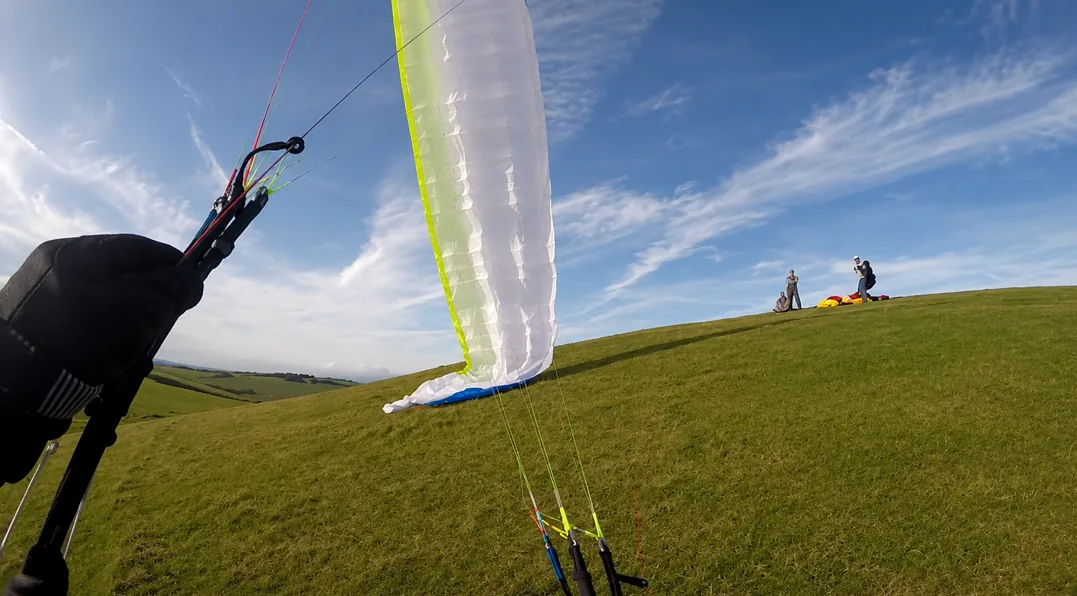
There's a moment every coastal pilot knows: you're on the launch, the wind is reading 22 km/h, and your instinct says a reverse launch is going to go wrong. The wing will surge hard overhead, you'll be fighting it at the critical moment when you need to pivot and run, and the limited run-out at a cliff site turns a controllable situation into a dangerous one. The cobra launch — also called the A-frame or controlled inflation technique — exists specifically for this situation, and it is one of the most valuable techniques any coastal or mountain pilot can add to their repertoire.
What the Cobra Launch Is
The cobra launch is a strong-wind inflation technique where the pilot faces the wing throughout the inflation phase, walking forward while controlling the wing's rise with A-risers (to initiate lift) and C-risers (to moderate the surge). Rather than the wing flying up rapidly overhead as in a conventional reverse launch, it rises slowly into an inverted V — the A-frame shape — where it stabilises directly above the pilot before the pivot and run.
The name comes from the shape: a cobra rising from a basket, slow and controlled, head directly above the handler. It's an apt image. The technique turns the wing's tendency to surge in strong wind from a hazard into a controllable, predictable sequence.
When to Use It: Reading the Conditions
The cobra launch is the right choice when wind speed is roughly between 15 and 30+ km/h and a conventional reverse launch risks the wing overshooting overhead or surging beyond the pilot's control. More precisely, use it when:
- Wind speed is consistently above 18 km/h and gusty — the wing rises too fast in a reverse layout for clean control
- The launch has limited run-out below — any cliff or steep slope site where an overshoot puts you in the air before you're ready
- The wind is slightly cross — making a reverse launch direction unpredictable
- You've done a test kite at the site and the wing feels overpowered in reverse
At Sesimbra's coastal ridge sites and the clifftop launch at the Serra da Arrábida, 20–28 km/h conditions are entirely normal throughout the year. The cobra launch is not an emergency technique for exceptional conditions — it is a standard tool that any pilot flying Atlantic coastal sites should be practised and comfortable with.
Step-by-Step: The Cobra Sequence
Step 1 — Layout
Lay the wing directly downwind of your intended launch direction, spread cleanly with all cells open. Check lines carefully: no tangles, both brake handles accessible and positioned where your hands will find them after the pivot. The A-risers should be identified and separated — you'll be reaching for the inner A-risers specifically (the central A lines, not the outer A's, which create tip steering you don't want at this stage).
Step 2 — Position and grip
Stand facing the wing, upwind side, with the wing's leading edge between you and the launch direction. Left hand holds the inner A-risers — these will initiate the inflation when you walk forward. Right hand holds the C-risers — these moderate the surge and prevent the wing from overshooting overhead. The grip on the C-risers is the critical variable: too tight and the wing won't rise at all; too light and it overshoots. You want gentle, responsive contact, not a death grip.
Step 3 — Walk forward slowly
Begin walking toward the wing, applying gentle forward pressure on the A-risers. The wing's leading edge will begin to open and fill. Do not pull hard — you are not hauling the wing up, you are allowing it to rise under the wind pressure as you reduce the distance between you and it. The C-risers in your right hand provide drag that keeps the wing from overshooting: as the wing rises, maintain light upward resistance on the C-risers.
The wing should rise at a controlled pace, both wingtips rising evenly. If one tip lags, apply slightly more A on that side. If the whole wing is coming up too fast, increase C-riser resistance slightly.
Step 4 — The A-frame phase
The wing is now overhead in the inverted V shape — approximately 60—€70— from horizontal, with both wingtips lower than the central section. This is the A-frame stability point: the wing is inflated, pressurised, and stabilised. It is not fully overhead at 90— — that would be the overshoot position. Hold the A-frame for a moment. Feel the wing's pressure through the risers. Both sides should feel even. If one side feels heavy, it means the wing is beginning to bank that way — correct with a small A-riser adjustment before pivoting.
The A-frame is a natural equilibrium point in strong wind: the wing wants to stay there. You have several seconds — sometimes five to eight — to assess and decide. Use them.
Step 5 — The pivot
Once the A-frame is stable and both risers feel even, execute the pivot: turn 180— quickly and cleanly toward the launch direction. As you turn, the C-risers transfer to your other hand and you collect the brake handles in the normal flying position. The sequence should be fast — hesitation during the pivot allows the wing to start moving forward or backward. Commit to the turn.
Step 6 — Run and launch
You are now facing the launch with the wing overhead in normal flying position. Apply brake if the wing surges forward past the 12 o'clock position. Run toward the edge. Launch procedure from here is identical to a normal forward launch: accelerate, feel the lift, release the ground.
What Each Hand Is Doing
The cognitive load of the cobra comes from managing two different riser inputs simultaneously while walking. Break it down into simple sensations:
- A-risers (initiating hand) — pull gently forward and slightly downward. Think of it as a slow invitation rather than a command. The wing responds to this pressure by opening and filling.
- C-risers (moderating hand) — provide gentle upward resistance. Think of it as holding a dog on a lead that's pulling toward you — enough tension to slow it, not enough to stop it entirely.
- Eyes — watch the wingtips. The A-frame is symmetric when both tips are at the same height. Any asymmetry needs correction before you pivot.
The Cobra versus the Reverse Launch
The distinction is worth stating clearly because the two techniques are often confused:
In a reverse launch, the pilot faces the wing throughout — they walk backward to tension the lines and the wing rises, then pivot to face the launch. The wing comes up rapidly and must be controlled with brakes as it rises. In light-to-moderate wind (8–15 km/h) this is clean and efficient. In stronger wind, the speed of the rise makes control harder and the overshoot risk increases.
In a cobra launch, the pilot also faces the wing — but walks forward toward it during inflation, using A-risers to initiate the rise and C-risers to control the speed. The wing rises slowly into the A-frame position. The pivot happens from A-frame stability rather than from a fast-rising wing overhead. The cobra is safer in strong wind specifically because the inflation rate is slower and more controlled.
Common Errors and How to Avoid Them
- Letting the A-frame collapse forward — if you walk too far toward the wing after it reaches A-frame, the pressure differential reverses and the wing collapses forward. Stop walking when the A-frame stabilises.
- Pivoting too slowly — a sluggish pivot allows the wing to move. The pivot is a single committed rotation, not a gradual turn. Hesitation is the enemy.
- Gripping C-risers too hard — the wing won't rise at all, or will stall in a half-inflated state with cells still collapsed. Light, responsive contact is what works.
- Not watching the wingtips — both tips must be at the same height when you pivot. An asymmetric A-frame means one side is more inflated than the other — launching from this position risks a post-launch asymmetric surge.
How I Teach It at Costa Caparica and Fonte da Telha
The dunes at Costa Caparica and Fonte da Telha — roughly 15 minutes north of Sesimbra on the Atlantic coast — are the best ground handling sites I know for learning the cobra systematically. The Atlantic breeze is consistent, the terrain is flat, there is no consequence from any direction, and the dune gradient means you can do walk-up launches in both light and strong winds on the same morning by simply moving up or down the face.
During ground handling weeks, I introduce the cobra in three phases:
- Light wind (8–12 km/h) — learning the riser feel, practising the A-frame hold time, practising the pivot alone without running. Many repetitions.
- Moderate wind (14–18 km/h) — full cobra sequence with runs, building the automatic motor pattern. This is where most pilots find the technique clicks.
- Strong wind (22–28 km/h) — the conditions the technique was designed for. By this point the sequence is automatic and the stronger wind simply makes the A-frame phase feel more solid.
A pilot who has done 30 cobra repetitions across those three phases will arrive at any Atlantic coastal site in strong conditions with complete confidence. It's a technique that stays with you — once the motor pattern is in muscle memory, you don't lose it.
Check that your C-riser loops are large enough to grip comfortably with a gloved hand — some older harnesses have tight C-riser loops that make the technique harder to execute cleanly. Your brake handles should be positioned before you step into the launch position: reaching for them after the pivot costs time. A smooth, pre-positioned brake setup is worth an extra 30 seconds of pre-flight organisation.