


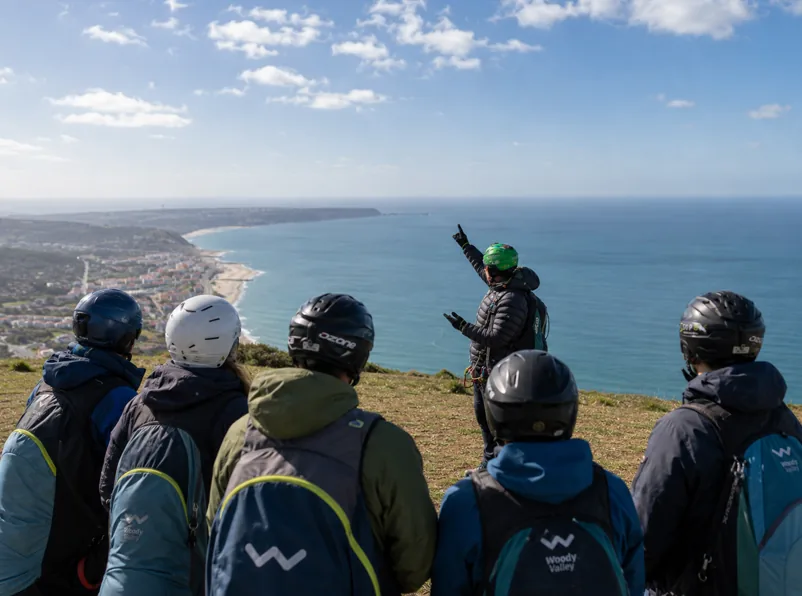
Coastal paragliding is among the most enjoyable forms of flying — long sessions, consistent lift, spectacular scenery, and the particular pleasure of soaring above the Atlantic. It is also a setting where the specific hazards are different from inland flying, more concentrated, and less forgiving of the wrong response. Pilots who come to Sesimbra from inland backgrounds need to reorient their awareness around a new set of risks. This guide explains them in detail — not to make coastal flying seem dangerous, but to make it as safe as it can be.
The Fundamental Difference — Terrain That Cannot Move
In inland flying, the primary consequence of a mistake is usually a field landing — not ideal, but typically non-catastrophic. In coastal flying, the terrain behind and below you is a cliff face, and below the cliff is the sea. There is no safe emergency landing option at the base of a Portuguese coastal cliff. This changes the priority ranking of everything else in the flight.
Every rule and technique in coastal flying is designed around a single underlying principle: maintain your position in front of and above the cliff top at all times. Everything that follows is a mechanism for achieving that.
The Rotor Zone — The Most Serious Coastal Hazard
When wind strikes a cliff and flows over the top, it separates on the leeward side (behind the cliff) and forms a recirculating vortex called the rotor zone. This is a region of severely turbulent, reversed-direction air that extends from the cliff top downward and for some distance behind the ridge.
Key facts about the rotor zone:
- It is invisible — there are no visual cues to show you where it starts
- Its size and intensity scale with wind speed — stronger wind means a larger and more violent rotor
- Entering the rotor with a paraglider can cause immediate, severe collapses from which recovery at low altitude is very difficult
- The rotor zone at the foot of a high cliff (like Sesimbra's 80+ metre face) is not survivable in the event of a full collapse
Never fly behind the ridge line. Not once, not briefly, not to explore. The rotor zone behind the cliff is the mechanism behind the vast majority of serious coastal accidents. This rule is not a guideline — it is the non-negotiable boundary of the safe flying environment. We reinforce this on every session and it is the first thing new coastal pilots are assessed on.
Wind Gradient Near Cliffs
Wind speed changes significantly with height, and this effect is amplified near terrain. The phenomenon is called wind gradient: at ground level, wind is slowed by friction with the surface; at altitude, it flows freely. The steeper the gradient, the more rapidly wind speed drops as you descend.
Near a coastal cliff, the gradient is more pronounced than in open airspace because the cliff itself acts as an obstacle that distorts the flow locally. Practically, this means:
- A pilot at 100 metres above the cliff top may be flying in 20 km/h of wind
- At 20 metres above the cliff top, the wind may be 14–16 km/h
- At cliff-top level, it may be 10–12 km/h
- At the cliff face itself, there is a thin layer of almost no flow
The practical consequence: if you descend too low while soaring, you risk losing the penetration speed needed to maintain your position in front of the cliff. The wind slows beneath you, your apparent airspeed decreases, and you may find yourself being pushed back toward the ridge by the reduced lift. This is the mechanism behind what pilots call "getting sucked back" — not a mystery, but a predictable physical result of flying too low in the wind gradient.
The fix is simple: maintain height above the cliff top, particularly when the wind is light or when it freshens (gust effects compress the gradient further).
Sea Breeze Interactions and Rapid Condition Changes
The Atlantic coastal environment produces condition changes that can be much faster than inland changes. The main mechanisms:
Sea breeze development
On calm mornings, a thermal sea breeze develops as land heats faster than the sea. This can cause the surface wind to shift from calm (or light offshore) to a sustained onshore flow within 20–30 minutes. If you're in the air during this transition, you'll experience a wind direction change and a rapid increase in wind speed. This is generally manageable if you know it's coming — it becomes a problem if it catches you off-guard or if you're already low.
Wind speed increases with the Nortada
The Atlantic Nortada is not a perfectly steady wind — it oscillates in cycles. Wind speed can go from 14 km/h to 26 km/h over 15–20 minutes as a pulse of stronger flow arrives from the north. These increases are visible in the Windguru forecast as a building trend, but the timing of individual pulses is not forecast accurately at short range. Flying conservatively — with more height margin than you think you need — is the correct response to this unpredictability.
Wind direction shifts
If the wind direction shifts by more than 30–35— away from the cliff's aspect, the lift zone weakens, the rotor may shift position, and the safe flying window narrows. Wind direction shifts can happen as frontal systems approach or as the sea breeze rotates through the day. Watching the wind direction indicator (or your glider's response to direction changes in the air) is part of continuous monitoring on a coastal flight.
| Condition change | What to do | Why |
|---|---|---|
| Wind speed building (>28 km/h) | Gain height, move to the outer edge of the lift zone, plan to land | Higher wind = larger rotor zone, stronger gusts, reduced penetration margin |
| Wind speed dropping (<8 km/h) | Move closer to the cliff to stay in the narrowing lift zone, land if lift disappears | Light wind = thin lift band, no rotor concern but less power to recover from mistakes |
| Wind direction shifting | Watch glider response, move to a section of cliff that still faces into wind, land if shift is large | Cross-wind reduces lift quality and can create turbulence from cliff-edge vortices |
| Sudden gust (feels like surge forward) | Apply light brake to damp pitch-up, maintain altitude, wait for gust to pass | Gusts increase lift temporarily — the passive response is to float up, not surge forward into potential collapse |
| Lull after gust (feels like sink) | Release brakes to keep speed up, fly forward to maintain position | Lulls reduce lift and penetration — passive response risks drift back |
Landing in Coastal Conditions
Landing from a coastal soaring session is the moment when most skill gaps reveal themselves. The approach must be planned for wind-effect: coming in to the launch/landing area from an upwind angle, accounting for the wind gradient during descent, and not committing to a final approach from over the cliff where there is no go-around option.
The standard coastal landing sequence at Sesimbra:
- Pull well away from the cliff to get outside the main lift band
- Assess wind speed and direction from a safe altitude
- Enter the landing approach from the upwind side of the landing area
- Fly a controlled approach path, not a straight-in from over the sea
- Flare fully and step off cleanly — do not half-flare and stall
On the first session of any coastal week, we practice the approach before the soaring session, not after. Once the approach pattern is clear, the session is much more relaxed because the exit is known.
What to Do If Conditions Deteriorate Mid-Flight
The most important decision in coastal flying is timing the land call correctly. The wrong tendency is to stay in the air until you're forced to land — in coastal conditions, waiting too long removes your options. The right tendency is to land while you still have comfortable height and conditions are still manageable.
Signs that you should begin the landing sequence immediately:
- Wind speed building beyond your comfortable limit (typically 25–28 km/h for intermediate pilots)
- Glider becoming difficult to handle actively — more collapses, stronger surges
- Wind direction shifting more than 20–25— from the cliff's ideal aspect
- Increasing turbulence in the lift band (usually a sign of more wind to come)
- Your concentration starting to slip due to fatigue
Fatigue deserves emphasis: three hours of active coastal soaring is more demanding than it looks from the ground. An experienced pilot who is tired makes worse decisions and has slower reactions. Landing before you're exhausted is a deliberate choice, not a concession.
Why Coached Coastal Flying Is the Right Starting Point
The risks described above are all manageable — but only if you know about them, can identify the signals in real time, and have practised the correct responses. A pilot flying a coastal site for the first time without guidance has no sensory library for "this is what the wind gradient feels like when I'm getting low" or "this gust pattern means conditions are building." They are flying on guesswork.
What a coached week at Sesimbra provides is the systematic development of exactly that sensory library, in a progression from easier to more demanding conditions, with a coach in radio contact who can call you down if a situation is developing you haven't spotted yet. By the end of the week, you have the reference points to assess any coastal site you visit independently in the future.
Frequently Asked Questions
Is the sea itself a hazard if I land in it?
Landing in the sea is not a planned outcome at Sesimbra's main soaring sites — the approach and landing areas are on land. At the base of the cliff, the combination of rocks and breaking swell makes this a serious hazard. This is precisely why staying in front of the cliff is so important: a controlled coastal soaring session never puts a pilot in a position where a sea landing becomes likely. We fly to make it impossible to end up there, not to manage the consequences if you do.
What happens if my glider collapses near the cliff?
A collapse close to the cliff is the most serious event in coastal flying. The correct response is immediate active pilot intervention — counterbrake on the open side to prevent spiral entry, pump the collapsed side to recover, and simultaneously fly forward (away from the cliff) if still in control. This is why active piloting technique is the first and most practiced skill in any coastal session with me. Pilots who rely on the glider to self-recover (passive flying) are not appropriate for coastal sites. If you are uncertain whether you react actively to collapses, tell me before the first flight.
How do you know when to call pilots down for the day?
I monitor Windguru, the real-time wind speed display at the site, and what I can observe from the air and ground. The call to land is made when wind speed trends upward past the comfort threshold for the group's ability level, when direction shifts significantly, or when fatigue is visibly affecting pilot responses. In practice I tend to call it before pilots feel ready to come down — the conservative call is always the right one. The rule I follow: if I'm uncertain whether conditions are safe to continue, they're not safe to continue.
Learn coastal flying the right way
Every skill in this guide is built systematically across a Coastal Soaring Week at Sesimbra — in progression, with a radio, with a coach who has flown this site in every condition. Your first coastal sessions should be with someone who knows the site cold.