


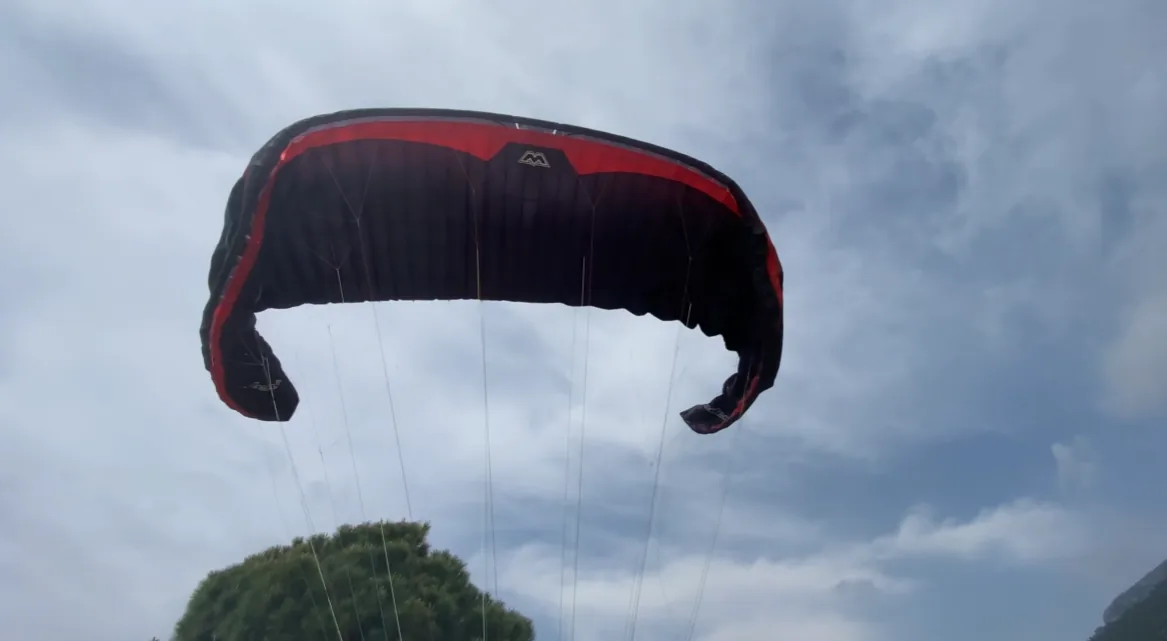
Big ears are the first active descent technique every pilot should own — before spirals, before B-line stalls, before any of the more dramatic options. They are gentle, reversible, certified as safe on every EN-certified wing, and available in conditions where other techniques would be inappropriate. Flying coastal Portugal, where the nortada can push you up the ridge faster than you want to climb, a confident big-ears technique is as useful as a good turn.
What Big Ears Do
Big ears fold the outer cells of the wing inward by pulling the outer A-risers. The folded tips no longer generate lift — they create drag instead. The combined effect is a modest increase in sink rate (typically +1.5 to +2.5 m/s depending on wing and riser pull) and a small increase in forward speed, with no loss of overall glider control and no meaningful change in the wing's pitch stability. The glider continues to fly forward in a stable and comfortable configuration.
Big ears are not a radical emergency technique. They are a routine flight management tool used by experienced pilots on every flying day — to descend from unwanted height over a ridge, to avoid airspace ceilings, to control altitude while waiting for a thermal cycle, or simply to come down more efficiently at the end of a flight.
How to Apply Big Ears
The technique varies slightly between harnesses and risers, but the standard method is:
- Identify the outer A-risers — these connect to the outermost cells of the leading edge and are usually clearly marked or colour-coded by the manufacturer. On split-A risers (where the A-risers divide into two attachment points), you pull only the outer branch.
- Reach up with both hands simultaneously and take hold of the outer A-risers, releasing the brakes. Your brakes will hang free.
- Pull both risers down evenly and smoothly until the outer cells fold over. The wing narrows visibly and the folded tips may flutter. This is normal.
- To steer in big ears, shift your body weight in the harness — do not try to use the brakes for steering, as pulling one brake while in big ears can cause an asymmetric opening and a turn you did not plan.
- To release, simply let go of the A-risers. The outer cells will re-inflate immediately on most modern EN-B and EN-C gliders. If they do not, one or two gentle pumps on the brakes will encourage re-inflation. Do not tug the A-risers more aggressively.
Applying speed bar while flying big ears significantly increases the sink rate — from around +2 m/s in big ears alone to +3 to +4 m/s with speed bar fully applied. This is the most efficient descent technique available on an EN-B without entering a spiral or B-line stall. The combination keeps the glider pressurised and stable, increases penetration into headwinds, and is appropriate in moderate turbulence where other techniques would not be. Practise it in calm air first: apply big ears, then add speed bar progressively. Release speed bar before releasing big ears.
Big Ears on the Sesimbra Ridge
The coastal ridge at Sesimbra generates consistent ridge lift in nortada conditions. On a strong nortada day, the lift band extends 50–100 m above the ridge — plenty of vertical space for enjoying the coastal soaring experience. But on lighter days, or when cloud base is lower, you may find yourself climbing past a comfortable altitude without any intention to do so. Big ears are the standard response.
Applied over the ridge, big ears give you control of your altitude without requiring you to leave the lift band by flying out over the sea or back over the land. You continue soaring at a controlled height while the technique keeps you in the window. Release, climb, apply again — the tool becomes second nature within an afternoon of practice.
The broader context of coastal flying safety includes understanding where not to apply big ears — in very turbulent conditions close to the ridge, or when you are already low enough that any manoeuvre reduces your recovery margin. At height with a stable ridge, big ears are entirely appropriate. Below ridge height in rotor, nothing active is better than flying conservatively on the brakes.
Common Mistakes
Using the brakes for steering in big ears
The most common error. With the outer cells folded, the wing is already operating at a different pressure distribution. Pulling one brake to turn can cause that side to open at the wrong moment or, worse, trigger an asymmetric collapse. Steer with weight shift only.
Pulling the full A-riser instead of the outer branch
On split-A risers, pulling the full riser (both branches together) results in a full leading edge collapse — a front tuck — not big ears. Always identify and isolate the outer branch before flying. Check your riser system on the ground before the flight if you are unfamiliar with it.
Not combining with speed bar
Many pilots apply big ears and then wait for the technique to descend them. Adding speed bar doubles the effectiveness of the descent and keeps the glider flying more actively. If you need to lose height efficiently, do both. If you only need a little height loss, big ears alone is fine.
When Not to Use Big Ears
Big ears are not the right tool in every situation:
- In turbulence close to terrain — any reduction in your margin for control inputs is unacceptable near the ground or ridge.
- When already very low — the time to apply descent techniques is when you have altitude to spare, not when you need it.
- In strong rotor zones — behind a hill or in mechanical turbulence, the glider needs full authority; do not restrict your ability to respond to collapses.
- As a substitute for a spiral when you need rapid descent — big ears descend at 2–4 m/s. If you need to get down from 1,000 m in a hurry, a controlled spiral is the faster tool (learned properly at an XC coaching week with supervision).