


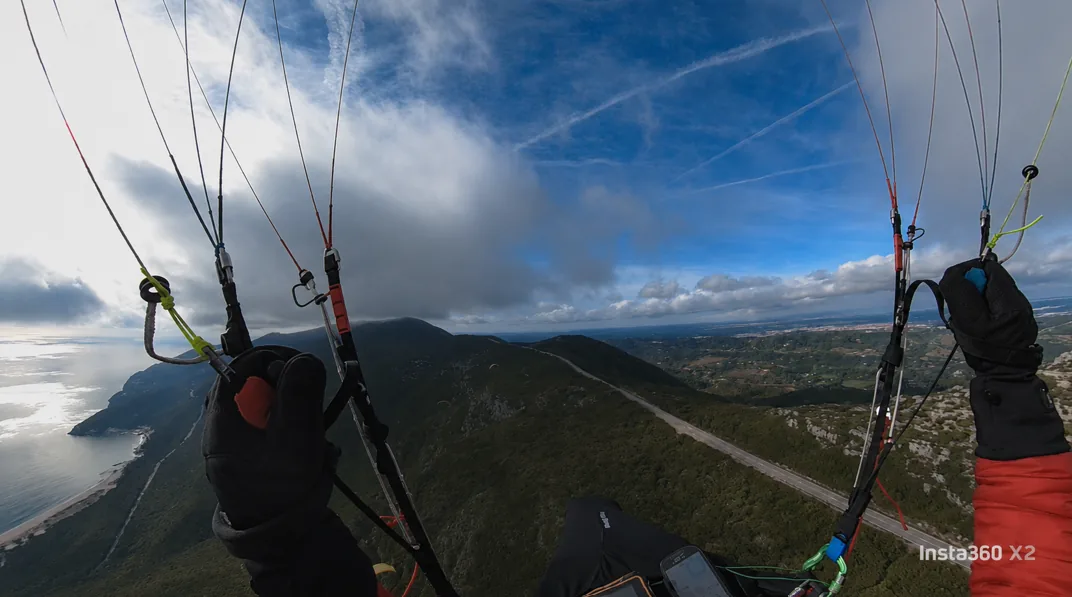
Pilots planning a flying week in Portugal often ask the same question: should I book a coastal soaring week or an XC week? The answer isn't always obvious, because coastal and XC flying look similar from the outside — same glider, same scenery, same sport — but they develop fundamentally different skills, suit different pilot profiles, and produce different kinds of flying days. This guide breaks down the difference in plain terms so you can make a confident, well-matched choice.
What Each Type of Flying Actually Is
Coastal soaring
Coastal soaring uses ridge lift — the band of rising air that forms when wind strikes a cliff or hillside and deflects upward. The lift is mechanical (wind-driven) rather than thermal (heat-driven), which means it is steady, predictable, and available for as long as the wind keeps blowing. A good coastal soaring day can give you 3–5 hours of continuous airtime without needing to climb a thermal or navigate to maintain height.
The flying zone is well-defined: you work the lift band in front of the cliff, turn away from the slope, and read the subtle variations in lift quality and wind gradient. The challenge is spatial precision, wind reading, and active glider control — not navigation or decision-making about where to go next.
XC thermalling
XC (cross-country) flying uses thermal lift — columns of warm rising air triggered by the sun heating the ground. Thermals are invisible, variable, and require the pilot to locate them, enter them efficiently, climb to cloud base, then transition across the sky toward the next thermal source. XC flying is navigation, weather reading, risk management, and endurance — in addition to glider control.
A typical XC session starts with a take-off from an inland hill, a search for the first thermal, a climb, and a series of transitions that can take a pilot 30–150+ km from where they started, depending on conditions and experience.
The Core Difference — Where the Skill Lives
| Dimension | Coastal soaring | XC thermalling |
|---|---|---|
| Lift source | Ridge lift (mechanical, wind-driven) | Thermals (heat-driven, invisible) |
| Lift predictability | High — stable while wind blows in the right direction and speed | Low to medium — thermals are patchy, timing-dependent, require searching |
| Primary skill | Precise weight-shift, spatial awareness, wind reading, active piloting near terrain | Thermal location, climb efficiency, transition planning, weather assessment |
| Navigation demand | Low — you stay within the lift zone | High — route planning, airspace awareness, landout field selection |
| Equipment needed | Glider, harness, helmet, radio | Glider, harness, variometer, GPS flight computer, radio |
| Retrieval logistics | None — you land where you launched | Complex — car retrieval or hitchhiking from the landout point |
| Minimum licence | P2 / Elementary Pilot | P3 / Club Pilot (P2 accepted for Combo programme) |
| Typical session length | 2–5+ hours continuous | 2–6 hours, broken by thermal searching |
Which Is More Physically Demanding?
This surprises many pilots: coastal soaring is physically harder than XC flying over a full day. The constant active piloting required near a cliff — managing the glider in gusty coastal wind, applying continuous weight-shift to hold position, staying alert for shifts in the lift band — is more tiring than XC transitions, which include glides with lower workload. Coastal soaring for 4–5 hours is exhausting in a way that a 3-hour XC is not.
XC flying, however, is more mentally demanding. The sustained decision-making required — where is the next thermal, what does that cloud formation mean, is my altitude safe to cross to that ridge, do I have enough height to reach a landing field — requires a different kind of concentration that most pilots find more fatiguing over a week than the physical effort of coastal soaring.
Which Type of Flying Builds What Skill?
What coastal soaring builds
- Weight-shift precision — Flying close to terrain demands constant small corrections. You develop a finer sensitivity to the glider's pitch and roll than inland flying typically requires.
- Wind reading — You learn to read the sea surface, feel the lift band edge, recognise gusts coming through before they arrive. This is transferable to every future site you fly.
- Active glider control — Coastal air is turbulent. Managing surges, collapses, and pitch movements in real wind (not just practised on the ground) cements active piloting habits.
- Spatial awareness near terrain — The discipline of always keeping the cliff behind you, maintaining safe distance, and planning turns in limited space directly improves safety decision-making everywhere.
What XC thermalling builds
- Thermal location — The skill of reading the ground for likely thermal triggers (dark fields, roads, south-facing slopes) and reading the sky for signs of lift (building cumulus, cloud streets) is a complete discipline in itself.
- Thermalling technique — How to centre a thermal efficiently, how to handle asymmetric climbs, when to leave a weak thermal for a stronger one — these are foundational XC skills.
- Weather assessment — XC pilots become competent weather readers out of necessity. Understanding sounding data, cloud development, the sea breeze convergence, and over-development risk is required for safe XC flying.
- Navigational judgement — Choosing routes, reading topography for lift potential, and making conservative landout decisions are skills that can only be developed by doing XC flights, not by soaring the same cliff repeatedly.
Which Programme Is Right for You?
Here is the honest guide. These are not rigid rules, but they are based on what I observe produces the best outcomes for pilots who come to fly with me in Portugal.
If you hold a P2 / Elementary Pilot licence with under 50 hours, or if you haven't flown consistently in the past year, the Coastal Soaring Week is almost always the right starting point. It builds the fundamentals — active piloting, wind reading, precise control — that make XC development faster and safer when you move to it later. Pilots who rush to XC without solid coastal hours often learn bad habits under pressure that take years to unlearn.
Choose Coastal Soaring if:
- You hold P2 / Elementary Pilot or above and want to consolidate fundamentals
- You haven't flown in several months and want to rebuild currency and confidence
- Your glider control in turbulence feels reactive rather than proactive
- You want long, uninterrupted airtime and a physically engaging session
- You're attracted to the aesthetic of soaring Atlantic cliffs in strong sea wind
- You plan to fly coastal sites at home (UK, France, Ireland, Morocco) and want proper technique
Choose XC / Combo if:
- You hold P3 / Club Pilot or above with 80+ hours of solid flying
- You're already comfortable in moderate turbulence and don't need to rebuild confidence
- You understand basic thermal indicators and have some thermalling experience
- You want to extend your flight range beyond the immediate site
- You own or plan to buy a vario/GPS and want to learn to use it purposefully
- You're preparing for competitions, long-distance routes, or mountain flying
Consider the XC Coastal Combo if:
- You hold P2 / Elementary Pilot (this is the only XC programme open to P2 holders)
- You want a broader experience without the full commitment of a dedicated XC week
- You want to see whether you enjoy thermalling before investing in dedicated XC training
- You're a confident P3 pilot who wants to consolidate both disciplines in one week
Can You Do Both in the Same Trip?
On most weeks in Portugal, conditions dictate the day's programme naturally. A strong Nortada day is ideal for coastal work; a calm morning with building cumulus shifts the focus inland. In practice, most pilots in any programme get a mix of coastal and thermal exposure across the week, even if the primary focus is one discipline. The XC Coastal Combo formalises this mixed approach for pilots who want it structured.
If you are considering two separate trips — one coastal, one XC — I typically recommend doing the coastal week first, regardless of your licence level. The precision and active piloting habits you develop on the coast make your XC development much more efficient when you return.
Frequently Asked Questions
I've been flying for four years but only 60 hours — which should I choose?
Four years is a long time to have only accumulated 60 hours, which usually means flying has been sporadic. With infrequent flying, the active piloting skills that coastal soaring develops are exactly what you need to rebuild — and the consequence of weak active piloting is much higher in XC flying than coastal. I'd recommend the Coastal Soaring Week first. If you feel very solid after a week of that, we can discuss whether a follow-up XC week makes sense the same season or the next.
Is one type of flying more dangerous than the other?
Both are safe when practised with appropriate skills and within the right conditions. Coastal soaring has one significant and non-negotiable hazard: the terrain behind you. A pilot who breaks the rule of never flying behind the ridge risks rotor turbulence and severe consequences. XC flying has a different risk profile — overdeveloped conditions, strong thermals, and decisions made at altitude far from the launch. Neither is inherently more dangerous, but each requires specific situational awareness that is largely separate from the other. This is exactly why I recommend building one skill base before adding the other.
What glider do I need for each type?
A modern EN-B low or mid glider is appropriate for both coastal soaring and introductory XC. For the Coastal Soaring Week and XC Coastal Combo, most certified EN-B gliders from established manufacturers (Advance, Nova, Ozone, Gin, BGD) are fine. For dedicated XC weeks, a higher EN-B mid or EN-C can be useful but is not required — I frequently fly with pilots on EN-B lows who outperform pilots on EN-C gliders because their technique is better. Glider choice becomes important at higher performance levels, not at the coaching stage.
My instructor at home says I should do more XC. But I feel uncomfortable in turbulence. What should I do?
Discomfort in turbulence is almost always a sign that active piloting hasn't yet become automatic. It's a muscle memory problem, not a courage problem. Pushing into XC when this feeling persists tends to create anxiety-managed flying rather than skills-built flying — which produces bad habits under pressure. The right response is targeted work on the root cause: more ground handling, and then more hours in turbulent coastal air where the stakes are manageable. The Coastal Soaring Week at Sesimbra is specifically designed to build this. Come do that first, then revisit the XC conversation.
Not sure which programme fits you?
Message me on WhatsApp with a quick summary of your hours, licence, and what kind of flying you've been doing. I'll tell you honestly which programme makes the most sense for where you are now.