


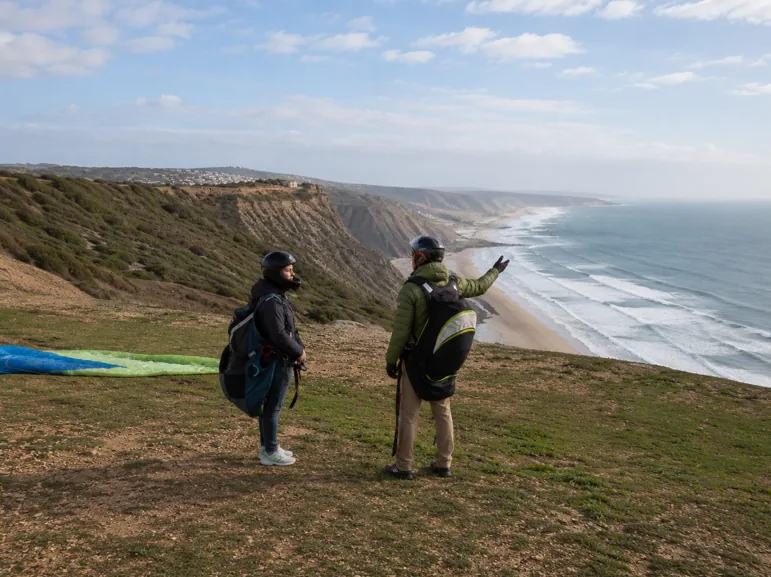
Paragliding is growing fastest among women. The demographic shift has been gradual but consistent — every year, a higher proportion of the pilots taking their first lesson, booking their first coaching week, and completing their first cross-country flight are women. The sport is still majority male, but the gap is narrowing, and the culture of the sport is changing with it. This guide is for female pilots who want a practical, honest account of what to expect — from learning dynamics to equipment to the social reality of a mixed-group coaching week in Portugal.
Where Women Stand in Paragliding Today
Precise global statistics are hard to pin down — paragliding licensing is managed at the national level by dozens of different bodies — but the broad direction is clear. Women now make up an estimated 20–30% of licensed pilots in Western Europe and the UK, up from below 10% a decade ago. In the beginner cohort, the ratio is often higher still. Several national governing bodies have reported that their most recent intake classes were more than 40% female.
At Behrooz's coaching weeks in Sesimbra, female pilots have made up roughly a quarter to a third of guests in recent seasons. That ratio has been rising steadily. The fastest-growing enquiry category is female pilots in their 30s and 40s who have completed a licence and are looking for their first dedicated coaching week abroad.
Is There Anything Physically Different About Flying as a Woman?
The honest answer is: not really, and in some respects the advantage runs the other way.
The common assumption — that paragliding favours size and physical strength — is largely wrong. Wing inflation and launch technique are about timing, positioning, and sensitivity of touch. A pilot who has excellent ground handling reads the canopy's feedback through subtle pressure in the risers, not through brute force. Lighter pilots (which often, though not always, correlates with female pilots) sometimes develop this sensitivity faster because they cannot compensate for poor technique with muscle.
On XC days, lighter pilots typically fly longer at a given glide ratio — less weight means less sink rate penalty in still air. Wing manufacturers design every certified glider to perform across a wide weight range; there is no "female paraglider" and no need for one.
The one area where there is a genuine practical difference is harness and equipment sizing. Most harness manufacturers have historically designed around a 75–85 kg male body. Women who are outside that reference shape — shorter torso, different hip-to-shoulder ratio — can find that standard harness sizing produces poor fit. This matters: a harness that fits badly is uncomfortable over a long flight and can affect your control inputs. More on this in the equipment section below.
What to Look for in a Coach
A good coach is a good coach regardless of your gender. But it is worth being specific about what the coaching relationship looks like for female pilots who have had less-than-ideal previous experiences.
The most common complaint Behrooz hears from female pilots about previous coaching experiences is not overt sexism — it is condescension by omission. Being given less detailed feedback. Having launches assessed less critically. Being praised for attempts that a male pilot at the same level would have had thoroughly debriefed. This is well-intentioned but ultimately unhelpful. A pilot who is treated as fragile does not improve as fast as a pilot who is treated as capable and given the same rigour of analysis.
Radio coaching on every flight, the same for every pilot regardless of gender. Track log debrief using the same analytical approach for every flight. Launch assessment that is honest, specific, and forward-looking. The goal is to identify what changes will make the next flight better — not to manage emotions or protect confidence at the expense of improvement.
Female pilots consistently say the same thing after a week: that being coached with the same seriousness as everyone else in the group was what made the week work.
How Behrooz's Weeks Work for Female Pilots
Groups at Sesimbra are small — typically four to eight pilots. The composition varies week by week and is genuinely mixed most of the time. Female pilots are rarely the only woman in the group; if they are, the group dynamic is typically shaped more by skill level and flying interest than by gender.
The atmosphere on the hill is low-key and task-focused. Sesimbra's flying community is welcoming and unpretentious by Portuguese culture — there is less of the performance posturing that can make some paragliding clubs uncomfortable for newer or less experienced pilots. Flying the ridge is the main activity; gear comparison and one-upmanship are not.
Evening debriefs are over coffee or drinks, relaxed, and focused on what happened in the air. The track log is pulled up, flights are discussed, and questions are welcomed from every direction. Female pilots tend to ask more questions and engage more openly in these sessions, which is one of the things that makes them productive guests in mixed groups.
Practical: Equipment Sizing and Harness Fit for Women
If you have your own harness, bring it. Fit is critical and your own harness — once adjusted correctly — is always going to outperform a rental for comfort and control feel over a full flying day.
If you are looking to buy a new harness, consider:
- Trying before you buy. Sit in the harness in the shop with your legs at the flying angle. The seat board should support your lower back without pushing it into an unnatural curve. The leg straps should grip without digging in.
- Torso length. Female pilots typically have shorter torsos, which means the carabiner position on standard harnesses can be set too wide. Look for models with adjustable chest strap positioning and test that the wing control rems (brake travel) feel correct when seated.
- Women-specific models. A small number of manufacturers (Advance, Dudek, others) offer models designed around female body proportions. These are worth considering if you find standard sizing consistently uncomfortable, but they are not necessary — many female pilots fly in unisex harnesses with minor adjustments.
- Reserve fitting. The reserve container position is often more important for smaller pilots than the marketing suggests. Make sure the handle is reachable with a natural arm movement in the seated position before you buy.
Female Paragliding Communities and Resources
The growth of women in paragliding has produced several worthwhile communities and events:
- Women's fly-ins and female-only events — several European sites now run women-only fly-ins in spring and autumn. These are worth attending if you want to fly in a group where gender is not a variable at all. The instruction quality varies; focus on events run by nationally licensed coaches.
- Social media groups — there are active Facebook and Instagram communities specifically for female paragliding pilots. The quality of information varies, but the communities are genuinely supportive and useful for finding flying partners and getting unfiltered feedback on destinations and coaches.
- National federation women's programmes — the BHPA (UK), DHV (Germany), and FFVL (France) all have initiatives aimed at increasing female participation. These sometimes include subsidised training and events.
Portugal as a Destination for Female Pilots
Portugal works well for female pilots travelling alone for several reasons. Sesimbra is a small, safe town where solo travel is genuinely comfortable. The group week format means you are never alone in the air or navigating logistics alone. The Portuguese are warm and hospitable without being pushy. English is widely spoken among the working-age population. The food is excellent and the town has enough going on for evenings to be enjoyable.
Female pilots who have travelled to other paragliding destinations — Oludeniz in Turkey, Interlaken in Switzerland — sometimes remark that Portugal feels notably less commercial and more personal. Sesimbra does not have the high-volume tandem operations of those places; the hill culture is more reflective and the pace more relaxed.
If you have specific questions about what a week in Sesimbra looks like for a female pilot, message Behrooz directly. He is happy to discuss group composition for any upcoming week and to answer any questions before you commit to booking.