


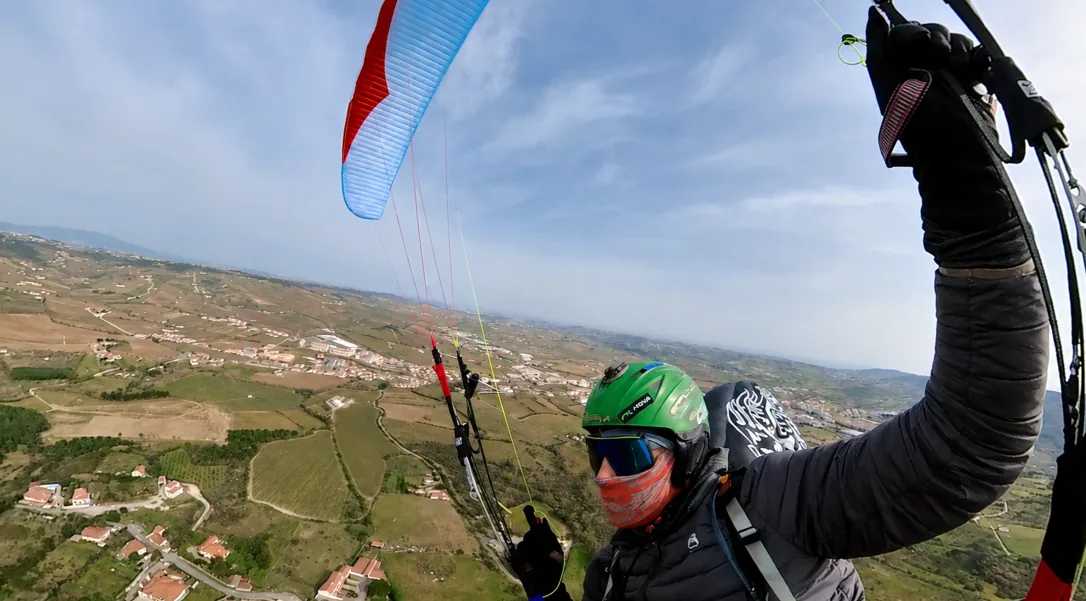
People ask me why I fly. They mean it as a simple question, and I understand why — from the outside, the answer seems obvious. The view, the freedom, the adrenaline. Three words and you're done. But I've been doing this for over 20 years, and somewhere in that time the question stopped being simple and started being the question I find most interesting to sit with. This is my attempt to answer it properly.
The First Flight
I remember the specific quality of the air that morning. It was late spring, the kind of morning where the sky is not quite blue yet but is working toward it, and the grass on the hillside was still damp. My instructor — a patient man with the calm efficiency of someone who has watched a thousand people discover they are afraid of nothing they thought they were afraid of — walked me through the pre-flight check for the third time. I had memorised the sequence but my hands were doing something independent from my memory.
The launch felt like falling sideways. That's the honest description. The wing filled above me with a sound I had not expected — not a crash of air, but a low smooth rush, like something large and alive taking a breath — and then the ground moved away from my feet and my body had no frame of reference for what was happening to it. I had been told what to expect. I had watched other people do it from below. None of that preparation had reached the part of my nervous system that registers "this is real."
And then the silence.
That is what I had not been told about, or what I had been told about but had not understood until it happened. The ground sounds — the wind in the grass, the insects, the distant road — all of that disappeared at once, replaced by a silence that is not actually silence but is the absence of all the ground-level noise you carry with you everywhere without knowing it. The wing made almost no sound. The air around me was still. I was a hundred metres above the hillside and I could hear my own breathing with a clarity that felt medical.
I went back the next day. And the day after that. Not because the fear had gone — it hadn't, not entirely, not yet — but because the silence was not available anywhere else, and I had decided I needed it.
The Learning Years
The first hundred hours of solo paragliding are the most humbling period of the sport, and the most important. You have enough ability to get yourself into situations your experience cannot yet handle. The gap between competence and wisdom is widest here, and the gap is not announced. You close it by being wrong about things in recoverable ways, and learning what you were wrong about, and being slightly less wrong the next time.
There was a flight in my second year that I still think about. An afternoon session in summer, conditions that looked clean from the ground. I was climbing in a thermal that felt stable and organised, and then it wasn't. The wing folded on the right side — not dramatically, not slowly, just suddenly differently — and I had about two seconds of genuine confusion before the inputs I had been practising for months worked the way they were supposed to work. The wing recovered. I was at enough altitude that I had time and space. I landed, and I sat in the field for a while without unpacking the wing, just thinking.
What I was thinking was: the sky had changed and I hadn't noticed until the wing told me about it. That was the lesson. Not the recovery technique — I had that. The lesson was that the sky changes continuously, that conditions are not a fixed state you assess at takeoff and then live inside, and that the pilot's job is to read that change in real time, not to react to it after the fact. I spent the next two years developing that reading, and it is the skill I think matters most at every level of the sport.
I stopped being primarily frightened of flying somewhere around 200 hours. The fear doesn't disappear — a pilot who tells you they have no fear is either lying or has stopped paying attention — but it changes character. It shifts from anticipatory dread to operational attention. You are not frightened of what might happen; you are alert to what is happening. The attention feels purposeful rather than anxious. This is the transition that most pilots describe as the point when flying became genuinely enjoyable rather than just compelling.
What Competing Taught Me
Competition paragliding is not about the trophy. I want to say that plainly, because the trophy is the wrong thing to look at if you want to understand what competition flying teaches. What the trophy measures is the accumulated result of thousands of small decisions made under pressure, often in three seconds or less, in conditions that are not giving you the full information you want before you have to act. The pilots who are consistently good in competition are not necessarily the ones with the most raw talent. They are the ones who have developed the discipline to commit fully to a decision and stop second-guessing it, and to make the next decision cleanly rather than carrying the weight of the previous one.
I flew in gaggles of 60, 70, 100 wings — a competition start, everyone circling in the same thermal, everyone watching the same sky, everyone having to decide at the same moment whether to push ahead on glide or stay and climb more. The pilots who flew well were the ones who had thought through their options before they were needed, so that when the moment arrived, the decision was almost already made. The pilots who struggled were the ones who were still deliberating when the sky had already moved on without them.
What competition taught me about risk is probably the most useful thing I took from it. I watched pilots I respected enormously take risks I would not take, and I watched some of them have serious incidents as a result. Not all risks that end badly were unreasonable — paragliding at the competition level involves accepting a certain threshold of uncertainty that recreational flying does not. But I watched enough to understand the difference between a calculated risk taken by a pilot who had genuinely assessed the variables, and a risk taken because the gap between a pilot and the leaders was shrinking and the decision-making got compressed. The second kind of risk is where incidents live. The lesson is that the pressure to perform never justifies the compression of good process. It took me longer to really believe that than to understand it intellectually.
Finding Sesimbra
I came to the Sesimbra coast for the first time in circumstances that were not particularly romantic — it was a recommendation from another pilot, a site worth checking on my way through Portugal. I flew Bicas on an afternoon in late September, when the nortada had been running all day and the ridge lift was clean and the light was at that specific angle you only get on the Atlantic coast in autumn, where everything has an extra stop of saturation and the shadows are long enough to give the landscape depth you don't see at midday.
I noticed three things on that first flight that I have since come to understand as the signatures of this site. The first was the consistency of the lift — not dramatic, not variable, but deeply reliable, the kind of ridge air that you can read twenty minutes ahead because it is behaving according to principles rather than personality. The second was the geography: the castle, the limestone ridge running west, the way the Serra drops into the sea. The third was something harder to name, which is the relationship between the flying and the place. Sesimbra is a village, not a resort. It has its own rhythm, its own light, its own smell of the sea and the fishing boats in the morning. When you land on the slope above it, you land into something. It is not just a landing zone.
I came back the following spring and flew for two weeks. Then I started spending more time here than anywhere else. Then I stopped making the calculation of how much time, because the answer had become simply: here is where I live and fly. The decision to build a life here rather than somewhere with larger mountains or more competitive prestige was never a difficult one. The mountains are bigger elsewhere. But the relationship between the flying and the place is not replicable. I have not found it replicated anywhere else I have flown.
What Twenty Years Teaches You That You Cannot Learn Faster
There are things you know about a site after twenty years that you cannot know after two. They are not dramatic things. They are the kind of small, accumulated observations that build a map of a place that is more detailed and more useful than any forecast or any site guide.
I know, for example, that the Arrábida cliffs take on a specific colour in the late afternoon in September — a pale amber that appears around 4:45pm when the sun is low enough to catch the limestone at an oblique angle — and that this light, when it is present, means the thermal cycle on the ridge has 45 minutes left before it closes for the day. That is not something I read. It is something I have watched several hundred times until the connection between the light and the thermal cycle became as reliable as anything in meteorology.
I know the smell of the Atlantic at 300 metres in July. It is different from the smell at ground level — cleaner, thinner, with a salinity that is not unpleasant but is distinctly oceanic — and the way it changes tells me something about the humidity layer and whether the sea breeze is building or beginning to diminish. Experienced coastal pilots read the air through a combination of instruments and sensory information that is richer than any single input.
I know the hour before the nortada drops in the evening — the specific quality of restlessness in the air, the way thermals become more disconnected and the ridge lift becomes slightly less organized, and the window of 20 or 30 minutes when the air is genuinely complex before it settles into the calm that follows the north wind's end. Most pilots want to be on the ground before that window. I want to be in the air for it, high enough to have options, knowing what is coming well before it arrives.
None of these things are communicable in a briefing. They are the residue of twenty years of paying attention to the same sky above the same ridge above the same ocean. They are, in a sense, the answer to the question I started with.
Why I Guide
I could have spent more of my flying years alone. I could have chased longer XC flights, flown more competitions, spent weeks in the air without the interrupted attention that comes with having other pilots in your care. Some pilots I respect enormously have built their flying lives that way. I understand the appeal.
What I have found instead is that the weeks I spend with other pilots — watching them develop, calling them on the radio when I see something they're not seeing yet, watching their track logs in the evening and finding the moment when they understood a thermal that had been confusing them for two days — these weeks have taught me more about flying than many of my solo hours. You understand something differently when you have to articulate it to someone else. You see the sky differently when you are watching it through two sets of eyes simultaneously, your own and the eyes of the pilot you're coaching, who is seeing things you stopped seeing years ago because familiarity made them invisible.
There is a specific moment that I find difficult to describe but that I have witnessed many times. A pilot finds their first thermal on their own — really on their own, without the radio, without the nudge that had been coming for the first three days of the week. They work it to the top, they come off the thermal confident, they glide away. And the radio is quiet from my side because I am watching and they don't need me. They know they don't need me. That moment — the particular quality of the silence on the radio — is more satisfying than most of the things I have done in the air alone. I don't fully understand why. But I have stopped trying to explain it and started just expecting it, because it comes, on almost every week, from almost every pilot who is ready for it.
What Patience Actually Looks Like
People use "patience" to mean hesitation. In flying, it means something entirely different. Patient flying is not slow flying. It is not cautious flying in the sense of being conservative with every decision. It is the ability to wait for the right moment with complete confidence that you have correctly identified it, and to do so without the anxiety that comes from uncertainty about whether you are right. Patience in a pilot looks like calm. It often looks like someone who is doing nothing, watching. What it actually is, is someone who has processed the available information and arrived at a clear conclusion and is waiting for the external conditions to match what they already know is coming.
I did not arrive at this quickly. It took losing, specifically, the discipline to wait for conditions that I had identified correctly, only to decide at the last minute that I had been too cautious and go anyway, into conditions I should have waited out. The flights that followed those decisions were not disasters, but they were not the flights I had planned, and the discomfort they produced was not the useful kind. The discipline to walk away when the conditions are at the edge — genuinely to walk away, without the internal argument — gets easier with experience, not harder. The experienced pilot is not fighting the urge to go. They have already decided the question and moved on to thinking about tomorrow.
A Letter to the Pilot Reading This
If you are reading this because you are thinking about coming to Sesimbra — or because you are thinking about flying in general, or because someone sent you a link and you have read this far and are wondering what it is that pilots are actually talking about when they talk about why they fly — this is the most direct thing I can tell you:
There is a version of the world that is only visible from the air. Not from a plane, where you are separated from the sky by pressurised aluminium and the perspective is always distant. From a paraglider, where the air is on your face and the altitude is personal and the silence is real. From that position, the world reveals its geography — the way the coast makes sense, the way the ridge forms a shape you could not have predicted from below, the way the light falls differently on everything — in a way that is genuinely new. You are not seeing the same world from higher up. You are seeing a different version of it that happens to be located higher up.
I have tried to describe what this feels like. Twenty years of trying, in briefings and debriefs and conversations over dinner and in moments on the radio when I am watching a pilot discover something that I watched a pilot discover the week before and the week before that. The honest truth is that words get you most of the way there and then run out. The last part you have to do yourself, from 400 metres above the Atlantic, with the castle on the hill to the east and the ocean to the horizon in every other direction. I will be there when you launch. I will be on the radio. And at some point — probably on the third day, sometimes the second — the radio will be quiet from my side because you won't need it anymore. That is the moment I am working toward. I look forward to it.