

Both involve leaving the ground in the most deliberate possible way. Both produce memories that most people carry for decades. But paragliding and skydiving are fundamentally different experiences — different physics, different duration, different emotional arc, and different relationships with the sky. If you're trying to decide which to try, or which to pursue seriously, this guide covers everything you need to make that choice clearly.
The Fundamental Difference
The single most important distinction: paragliding is flying. Skydiving, for most of its duration, is falling. This is not a criticism of either activity — it is the defining characteristic of each, and it shapes everything about the experience.
In skydiving, you exit an aircraft at 3,000–4,000 metres and enter freefall. For 45–60 seconds you fall at approximately 190 km/h before your parachute deploys. The canopy ride down takes 4–6 minutes — serene, controlled, aerial. Total airborne time: roughly 6–8 minutes.
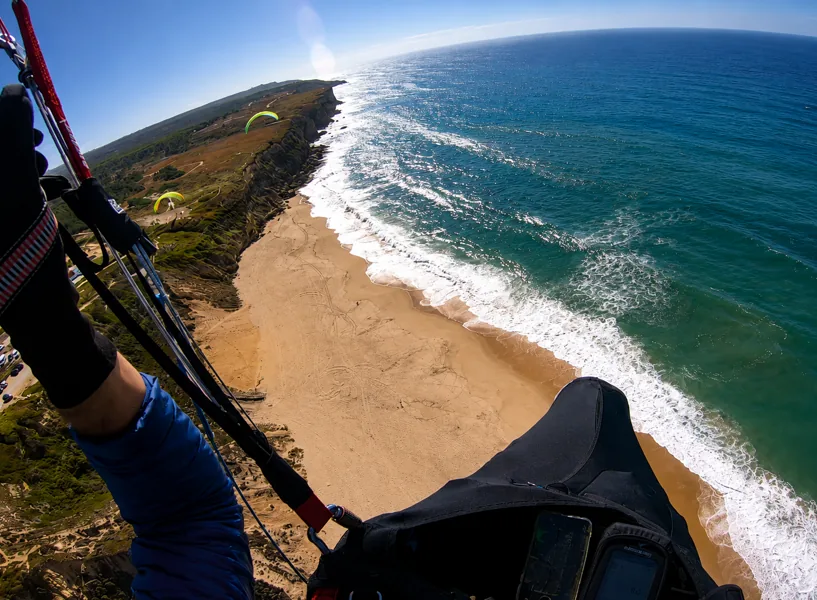
In paragliding, you launch from a hillside or coastal ridge into sustained, controlled flight under an unpowered wing. You are not falling — you are trading altitude for forward motion slowly enough that rising air (thermal or ridge lift) can sustain or gain height. A recreational flight lasts 20–90 minutes. A cross-country flight can last several hours. From launch to landing, you are actively flying the entire time.
Side-by-Side Comparison
| Feature | Paragliding | Skydiving |
|---|---|---|
| Total airborne time (tandem) | 20–90 minutes | 6–8 minutes |
| Freefall | None | 45–60 seconds |
| Altitude | 50–2,000 m above terrain | 3,000–4,500 m AGL at exit |
| Speed | 35–55 km/h typical | ~190 km/h in freefall |
| Adrenaline type | Wonder, calm — awe at the view | Overwhelm, intensity — freefall shock |
| Time to try (tandem) | 30-min briefing, 2-hr total | 30-min briefing, 1-hr total |
| Tandem cost (approx.) | €100–180 | €180–260 |
| Can you talk during the experience? | Yes — easily | No — wind noise prevents it |
| Solo licence training (approx.) | 10–14 days (EP course) | 8 jumps AFF + consolidation |
| Solo licence cost (approx.) | €900–1,400 | €1,200–1,800 |
| Ongoing solo cost per session | Low (site fees, equipment amortised) | Significant (jump tickets: €20–30 each) |
| Weather dependency | Wind, clouds, thermals matter | Clouds, wind above 800m matter |
| Social context | Small group, extended day | Drop zone community, quick turnaround |
Duration and What It Means for the Experience
Duration is perhaps the most underappreciated difference. A tandem skydive is intense and brief. The freefall — which is the heart of the experience — passes in under a minute. Many first-time skydivers report that it was over before they fully processed what was happening. The canopy ride is calm and scenic, but most people's memory of the experience is dominated by those 45 seconds of freefall.
A tandem paragliding flight gives you 20–90 minutes of fully conscious aerial experience. You can look around, point at things, talk to the pilot, watch the coastline pass beneath you, observe birds thermalling below you, and genuinely absorb what being in the air feels like. The experience is long enough that your nervous system settles into it, rather than being overwhelmed and then ending.
Neither duration is objectively better. For some people, the intensity-in-brevity of skydiving is exactly what they want. For others — particularly those who want to understand what flight actually feels like, or who are considering learning — the extended duration of paragliding is far more valuable.
Adrenaline Type
This is worth being precise about, because the two activities produce genuinely different neurological experiences.
Skydiving's freefall is sensory overwhelm: wind noise at 190 km/h, physical disorientation, the visual shock of the ground receding rapidly. The brain typically cannot process it fully in real time. The emotional peak often comes on landing, not during the jump itself. Post-jump shaking is common. The memory of the experience is often slightly blurry — hyper-arousal impairs encoding.
Paragliding's adrenaline — if it appears at all — is concentrated in the takeoff moment. After that first 30–60 seconds, most passengers shift into a state that is closer to calm absorption than adrenaline. You are alert and aware, taking in information, present. The emotional peak is typically somewhere mid-flight when the view or the silence becomes fully apparent. Post-flight, people are generally calm, reflective, and articulate about what they experienced.
If you want to understand what flight is, try paragliding first. If you want the most intense possible single-moment experience, try skydiving first. But if you're genuinely curious about becoming a pilot — if the idea of reading the sky and navigating the air interests you — paragliding is the one that leads somewhere. Skydiving is something you do. Paragliding is something you learn. Both are worth doing. The question is what you're actually after.
Training Required for Solo Flight
The paths to solo flight differ substantially between the two sports.
Skydiving — AFF (Accelerated Freefall)
The standard solo progression is the AFF course: a ground school day followed by 8 jumps with one or two instructors in freefall. Each jump has specific skills to demonstrate. Once all 8 are completed satisfactorily, you move to consolidation jumps (typically 25 total before an A-licence). The whole process takes 2–5 weekends depending on weather and availability. AFF costs roughly €1,200–1,800 at most European drop zones.
Paragliding — EP Course (Elementary Pilot)
The standard entry qualification is the EP (Elementary Pilot) course: 10–14 days of intensive training covering ground handling, meteorology, equipment, and progressive flights from training slopes to soaring ridges. By the end, students are making independent soaring flights. The full EP course costs roughly €900–1,400 depending on location and school. A Portuguese coastal training site like Sesimbra offers consistent conditions for learning that many mountain locations cannot match.
Ongoing Cost to Continue
This is where the two sports diverge most significantly for those who want to continue. Each skydive costs a jump ticket (typically €18–32 depending on altitude and drop zone), plus eventually your own equipment (€5,000–12,000 for a full rig). Active skydivers who jump 100+ times a year spend €2,000–4,000 on jump tickets alone. The sport remains expensive to practise regularly.
Paragliding, once you own a wing (€1,500–5,000 secondhand to new) and harness (€300–1,500), costs relatively little per flight. Site fees range from free to €20. Travel to the site is the main recurring cost. Active paragliders flying 80–100 hours a year can do so for €500–1,000 total beyond the initial equipment investment.
Can You Do Both?
Absolutely. Many people do. The skills overlap more than you might expect — spatial awareness, weather reading, calm decision-making under novelty — but the actual techniques are completely separate. Being a licensed paraglider pilot does not make you a better skydiver, and vice versa. They are independent disciplines that happen to both involve leaving the ground.
The practical constraint for most people is time and cost. Both sports require investment. Doing both seriously is possible but demands genuine commitment to each. Most people who try both eventually settle into one as their primary focus, and keep the other as an occasional experience.
Which Is Right for You?
A few honest decision points:
- You want maximum intensity in the shortest time: skydiving. The freefall experience is singular.
- You want to understand what flight actually feels like: paragliding. 90 minutes in the air teaches you things that 60 seconds in freefall cannot.
- You are nervous about heights but still want to try something aerial: paragliding tandem. The altitude gain is gradual and the pilot is beside you throughout — it is more manageable for height-sensitive people than the exit from 4,000 metres.
- You want to learn a skill you can practise regularly without very high per-session costs: paragliding.
- You want a dramatic story and a video your friends will watch: skydiving has the edge on raw spectacle.
- You have a week in Sesimbra and want to use it well: paragliding, for reasons that involve everything from the flying to the town to the company.