


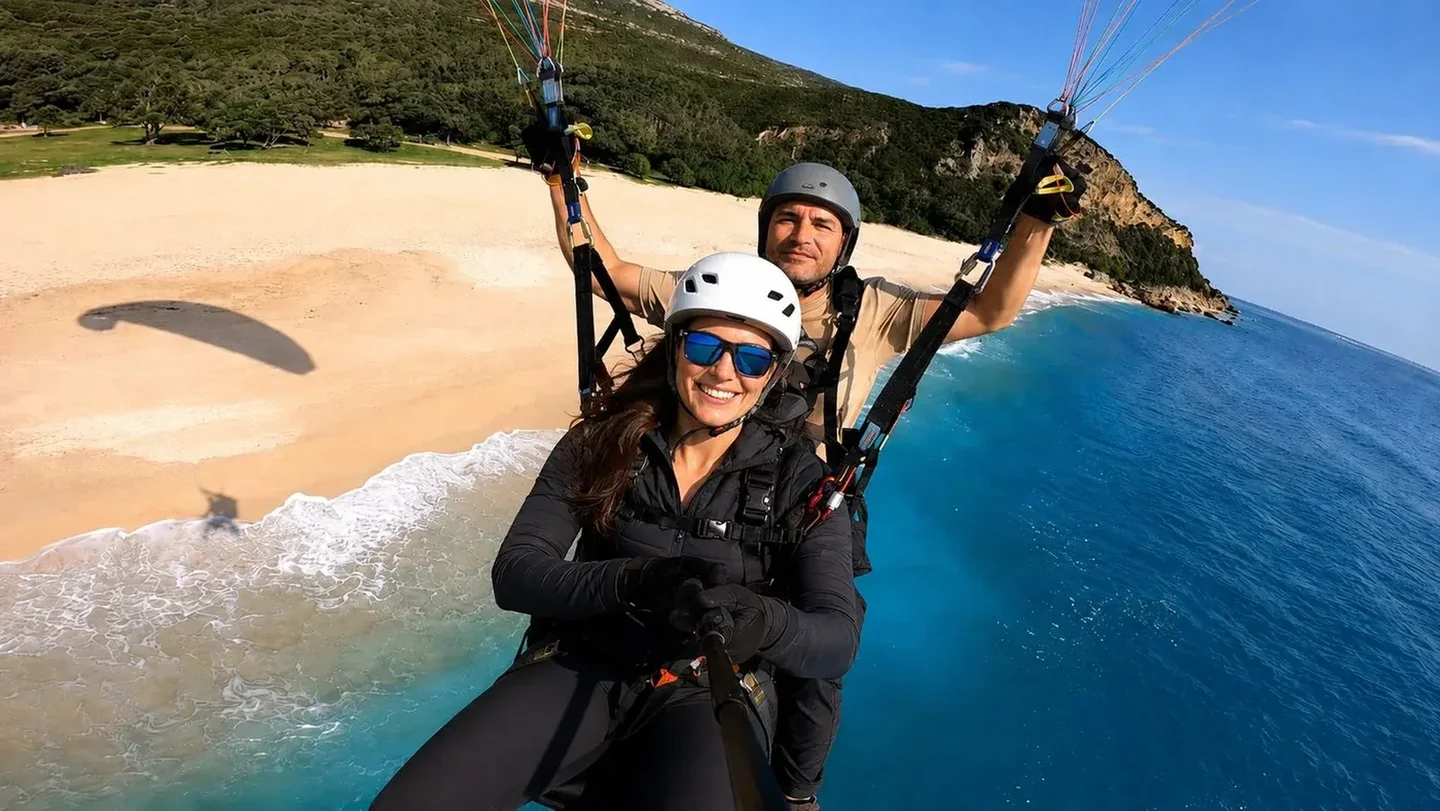
Tandem paragliding in Portugal is one of those experiences that people tend to describe in superlatives — and that's before they've even processed where they've just been. You step off a sea cliff 120 metres above the Atlantic Ocean, you rise into the smooth coastal air, and you spend the next 20 to 40 minutes soaring above one of the most dramatically beautiful coastlines in Europe. No training required. No experience needed. Just you, a licensed pilot, and the open sky above Sesimbra.
What Is Tandem Paragliding?
A tandem paraglider is a two-person glider — larger and more stable than a solo wing — with two harnesses attached side by side beneath it. You sit in the front harness; your pilot sits directly behind you and controls everything. Your only job during the flight is to walk forward at launch, sit back in the harness when you're airborne, and enjoy the view. The landing is a smooth, feet-forward glide to the ground — no rolling, no falling, no impact.
The pilot manages the wing inflation, the launch run, all control inputs in the air, the approach, and the landing. You don't need to do anything technical. What you'll notice is that the flight feels nothing like any other aircraft — there's no engine noise, no vibration, no enclosure. You're suspended in silence above the sea, moving with the air the way a soaring bird does.
What Happens on Your Tandem Flight Day
Here's how a typical tandem flight day works when you book with me.
Meeting and kit-up (15 minutes)
We meet at or near the launch site — I'll tell you exactly where when you book. I fit you into the tandem harness and run through a brief safety check: how the harness works, what happens at launch (walk forward, keep walking until your feet leave the ground), what to do during the flight (sit back, relax, don't grab anything), and how the landing works. The briefing is thorough but not alarming — this is everyday routine for me, and I'll put you at ease quickly.
Launch
We inflate the glider behind us, it rises above our heads, and I give you the signal to walk forward. You take ten or twelve steps toward the cliff edge, the harness takes your weight, and your feet leave the ground. That transition — walking on solid earth, then floating above the sea — is the moment people most often describe as transformative. There's no dramatic jump, no falling sensation. You simply rise.
The flight
We soar out over the Atlantic cliffs and I find the ridge lift — the smooth, rising air that flows off the ocean and climbs the cliff face. We work back and forth along the coast, gaining height gradually. Below you: the beach, the fishing boats in the bay, the terracotta rooftops of Sesimbra town, the 12th-century castle above it all. To the east: the Arrábida Natural Park hills, limestone white against the scrubby green. On clear days, you can see the mouth of the Tagus estuary to the north, with Lisbon beyond it.
During the flight I'll point out the landmarks, describe what's creating the lift, and answer any questions you have. If you'd like a more active experience — a gentle turn, a bird's-eye view of a specific spot — just say so. Most passengers want to be quiet and look. That's the right instinct.
Landing
We land on the beach below or on the clifftop grass, depending on conditions. I'll tell you about 30 seconds out: "feet forward, stand up as we touch down." The ground comes up slowly and smoothly. Most first-timers are surprised by how gentle it is — there's typically less impact than stepping off a kerb.
How Long Is a Tandem Paragliding Flight?
This depends primarily on the wind conditions. On a good coastal soaring day — northwest breeze at 12–20 knots, which describes a large proportion of days at Sesimbra — typical flight time is 20 to 40 minutes. On exceptionally good days with strong, consistent lift, flights can extend to 50–60 minutes. On lighter days near the edge of the flyable range, expect 15–20 minutes.
I don't set a fixed flight duration and then terminate the flight at a timer — I fly until conditions determine it's time to land. That means some passengers get a shorter flight than they hoped; others get significantly more than expected. The Atlantic ridge at Sesimbra is one of the most consistent soaring environments in Europe, which is why it's my base. Most tandem flights here are at the longer end of the range.
Tandem flights are available year-round at Sesimbra. April through October offers the most reliable conditions for coastal soaring, with the summer months (June–September) giving the longest flyable windows. December through February is also good — the Atlantic ridge runs through winter, though some frontal systems can close flying for a day or two. The best time to visit guide covers the full seasonal picture.
Who Can Do a Tandem Paragliding Flight?
The barriers to tandem paragliding are genuinely low. You don't need any experience, any fitness training, or any background in aviation. Here's the full picture:
| Requirement | Detail |
|---|---|
| Age | Minimum 10 years old. Under-18s require written parental consent. No upper age limit. |
| Weight | Up to 100 kg (220 lbs). Please mention weight at booking — important for equipment selection. |
| Fitness | Normal everyday mobility is sufficient. You'll walk 10–15 steps at launch; the rest is passive. |
| Health | Not suitable with serious heart conditions, recent surgery, severe epilepsy, or acute motion sickness. Pregnancy: not recommended. |
| Experience | None required. Your pilot manages everything. |
If you have any doubt about whether a health condition is relevant, send me a WhatsApp message before booking — I'll advise honestly. I'd rather have that conversation beforehand than have anyone feel uncertain on the day.
What to Wear for a Tandem Paragliding Flight
- Footwear: Closed-toe shoes with ankle support are essential — trainers or light hiking shoes. No sandals, flip-flops, or heels. You'll be walking on uneven ground at the launch and the landing.
- Clothing: Comfortable outdoor clothes. At altitude and on the coast it will feel 3–5—C cooler than at street level, so bring a light layer. Avoid anything very loose or flowing that can catch the wind during launch.
- Sunglasses: Strongly recommended — you'll be looking into the light above the sea for up to an hour.
- Camera: I can mount a GoPro to the harness or wing if you bring one. Alternatively, I can take photos and video during the flight — ask me when you book.
- Leave at the car: Large bags, loose hats, scarves. Anything that could snag or blow away during launch.
Why Sesimbra Is an Outstanding Location for a First Flight
There are tandem paragliding operations at dozens of sites across Europe. What makes Sesimbra specific:
The scenery is exceptional. You're flying above a medieval fishing town with a 12th-century Moorish castle, looking out over a bay that's been a harbour since the Romans. The Arrábida hills run east in a limestone ridge above Atlantic forest; the Setúbal Peninsula curves south into open sea. Very few tandem sites in Europe combine this quality of landscape with this quality of flying.
The conditions are consistent. The Atlantic ridge at Sesimbra produces reliable lift across a wide wind direction range. I don't run tandem flights on marginal days — when I say the conditions are good, they genuinely are. The flying here is smooth and laminar; it doesn't have the turbulence you sometimes find at inland thermal sites.
The location is accessible. Sesimbra is 30 minutes from Lisbon airport, easily combined with a city visit or a week touring the Setúbal Peninsula. Many people do a tandem flight as part of a Lisbon trip — fly in, take an Uber south to Sesimbra, fly, have lunch at a fish restaurant, and be back in the city by evening.
If you're travelling with a pilot partner who's coming for a full flying week, the Tandem Flight page has full details on how to combine a tandem experience with a pilot's coaching week — including scheduling and pricing.
How to Book a Tandem Paragliding Flight
There is no online booking system, no deposit required, and no form to fill. Message me directly on WhatsApp with your preferred date (or a range of dates), how many people are flying, and any relevant health or weight notes. I'll confirm availability and give you the exact meeting location and time.
WhatsApp: +351 914 828 076
Email: flywithbehrooz@gmail.com
I recommend booking 2–4 days ahead minimum to allow weather assessment. Same-day bookings are occasionally possible but not guaranteed. If weather prevents flying on your booked date, we'll rebook for the next available window.
Frequently Asked Questions
Is tandem paragliding safe?
Tandem paragliding with a certified, experienced pilot is one of the safest forms of aviation. The risk profile is significantly lower than motorcycling, skiing, or many other outdoor activities. I hold a full tandem instructor rating and I've logged thousands of tandem flights over 15 years at Sesimbra. I don't fly in conditions I'm not confident in — if I'm uncertain about the day, we don't fly. Safety is the non-negotiable first filter before every flight.
What if I'm scared of heights?
This is more common than you'd think — and the experience is often completely different from what height-sensitive people expect. Paragliding doesn't give the same sensation as looking over a balcony edge or a glass walkway. You're sitting in a harness with your feet dangling, moving through the air like a bird. Many people who describe themselves as acrophobic find the flight comfortable and even calming. That said, if you have severe acrophobia, be honest with yourself before booking — and perhaps come and watch a flight before committing to one.
Will I feel sick or dizzy?
Coastal ridge soaring at Sesimbra is notably smooth — the Atlantic air is laminar rather than thermal-driven, so there's no bumping in and out of thermals that can unsettle passengers. Motion sickness is much less common in paragliding than in light aircraft. If you're prone to motion sickness, avoid flying after a heavy meal and take a non-drowsy motion sickness tablet an hour before as a precaution. In my experience, the majority of passengers who were worried about this find the flight entirely comfortable.
Can children fly?
Yes, from age 10 with parental consent. Children tend to be enthusiastic and completely unfazed by the height — in my experience, children make excellent tandem passengers. The harness system accommodates smaller frames comfortably. Please mention the child's age and approximate weight when you book so I can ensure I have the correct harness size.
How is it different from skydiving or bungee jumping?
Completely different. Skydiving involves freefall — a rapid drop before the parachute opens. Paragliding involves no freefall at all; you launch from a hillside and immediately glide. There is no falling sensation, no sudden drop, no adrenalin spike at the start. The closest analogy is soaring — sitting above the sea like a seagull, drifting on the same air currents that have carried birds along this coastline for millennia. Many people who would never skydive find paragliding perfectly comfortable and deeply peaceful.
Can I do a tandem flight and also watch my partner fly solo?
Absolutely. Many visitors come as a mixed group — one or two pilots joining a coached week, partners or family members doing a tandem flight. The logistics work naturally: tandem flights typically happen in the morning when the soaring conditions are at their best, which fits alongside the pilot coaching schedule. Let me know the full group composition when you get in touch and I'll organise the day so everyone gets the most out of it.
Ready to fly above the Atlantic?
Message me on WhatsApp with your dates and I'll confirm availability. No forms, no deposit — just a direct conversation.