


The honest answer is: it depends on when you ask. Ask most first-time tandem passengers during the 10 minutes before takeoff and they will describe a real, physical sense of nerves — dry mouth, restless hands, the slightly surreal feeling of standing on a ridge with a large wing above them and open sky ahead. Ask the same people 20 minutes later, after they've landed on the beach, and the majority say it was calmer, more beautiful, and less frightening than they expected. The fear tends to live in the anticipation. The flight itself is usually a different experience entirely.
Why the Anticipation Feels Intense
Your nervous system is doing its job. You're about to leave the ground attached to a piece of fabric. Every survival instinct you have is scanning for danger and finding what looks like a genuinely unusual situation. This is normal. It is also, somewhat counterintuitively, a sign that you're taking the experience seriously — which is the right disposition to have.
The particular texture of the pre-flight anxiety is worth naming. For most people it is not dread — the sinking, this-is-a-mistake feeling. It is more like the heightened alertness before something significant: the same feeling before a job interview or a big presentation, but routed through your body differently because the physical context is unusual. It feels like excitement with a different name. The two emotions use the same physiological pathway. The difference is mostly in how you interpret the signal.
Understanding this is practically useful. The pre-flight briefing Behrooz gives is partly about logistics — where to run, how to hold the brake handles, what to expect at landing — and partly about giving your nervous system something concrete to focus on. A briefed mind is calmer than an unbriefed one. Uncertainty amplifies anxiety. When you know exactly what the next 90 seconds will look like, the unknown shrinks considerably.
What the Launch Actually Feels Like
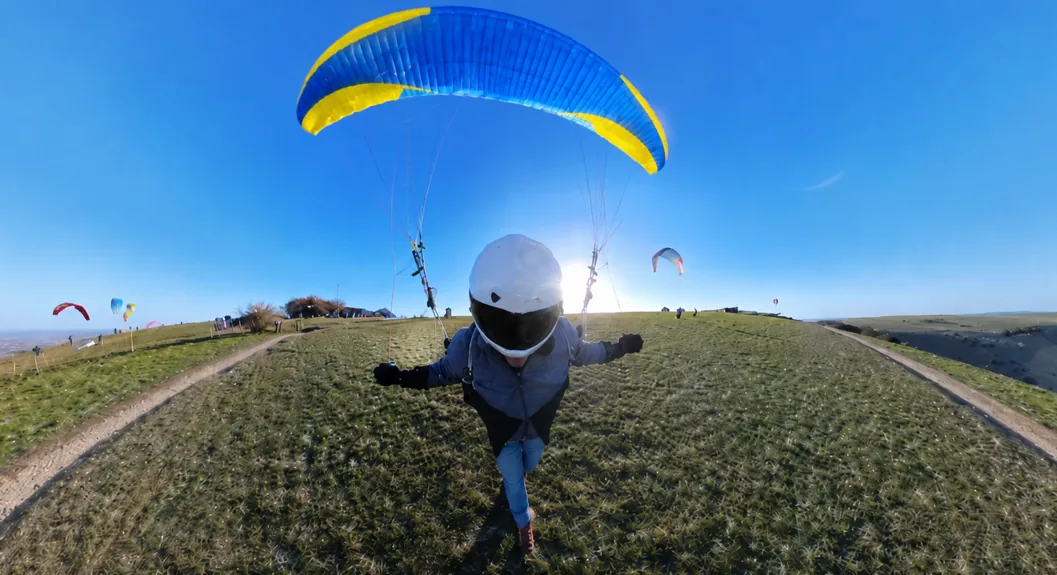
A tandem launch from Sesimbra's main ridge site is gentler than most first-timers imagine. The sequence is straightforward: you stand in front of Behrooz in the tandem harness, the wing inflates above you both — which you feel as a light, progressive pull on your shoulders — and then you run forward together for three or four steps. The wing does the lifting. You are not jumping off anything. You are being carried upward.
The moment your feet leave the ground is the one that first-timers most often describe as the most intense. It happens quickly. One step you have ground under you; the next you don't. For many people this is where the adrenaline peaks — a brief, sharp spike that typically fades within the first 30 seconds of flight as the body registers that it is suspended safely and not falling.
The sensation is not a drop. There is no stomach-lurching falling feeling of the kind you get on a roller coaster or when a lift descends suddenly. You are moving upward and forward, carried by a wing that is developing lift. The body's experience of this is closer to being in a very smooth chairlift than to any freefall experience. The ground recedes gradually. The view opens. The noise of the launch site fades.
The First 60 Seconds in the Air
What most people notice first is the quiet. Paragliders are nearly silent — the only sound is the soft rush of air and the occasional creak of the harness or brake handle. After the noise and activity of the launch, this silence lands differently than expected. For many first-timers it is the moment the flight stops being frightening and starts being beautiful.
Within the first minute, the majority of tandem passengers have made a verbal observation about the view. The Atlantic coastline from 200–300 metres above the Sesimbra ridge is genuinely spectacular — the bay below, the castle on the hill, the wide ocean to the south. The brain shifts from survival-scanning to taking things in. The body relaxes.
After thousands of tandem flights from Sesimbra, the most common post-landing reactions fall into a pattern. "It was so peaceful" — said by almost everyone who expected it to feel like a thrill ride. "Why wasn't I scared?" — said by people who had worked themselves up beforehand. "Can we go again?" — said by a significant majority. The fear rarely survives the first 60 seconds of flight. What replaces it is usually wonder, calm, and a strong desire to stay up longer.
When It Does Feel Unsettled
The air is not always perfectly smooth, and it's worth being honest about this. On a thermic day — typically in the afternoon when the ground has heated and convective air is rising — a paraglider will encounter small bumps and movements as it passes through columns of rising and falling air. These feel like light turbulence in an aeroplane: a gentle shift, maybe a slight rock of the harness. They are not dangerous in the type of conditions Behrooz flies in, but they are noticeable.
The coastal ridge soaring sessions at Sesimbra are generally the smoothest type of paragliding flying there is. The northwesterly sea breeze produces consistent, laminar lift along the ridge — no thermals, minimal turbulence, reliable and predictable airflow. These are conditions specifically suited to first-timers and anxious passengers. Behrooz does not fly tandem passengers in conditions that produce significant turbulence, and if the day develops in a way that the air becomes uncomfortable before landing, the flight ends early. That call is always the pilot's.
Ridge Soaring vs. Thermic Flying — What Anxious First-Timers Should Know
The distinction between ridge soaring and thermal flying matters more than most introductory articles acknowledge. The two types of paragliding feel completely different to a passenger.
Ridge soaring — the dominant flying style at Sesimbra in summer — uses the mechanical lift created when wind strikes a hillside or coastal ridge and deflects upward. The air is smooth and consistent. The pilot works the lift band along the ridge, and the flight is characterised by gentle, sweeping turns and a stable, predictable environment. This is the paragliding that most closely matches the image of peaceful soaring that first-timers hope for.
Thermal flying — used for cross-country and longer flights — involves climbing inside columns of rising warm air. The entry into a thermal can be bumpy. The air movement is dynamic and varied. This is excellent flying for experienced pilots who understand and enjoy that dynamism, but it is not what happens on a first tandem flight, and Behrooz does not put first-time passengers into thermic conditions without a specific conversation about what to expect.
If You Are Particularly Nervous — What to Do Before Your Flight
Being nervous before a first flight is not a problem to solve. It is a normal state that almost always resolves itself within the first few minutes of being in the air. But if your anxiety is significant — if you've been worried about it for days rather than just the hour before — there are things that help.
- Talk to Behrooz beforehand. Seriously. Message him the day before, explain what you're worried about, and let him answer specifically. Most anxiety about paragliding is rooted in misunderstanding what the experience is like. An accurate picture of what will happen reduces the unknown, and the unknown is usually what the fear is actually about.
- Watch other people fly first. Coming to the launch site and watching a few flights before your own gives your brain concrete visual information to replace the imagination. What you see is rarely as dramatic as what you imagined.
- Choose a good-conditions day. The difference between a calm summer morning ridge flight and an afternoon thermic session is enormous for an anxious first-timer. The right conditions exist most mornings in Sesimbra from May through September. If the day looks wrong, wait for a better one.
- Don't overthink the gear. The harness is secure. The wing is certified. The pilot knows the site. Trust the system and direct your attention to what you can actually see and feel.
The Honest Summary
Paragliding is not a white-knuckle experience. It is not designed to overwhelm you with adrenaline. The fear, when it exists, is typically concentrated in the 10–15 minutes before takeoff and the moment of leaving the ground. After that, most people find themselves in a state they didn't fully anticipate: calm, absorbed by the view, aware of the air in a physical way that is new and interesting, and slightly reluctant for it to end. That is the typical arc of a first tandem flight. It is not universal, but it is what happens to most people, most of the time, in good conditions with a competent pilot.
The honest truth is that the fear is real — and so is the resolution of that fear, which tends to happen faster than almost anyone expects once they are actually in the air.