


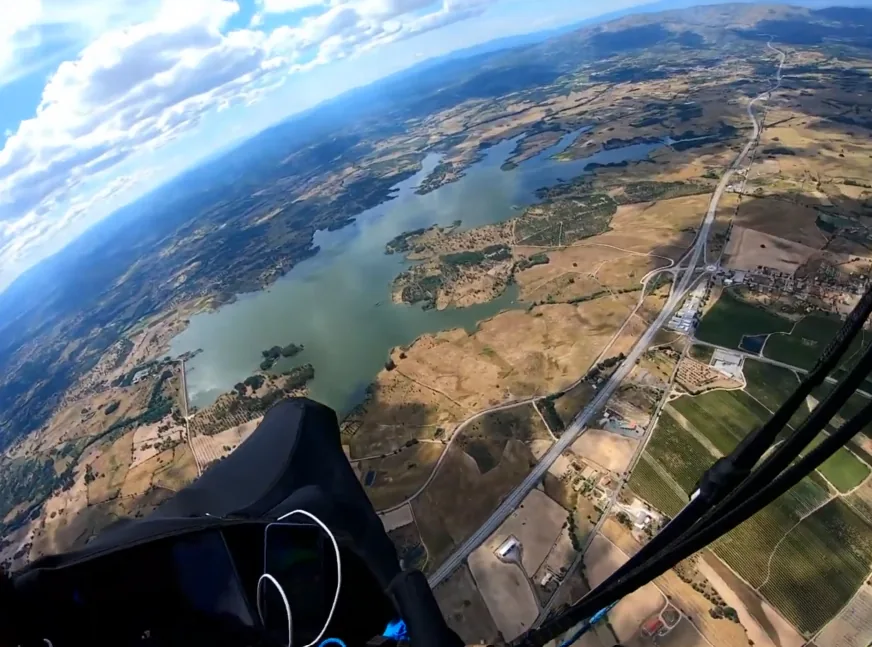
Most pilots who come to Portugal to fly are chasing the Atlantic coast and the Alentejo thermals. Few realise that three hours north of Sesimbra sits a completely different flying environment — Portugal's highest mountain range, with granite peaks rising to 1,993 metres at Torre, medieval villages perched on the ridges, and one of the most celebrated XC sites in the Iberian Peninsula. Serra da Estrela is not a casual day trip from the coast, but for pilots willing to build it into a longer Portugal itinerary, it delivers flying that is unlike anything else in the country.
The Serra da Estrela Massif — Geography for Pilots
Serra da Estrela (Star Mountain) is the highest point of mainland Portugal and the western end of the Central Iberian Mountain System. The massif runs roughly northeast to southwest for about 60 km, with the plateau above 1,500 metres dominated by granite moorland, glacial valleys, and the ski resort at Torre. The range creates a pronounced rain shadow: the western slopes receive Atlantic moisture, while the eastern side — where the main flying sites are — lies in the lee of the range and receives less rainfall, producing the stable, thermically active air that makes good paragliding.
The key paragliding location in Serra da Estrela is the medieval village of Linhares da Beira, on the eastern escarpment of the range. The village sits at 800 metres, with launches on the ridge above at around 900–1,000 metres and the valley floor at 300–350 metres below. The escarpment faces roughly east, catching the morning sun and generating thermal activity from late morning. It is one of the classic XC launch points in all of Portugal.
Linhares da Beira — The XC Site in Detail
The Linhares launch is a dedicated, well-established site with a clear gradient and a wide, obstacle-free takeoff area. The main launch faces east, which creates a clean thermal trigger from the sun warming the escarpment face. On a good spring or autumn day:
- Thermals begin cycling from around 10:00–11:00 local time
- Cloudbase reaches 1,800–2,500 metres above sea level on strong days
- The plain to the east provides easy outlanding in all directions
- Thermal streets form over the Beira Baixa plateau, pointing northeast toward the Spanish meseta
The XC potential from Linhares is significant. Pilots regularly make 80–120 km on good spring days, reaching into the Spanish Extremadura before turning around. The Iberian XC Tour — a cross-border flying route connecting the best sites of Portugal and western Spain — uses Linhares as a key waypoint. For pilots interested in that kind of exploration, it is a gateway launch.
How Serra da Estrela Differs from Coastal Portugal Flying
The contrast with Sesimbra and Arrábida is significant, and it's worth being clear about what that means in practical terms:
- Altitude: You're launching from 900–1,000 metres above sea level rather than 120–450 metres. A normal Linhares flight at cloudbase of 2,000 m means you're flying at 1,000 m above the launch — there is considerably more air between you and the ground.
- Thermal character: Mountain thermals at Linhares are stronger and more compact than the wide, gentle thermals over the Alentejo plains. They require active glider control and a pilot comfortable working inside a proper thermal column.
- Weather variability: Mountain weather at 900–1,993 m changes faster than coastal conditions. Rapid overdevelopment, unexpected convergence, and mountain wave effects are all real possibilities that a pilot flying here needs to monitor and understand.
- Valley complexity: The Beira Baixa plain to the east is outlanding-friendly, but the escarpment itself has more terrain options to consider than the flat coastal approach at Bicas.
Season Windows — When to Fly Serra da Estrela
The reliable flying windows at Linhares are late March through May and September through October. These brackets avoid the summer storm risk and the winter snow and instability that can close the site for extended periods.
Spring (late March–May): Best XC potential. Strong thermals, good cloudbase, long days. Watch for rapid overdevelopment from early afternoon in May — launch early.
Summer (June–August): Powerful thermals but frequent afternoon thunderstorms. Only for experienced mountain pilots with strong weather reading, launching before 12:00.
Autumn (September–October): Best for quality over quantity — thermals are cleaner and more predictable than spring, fewer storms, stable afternoons. October is the recommended month for first-timers to Linhares.
Winter (November–February): Snow at altitude, cold temperatures, unstable systems. Not recommended for visiting pilots.
Combining Serra da Estrela with a Portugal Flying Trip
Most pilots flying with me base themselves in Sesimbra for the coastal and Alentejo experience, and add Serra da Estrela as a one- or two-night extension. The drive from Sesimbra to Linhares da Beira is approximately 3 hours via the A23 motorway. The combination makes excellent travel sense:
- Days 1–4 at Sesimbra: Atlantic ridge soaring at Bicas, possible Arrábida thermal day
- Days 5–6 at Linhares da Beira: mountain XC flying and the medieval village experience
- Day 7: Drive back to Lisbon (2.5 hours) or continue to fly in Alentejo on the return route
Linhares da Beira itself is worth the drive for reasons beyond the flying. The medieval castle, the schist stone architecture, and the slow pace of the village are genuinely restorative between flying days. Accommodation in and around the village is simple but characterful — agri-tourism houses and small rural guesthouses that fit perfectly with the kind of week this is.
Skill Level Requirements
Serra da Estrela and Linhares are intermediate to advanced pilot territory. I recommend a minimum of solid P3 (BHPA) / EN B competency before attempting Linhares independently — you need to be thermalling confidently, reading your vario reliably, and able to make weather decisions mid-flight. Pilots who want the Serra da Estrela experience with coaching can discuss building it into a longer trip; the logistics work, though Linhares is not a site I include as a standard part of my weekly programmes.
Frequently Asked Questions
Is there a paragliding school or club at Linhares da Beira?
There is an active local paragliding club with knowledge of the site. For visiting pilots who are competent at their level, arriving on a good forecast day and meeting local pilots at the launch is the standard approach. The club is welcoming to visiting pilots and the site information is generally available through Portuguese paragliding community channels. As with all mountain sites, local knowledge about specific weather patterns and the site's quirks is invaluable — the first flight at Linhares benefits enormously from a local debrief beforehand.
Does snow at Torre affect flying at Linhares?
Indirectly, yes. When the plateau above 1,500 m is snow-covered, the cold air mass over the high ground can suppress thermal development on the eastern escarpment, even when the valley is warm and sunny. The spring thaw (usually March–April) can create interesting convergence effects as cold air from the snow-covered plateau meets the warming valley air — which is visible as cumulus forming over the ridge. Watching this process and understanding when it becomes problematic versus when it's useful ridge lift is part of the local weather reading that makes Linhares an interesting site.
Can I access Serra da Estrela by public transport?
Technically yes — bus services run from Lisbon to Covilhã (the main town below Serra da Estrela), and from Covilhã local taxis reach Linhares da Beira in about 20 minutes. But carrying a paraglider and harness on public transport, without a retrieve vehicle organised in advance, makes the logistics awkward for a multi-day flying trip. A rental car from Lisbon Airport and the 3-hour drive is significantly more practical, and gives you the retrieve flexibility that XC flying requires.
Build a full Portugal flying itinerary
Coast, Alentejo XC, and Serra da Estrela mountain flying — all within a 10-day Portugal trip. Message me and I'll help you plan the sequence around the forecast and your level.