


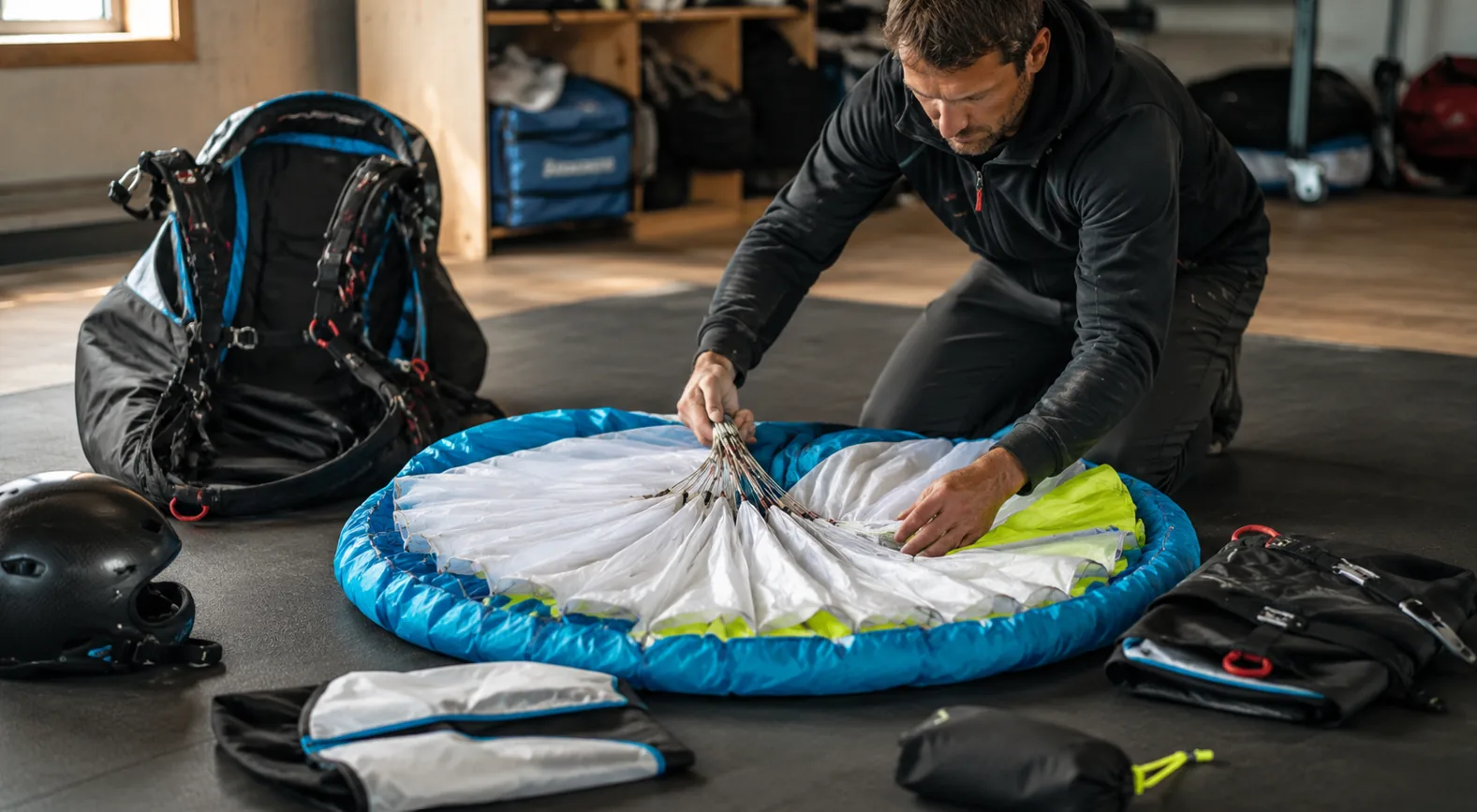
Your reserve parachute will spend its entire life folded in a harness pocket. With luck, it stays there. But it exists precisely for the scenarios where luck runs out — a cravat that won't clear, a collapse that won't recover, a mid-air situation that demands immediate action. When that moment comes, there is no time to remember theory. The only thing that works is an automatic response built through SIV training. Everything else — choosing, buying, maintaining — is the groundwork that makes that response possible.
The Three Types of Reserve
Round reserves
The traditional design: a circular canopy that deploys reliably and descends predictably at around 5–6 m/s. Round reserves are the reference standard against which everything else is measured. They are non-steerable — once deployed, you go where the wind takes you, which may or may not be toward a good landing area. For most recreational flying, including coastal flying in Portugal where landing options are generally good, a quality round reserve is the sensible choice. They are lighter, simpler, and less likely to malfunction during deployment.
Steerable reserves (SQR and variants)
Square or semi-square reserves allow limited steering — typically 30–45— of turn authority — by pulling on toggles attached to the rear risers. This lets you avoid obstacles, turn away from water, or angle toward a better landing field. The trade-off is complexity: they are heavier, require a slightly longer deployment time, and can oscillate more during descent. They are particularly valuable for XC flying over terrain with limited landing options. For coastal flying at Sesimbra, where the sea is one direction and flat ground is the other, a round reserve is usually sufficient.
Rogallo reserves
A delta-shaped design with significantly more glide (around 3:1) and full steering ability. Rogallo reserves allow you to fly away from obstacles and toward specific landing areas, but they are heavier, pack larger, deploy more slowly, and have more complex handling characteristics. They remain a niche choice for very experienced pilots flying in technical terrain.
Choosing the Right Size
Reserve sizing is based on total suspended weight — your body weight plus glider, harness, pack and anything you are carrying. The reserve manufacturer specifies a maximum suspended weight, and you must be comfortably below it. Comfortably means with margin: if the maximum is 110 kg and your total weight is 108 kg, look at the next size up. Sink rate climbs non-linearly as you approach the reserve's limit, and a sink rate above 6.5 m/s results in landing forces that cause serious injuries regardless of landing technique.
As a practical rule of thumb: total suspended weight — 1.05–1.10 gives you the target reserve maximum rating. If you weigh 80 kg all-up, a reserve rated to 90 kg gives you adequate margin.
Harness Compatibility and Routing
Reserves must be compatible with your harness in two respects: the reserve container must fit the harness pocket, and the deployment handle must be accessible. Many accidents involve reserves that were never deployed not because the pilot panicked, but because the handle was buried under a pack, routed behind the seat board, or had worked its way into an inaccessible position during previous flights.
When you buy a new harness or a new reserve, have the combination fitted by a qualified rigger. After every 10–20 hours of flying, reach down and locate the deployment handle without looking. If you ever cannot find it in under two seconds, re-route before your next flight.
1. Locate. Find the handle — reach for it in the same motion every time, from the same grip position. 2. Extract. Pull the handle firmly until the reserve clears the container; this may require one hard pull or several. Do not stop pulling. 3. Throw. Throw the reserve away from the glider — hard, into clear air, out to the side or upwind. Do not throw it into the glider. 4. Clear the glider. If the main canopy is still flying and tangling with the reserve, collapse it by pulling both brakes to full or wrapping the A-risers. A flying main glider in reserve deployment is a problem; a collapsed one is not.
Repacking Intervals
Most manufacturers specify a repacking interval of 6 months to 1 year. This is not bureaucracy — nylon fabric takes a compression set in the folded position, and a reserve that has sat packed for two years will take longer to open than one packed last month. Opening time in a real deployment scenario matters: the difference between 100 m and 150 m of altitude lost before the reserve is flying is the difference between reaching a field and hitting a tree.
Have your reserve repacked by a certified rigger, not by yourself. The packing sequence is specific to the reserve type and affects deployment reliability. Many flying schools and clubs offer repacking services, and it typically costs €30–60.
SIV Training and the Reserve
Knowing the theory of deployment is not the same as having practised it over water with a safety boat. An SIV course includes reserve throws — actual deployment over a lake, with a rescue boat positioned below. Pilots who have done this once know, at the level of muscle memory, what it feels like to locate the handle, pull it, throw it, and see the canopy open. Pilots who have only read about it are operating on theory in the worst possible moment.
If you have never done a reserve throw, an SIV course is the most important safety investment you can make. It costs less than a hospital stay and far less than the alternative. It also addresses the psychological barrier that prevents many pilots from deploying when they should: pilots who have felt the reserve open are far more likely to deploy early enough to matter.
For the broader question of how safe paragliding is, the reserve is one piece of a larger safety picture. Equally important is the question of when to deploy — most experienced pilots agree that pilots deploy too late, not too early. When in doubt, throw it out.
When packing for a flying trip, see the paragliding packing guide — it includes a reserve checklist section covering repacking documentation, deployment loop condition, and container seal integrity.
What to Check Before Every Trip
- Repacking date and manufacturer's interval — is it overdue?
- Deployment handle: visible, unobstructed, accessible in under 2 seconds
- Deployment loop: intact, no fraying at the handle attachment point
- Container seal: closing loop and pin secure but not over-tight
- Reserve risers: routed correctly through harness, not crossed
- Carabiners connecting reserve to harness: locked, correct kN rating