


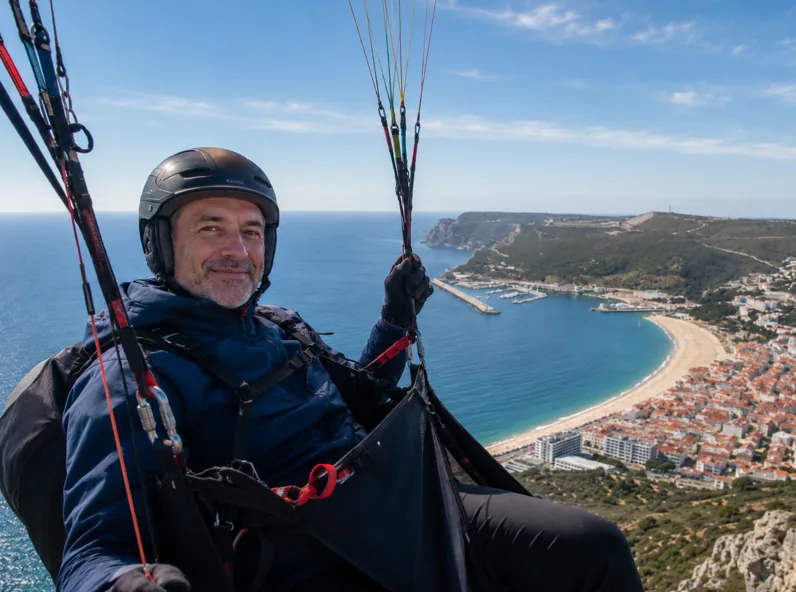
A significant proportion of Behrooz's coaching guests are between 50 and 70 years old. Some started paragliding in their 20s and have been flying for decades. Others picked up their licence in their 50s, having waited until the children left home or the career found a steadier rhythm. A few are complete beginners who discovered the sport late and are approaching it with the patience and focus that only comes with experience. What they share is that age, in paragliding, is far less of a limitation than most people assume.
The Age Myth in Paragliding
There is no upper age limit on paragliding. There is no licence expiry date. The sport does not select against older pilots — if anything, the qualities that develop with age are some of the most valuable you can bring to the sky.
The fear most pilots over 50 express when they first enquire about a coaching week is some version of: am I past it? The question is understandable, but it is based on a misreading of what the sport actually requires. Paragliding is not a young person's sport in the way that motocross or competitive football is. It rewards calm judgement, patience with conditions, emotional self-regulation, and the willingness to turn around and land when the day is not cooperating. All of these qualities tend to improve with age.
What Changes After 50
Honesty is more useful than reassurance here. There are things that change after 50 that are relevant to flying:
- Reaction time slows slightly. In paragliding, this matters less than it might seem — the active inputs that count most are not lightning-fast reflexes but sustained, proportional responses to canopy feedback. The half-second that separates a 25-year-old from a 60-year-old in reaction speed is not usually the limiting factor in competent paragliding.
- Physical recovery takes longer. A week of flying and hill walking leaves a 60-year-old more tired on Thursday than a 30-year-old. This is manageable — Behrooz adjusts the programme intensity based on how the group is doing, and pilots who need a rest day get one without any pressure.
- Flexibility is often reduced, which can affect ground handling if the pilot is not used to the physical movement involved in kiting a wing. A little targeted stretching before the week makes a noticeable difference.
- Fitness is variable and individual, not age-determined. A fit 65-year-old is a better flying candidate than an unfit 35-year-old. The relevant fitness for a Sesimbra week is: can you walk 30 minutes uphill with a wing bag? Can you stay alert and focused for a 2-hour soaring session? Both are achievable for the majority of pilots who enquire.
What Improves After 50
This list is longer than the one above, and matters more for how the week actually goes:
- Risk management. Older pilots are significantly less likely to push into conditions that are too strong, launch when there is doubt, or make the kind of impulsive decision in the air that accounts for most serious paragliding incidents. The self-preservation instinct and the willingness to wait are well-developed by 50.
- Emotional regulation. A bad launch, a frustrating non-flying day, a flight that did not go as planned — these things are processed differently at 55 than at 25. Older pilots are generally more resilient when the weather doesn't cooperate and less likely to get rattled by a challenging moment in the air.
- Focus under instruction. Pilots over 50 tend to listen more carefully during briefings and apply coaching feedback more consistently. They are less likely to tune out during a debrief because they have learned that attention is valuable.
- Patience with learning. The willingness to repeat a ground handling drill until it is correct, to do five launches before being satisfied with one, to come back on the second day and work on the same thing again — this patience is more commonly found in older pilots.
One of the pilots I coached last season was 65 and had been flying for twelve years. He knew his wing extremely well, had excellent situational awareness, and made the calmest decisions of anyone in the group during an unexpected sea breeze strengthening. He flew his longest XC of his life that week — 47 km. His age was not a factor. His experience was the factor.
Physical Fitness — What Actually Matters
Paragliding does not require athletic fitness. It requires what you might call functional fitness — the ability to do specific physical tasks repeatedly over the course of a week without accumulating injury or exhaustion.
The physical demands of a Sesimbra coaching week are:
- Walking 20–40 minutes uphill to the launch, carrying a wing bag (roughly 12–15 kg including harness)
- Kiting the wing on the ground (requires good balance and some arm strength)
- A run of 5–15 metres on launch (not a sprint — a brisk walk, in most conditions)
- Sitting in a semi-reclined position for 1–3 hours during soaring sessions
- A landing that requires standing from the harness position quickly
None of these tasks require exceptional fitness. A pilot who can go for an hour's walk without stopping is physically prepared for a coastal soaring week. XC days add more complexity, but the physical demands are similar.
Tandem First — The Right Entry Point for Some
For pilots over 50 who are not yet licensed, a tandem flight is the natural first step. It removes all the physical and technical demand and gives you the experience of flight itself — the sensation, the views, the silence — without needing to manage anything. Many pilots in their 50s and 60s take their first tandem flight and immediately decide to go further with the sport. The tandem experience is also a way for licensed pilots to reconnect with why they fly, or to share the experience with a non-flying partner.
The Radio Coaching Advantage for Older Pilots
Personal radio coaching is the defining feature of Behrooz's coached weeks — and it is arguably more valuable for older pilots than for younger ones. Here is why.
Younger pilots often learn through trial and error in the air: try something, get feedback, adjust, repeat. This approach is fine when you can afford a lot of repetitions and your physical resilience absorbs the effort. For older pilots, the radio shortcut is more valuable: instead of needing to discover through experience why a particular approach to a thermal is not working, you hear the correction in real time, apply it immediately, and see the result on the same flight. The learning curve is steeper and the physical cost lower.
Behrooz's coaching is not about protecting older pilots from challenge — it is about making the challenge more precise. The goal is always the same: more competent, more confident flying. Age changes the method slightly. It does not change the ambition.
If you are over 50 and considering your first coaching week abroad, message Behrooz on WhatsApp. He is happy to discuss your specific situation, what level of fitness and experience is relevant, and which programme suits you best.