


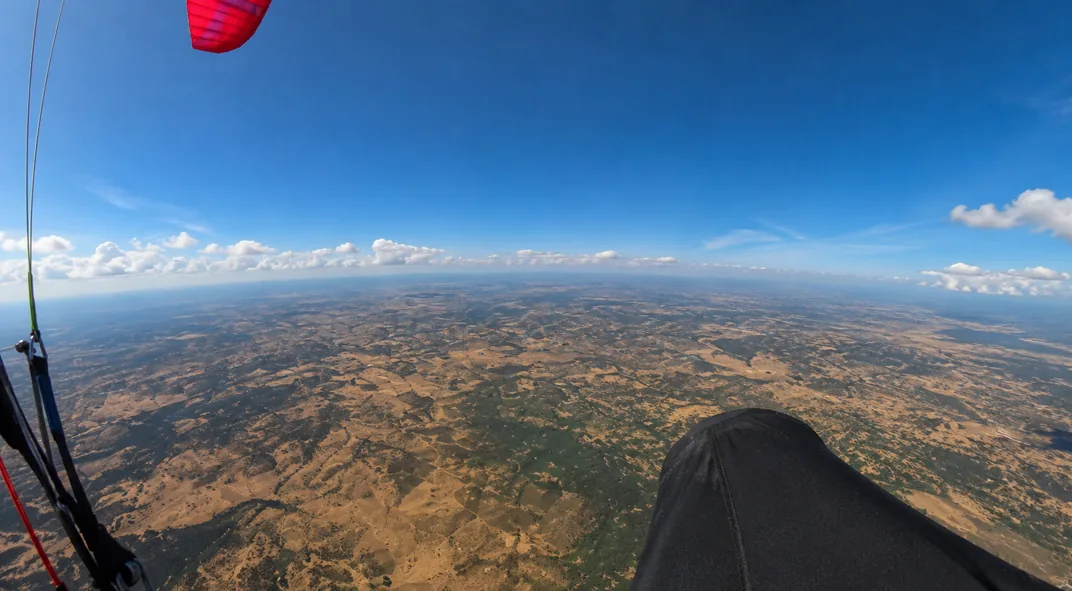
I launched from Sesimbra one April morning and landed in Extremadura that afternoon — 200 kilometres and an international border behind me, all under the same wing. Paragliding the Iberian Peninsula as a cross-border XC route is genuinely possible for intermediate-advanced pilots when the conditions line up, and I've run the Iberian XC Tour long enough to know exactly when they do. The thermal corridor from the Atlantic coast of Portugal through the Alentejo plain and into the Spanish meseta is wide, outlanding-friendly, and flyable from March through September. This guide covers the route, the waypoints, the cross-border logistics, and how the programme is structured.
Why the Iberian Peninsula for XC?
Most European XC destinations are mountain-dependent: the Alps, the Pyrenees, the Dolomites. The thermals are strong but the terrain is punishing for outlanding, retrieve distances are short because the mountains compress the route, and the weather window narrows sharply outside summer. Iberia is different in almost every respect:
- Outlanding is generous. The Alentejo and Spanish Extremadura are among the most outlandable terrain on the planet — tens of thousands of square kilometres of flat to gently rolling farm and scrub land. Fields are large, obstructions are minimal, and the typical outlanding involves a short phone call and a 20-minute drive rather than a helicopter.
- The thermal window is long. March through September is flyable, with peak performance in May–June and September when thermals are strong but base height is not extreme. July–August is very strong but can push base above 3,000 m, requiring careful dehydration management in the field.
- The corridor is wide. There is no fixed line you need to follow to make distance — the Alentejo allows routing variation of many kilometres without losing time or compromising outlanding options.
- The distances are real. 150–250 km days are achievable for intermediate-advanced pilots on modern EN B/C gliders. With the right conditions, even conservative pilots with solid XC skills regularly fly 80–120 km on their first Iberian days.
The Thermal Corridor — From Sesimbra to the Meseta
The practical XC route across the western Iberian Peninsula follows the thermal corridor from the Setúbal Peninsula east and northeast across Portugal and into Spain. The geography drives the routing: the Atlantic coast generates the onshore pressure that keeps wind light during the flying day; Alentejo's flat exposed terrain heats rapidly and produces consistent thermals from mid-morning; the ridge that marks the Portuguese-Spanish border at 400–600 m adds a final push of orographic lift before the Spanish meseta opens up beyond.
Key waypoints and distances
| Waypoint | Distance from Sesimbra | Terrain character | Significance |
|---|---|---|---|
| Palmela ridge | 20–30 km | Low ridge, vineyard/scrub | First transition off the coastal ridge; confirms thermal day |
| Alcácer do Sal | 50–70 km | River valley, rice fields, cork oak | Critical glide across Sado valley; good first-day landmark |
| —vora area | 80–100 km | Rolling Alentejo plateau, 250–300m | Open thermal country; strong pilots push for 2+ more thermals here |
| Portalegre–Elvas corridor | 130–155 km | Plateau edge, approaching border ridge | Orographic boost available off the border Serra; confirms Spain crossing |
| Badajoz–Mérida, Spain | 160–200 km | Spanish Extremadura, vast flat plains | Classic 200-km retrieve point; comfortable outlanding anywhere |
| Cáceres, Spain | 220–260 km | Spanish meseta, granite hills | Top-end Iberian day; exceptional conditions required |
The Thermal Clock — Reading an Iberian XC Day
Iberian thermals follow a reliable daily pattern that differs from Alpine flying in important ways. Understanding this rhythm is what separates pilots who fly consistent XC from pilots who repeatedly land short:
- 08:30–10:00: Morning moist layer is often present, suppressing thermals. Coastal sea-breeze may be active. Do not launch chasing early bubbles — they are often weak and short, and launching early wastes position near the coast.
- 10:00–11:30: Thermal development begins inland, first blue thermals appear. Good pilots launch at the lower end of this window after seeing at least one usable thermal from the ground.
- 11:30–16:00: Peak window. Thermals are strong (2–4 m/s), heights building to 1,800–2,800 m depending on season and moisture. This is your XC window — maximum distance per hour.
- 16:00–18:30: Thermals begin to weaken and cycle longer. Experienced pilots can still make distance. Sea breeze often pushes inland by 17:00–17:30, creating a helpful tailwind for east-bound pilots.
- After 18:30: Unless on a strong day with late thermals, plan for outlanding. Pushing on in weak evening air creates low saves and poor decision-making. Land, call retrieve, congratulate yourself on a distance flight.
Cross-Border Logistics
Flying from Portugal into Spain on a single flight raises practical questions. The answers are largely straightforward:
Airspace: Both Portugal (NAV Portugal) and Spain (ENAIRE) use standard ICAO airspace structures. The Alentejo corridor to the border is predominantly uncontrolled Class G below 2,500 ft AMSL (with local CTRs around Beja and —vora airports to route around). Study the charts before flying — xcontest and xcplanner both overlay airspace.
Border crossing by air: Portugal and Spain are both Schengen zone — there is no passport requirement for EU/EEA pilots. Non-EU pilots should carry identification but there are no aviation-specific border controls at this level of airspace.
SIM cards and phone coverage: Portuguese SIM cards work in Spain without roaming charges (EU rules). Spanish coverage in Extremadura is generally good even in rural areas.
Retrieve logistics: I handle cross-border retrieves as part of the Iberian XC Tour — the retrieve vehicle crosses with the group and I have Spanish route knowledge built from years of running this programme. Solo cross-border retrieve by rental car is possible but requires careful pre-flight coordination.
Multi-Day Iberian Flying
The single most common question I get about Iberian XC is: "Can we do it as a multi-day trip?" The answer is yes — and it's the most rewarding format. Flying east-to-west one day, retrieving, driving the van back, and flying again the next day is not efficient. Instead, a staged route or a hub-and-spoke approach works better:
- Staged route: Fly east as far as conditions take you, sleep in the field location (—vora, Elvas, or Badajoz all have accommodation), and fly back west on a suitable westerly day. Two-day out-and-back with overnight in Alentejo.
- Hub-and-spoke from Sesimbra: Day 1 east to —vora region. Retrieve. Day 2 different route, perhaps north toward Linhares. Return. Covers two different corridor experiences from the same base.
- The Iberian XC Tour format: We fly east across Portugal and into Spain on day 3 or 4 of the programme (after two days building XC confidence on shorter inland routes). The group is together in the retrieve vehicle all day. It is a structured adventure rather than a solo expedition.
The Iberian XC Tour Programme
The Iberian XC Tour is a structured 7-day programme that builds toward the cross-border flight progressively rather than attempting it on day one. The first two days are flown from Sesimbra coastal and inland sites, building comfort with Portuguese thermals and outlanding culture. Days three and four move to the Alentejo thermal corridor. Day five or six is the Spain crossing attempt — conditions permitting. The final days either extend the east route or use a westerly day for a return flight.
The programme runs from March through September. The March–April and September windows are often the most satisfying: thermals are strong but not violent, base is at useful heights (1,500–2,200 m), and the landscape has colour. July and August work but require more hydration discipline and the higher base (2,500–3,200 m) demands more oxygen awareness.
Frequently Asked Questions
What glider rating is needed for the Iberian XC Tour?
Minimum P4/EN C, with demonstrated XC experience — at least a handful of flights over 50 km and proven outlanding and retrieve experience. Strong P3 pilots on EN B gliders with documented XC hours are assessed case by case. The requirement is less about glider rating and more about demonstrated comfort with being away from landable terrain for extended glides, reading the thermal clock, and making sound outlanding decisions under fatigue. Message me with your flight log summary and I'll give you an honest assessment.
What if the weather doesn't allow the Spain crossing?
The Iberian XC Tour always has a full flying programme regardless of whether the specific cross-border day materialises. Portugal's Alentejo alone offers 100+ km potential on a good day — a full week of Alentejo flying is an excellent XC training block in its own right. The Spain crossing is the ambition, not the requirement. In practice, most tours manage the crossing at some point during the week because we have the schedule flexibility to wait for the right day.
How long is the retrieve from Spain?
From Badajoz or Mérida to Sesimbra, the retrieve is typically 2.5–3 hours by road. It's a long van ride, but it's also where the day gets replayed, routes get analysed on XCTrack, and group camaraderie deepens considerably. I've had pilots tell me the retrieve from Spain was one of their favourite parts of the week. We stop for food in Portugal on the way back — the Alentejo has excellent roadside restaurants.
Cross the Iberian Peninsula under one wing
The Iberian XC Tour runs March–September. 7 days, maximum 5 pilots, full retrieve support. Message me to check dates.