


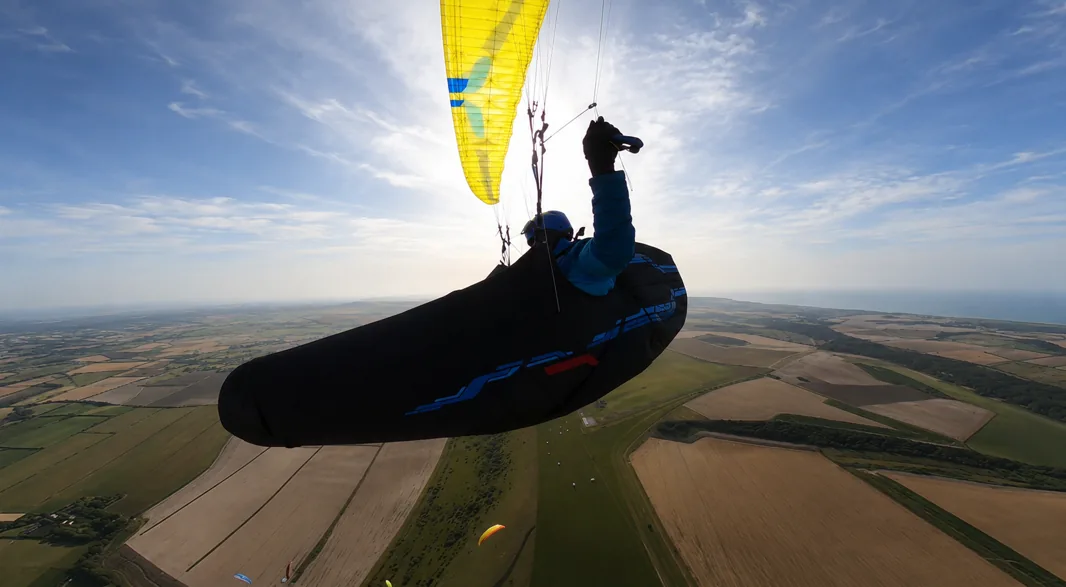
Most beginners spend their first months obsessing over which wing to buy. The harness is treated as an afterthought — something you sit in, strapped to the important thing above you. This is exactly the wrong way to think about it. The harness determines your comfort over a six-hour XC flight, your access to the reserve parachute in an emergency, how much aerodynamic drag you generate in every glide, and how well you can feel and transmit brake inputs to the wing. Choosing the right harness for your level is one of the highest-leverage decisions in your early flying career.
Why the Harness Matters More Than Beginners Realise
When I coach pilots on the Atlantic coast at Sesimbra, one of the first things I notice is how many intermediate pilots are flying in harnesses that actively slow their development. They're sitting in a position that limits their weight-shift authority, or they've jumped straight into a pod harness without the ground handling skills to manage it on a clifftop launch. The equipment isn't neutral — it either supports your development or it creates friction at every turn.
Three things the harness directly affects:
- Comfort — a harness that fits well and supports the lower back lets you fly for hours without fatigue. A harness that digs into your legs or leaves your lumbar unsupported produces real pain before you've reached your second thermal.
- Safety — rescue container placement, handle accessibility, and certification all vary enormously between harness categories. Getting to your reserve handle in a real emergency is not a time to be figuring out where it is.
- XC efficiency — a pod harness reduces aerodynamic drag by 15–20% compared to an upright design. Over a 100km flight in still air, that's a meaningful difference in glide ratio and final glide margin.
The Four Harness Types
Beginner Upright Harness
The upright harness is where every paraglider's equipment journey should begin. The pilot sits in a relatively upright position — typically between 20— and 35— reclined from vertical — supported by a high back panel that wraps around the lumbar and lower thoracic spine. Entry is straightforward: you step into the leg loops, clip the chest strap, and the harness does the rest. Most upright designs include a front cockpit pocket for instruments, food, and water. The rescue container sits behind the pilot, either with a single central handle or dual side handles depending on the manufacturer.
For coastal soaring — which is the primary flying environment around Sesimbra — the upright harness is entirely appropriate even for experienced pilots. You want your body position flexible enough to look back at the ridge, watch the other pilots, and react quickly to changing conditions. The more reclined you are, the more tunnel vision you have on what's directly in front.
Recommended brands in this category: Advance Alpha, Gin Genie Race 2, Sup'Air Altirando. Price range: €350–600.
Pod Harness
The pod harness — also called a cocoon or legshield harness — changes the pilot's body position significantly. A rigid or semi-rigid legshield closes around the pilot's legs once airborne, creating a streamlined fairing that dramatically reduces frontal area and drag. The recline angle is typically 50— to 70— from vertical, meaning you're almost lying back in the sky.
The aerodynamic advantage is real: independent testing from the DHV puts the typical drag reduction at 15–20% compared to an upright harness at cruise speeds. Over a long XC flight this translates directly into glide ratio. A pilot flying at L/D 10 in an upright harness might achieve L/D 11.5–12 in the same conditions in a well-fitting pod.
The trade-off is ground handling complexity. To enter a pod harness, you need to click in, get the wing overhead, launch, and then slide your feet into the legshield during the climb. On a flat inland field this is simple. On a clifftop coastal site in 20 km/h of breeze with limited run-out below you, it requires competence and calm. I've watched pilots fumble with a legshield zip while their wing was getting pushed back — not a good situation. The pod is a tool for pilots who have earned it through solid ground handling hours.
Recommended brands: Woody Valley GTO Light (excellent construction, rational cockpit design), Advance Comfort, Gin Explorer. Price range: €600–1,200.
Light / Hike-and-Fly Harness
The light harness prioritises packability and weight above everything else. Stripped of padding, rigid back protection, and sometimes the cockpit entirely, a quality light harness can pack to the size of a day bag and weigh under 2 kg. This makes it the obvious choice for vol-biv touring, ridge hikes where the glider is carried to the launch on foot, or specific hike-and-fly racing formats like X-Alps or Xtreme Verbier.
What it gives up: the rescue container is smaller and less accessible, the seat is typically hard or minimally padded, and the back protection — if present at all — is a thin foam panel rather than a full airbag system. For a hike-and-fly specialist this is an informed trade-off. For anyone doing ordinary XC flying or coaching weeks, it's the wrong tool.
One more important point: light harnesses require a high level of ground handling expertise precisely because they offer less stability and padding. If you fall during launch or landing, there is less material between you and the ground. This category is for experienced pilots who have a specific use case for it, not for pilots who just want to save weight on their first kit purchase.
Recommended brands: Woody Valley Wani Light, Sup'Air Altirando, Gin Genie Light. Price range: €400–900.
Competition Harness
Full rigid cocoon, minimal volume reserve container, maximum aerodynamic efficiency. Competition harnesses are engineered for pilots flying EN D and competition-class wings in PWC or FAI events. Ground handling is genuinely expert territory — the entry and exit procedure in a strong coastal or mountain wind requires hundreds of practised repetitions. Not relevant for most pilots reading this guide.
The Sitting Position Difference and XC Performance
The shift from upright to reclined changes more than just aerodynamics. In an upright harness you have direct, immediate access to weight shift — lean left, the wing banks left. The connection is intuitive. In a deeply reclined pod the weight shift mechanics are similar but the feedback is different: you're moving your hips relative to the harness rather than your upper body relative to the air.
For pilots transitioning from upright to pod, I recommend a specific acclimatisation period of at least five to ten flying hours in benign conditions, specifically practising weight-shift inputs and understanding the new feel. Don't take a new pod harness to your first XC coaching week and expect it to feel normal — give yourself time to adapt in a safe, coastal soaring environment first.
Rescue Container: The Part Nobody Reads About Until They Need It
Every harness with an integrated rescue container has either a single central handle or dual side handles (one for each hand). The location varies enormously between manufacturers and even between models from the same brand. This matters in one specific scenario: when you need to deploy your reserve at altitude with your hands shaking and your brain operating in emergency mode.
The standard test: sit in your harness in your kitchen or garden. Close your eyes. Reach for the reserve handle. If you can't find it in three seconds without looking, you need to practise more. This is not a drill — it is the single most important physical habit in paragliding. Every pilot flying with me at Sesimbra who asks about their rescue container gets the same instruction: reach for it every time you put the harness on, before every flight, until it is completely automatic.
Inner containers (behind a zippered panel inside the harness) are standard on most recreational designs. Outer-accessible handles, where the reserve bag is accessible through a Velcro or zip panel on the outside of the harness, are common on competition designs. Both work — but check yours and know the routing before you ever need it.
Sizing: Back Length and Leg Loop Fit
Harness sizing is primarily about back length — the distance from your shoulder to your hip bone. This determines whether the seat plate of the harness sits under your thighs correctly or whether it rides too high (compressing the lumbar) or too low (leaving you unsupported). Most manufacturers publish back length ranges for each size, and most shops that sell paragliding kit can measure you correctly in five minutes.
Secondary: chest strap width and leg loop size. The chest strap should be set so that the two risers are approximately 40–45 cm apart — this matches the typical A-riser spacing on most wings. Leg loops should be snug without pinching the thigh; too loose and the harness slides, too tight and you'll lose circulation on long flights.
A fitting session in a hang-test rig is worth doing if at all possible. Hang tests — where you're suspended in the harness from a frame or bar — immediately reveal whether the seat position is correct and whether any adjustment is needed before your first flight.
When to Move to a Pod: Prerequisites
The specific question I get asked most often on coaching weeks is: "Am I ready for a pod?" My answer is always the same: it's not about hours logged — it's about ground handling quality.
Before you move to a pod harness, you should be able to:
- Kite your wing for 20+ minutes in variable 15 km/h wind without significant excursions or loss of control
- Execute a reverse launch and a forward launch with consistent technique in 10–20 km/h conditions
- Top-land reliably at a coastal or slope site with controlled approach speed
- Enter and exit the legshield on the ground until the sequence is completely automatic
If you can do all four consistently, a pod will serve you well. If any of those is shaky, stay in the upright until it isn't. Typically this point arrives somewhere between 80 and 150 hours for most recreational pilots.
Cockpit Organisation
The cockpit — the front pouch or panel on most XC harnesses — is where your flight instruments live. A well-organised cockpit has your vario mounted centrally at eye level when you look down, your radio accessible without unclipping anything, and water within reach of your left hand (or right, depending on which hand you fly with more). Snacks go in a zip pocket, not loose in the cockpit where they can migrate into your speed bar line.
A poorly organised cockpit is a distraction in the air. I've coached pilots who spent 30 seconds rummaging for their radio while a thermal was developing ahead of them. Organise it on the ground, test the access while seated, then leave it alone.
Harness Comparison at a Glance
| Type | Who It Suits | XC Efficiency | Ground Handling Demand | Price Range |
|---|---|---|---|---|
| Beginner upright | New pilots, coastal soaring, low-airtime XC | Standard baseline | Easy — step in, clip, fly | €350–600 |
| Pod harness | Intermediate to advanced XC pilots | +15–20% aerodynamic efficiency | Moderate — requires practised legshield entry | €600–1,200 |
| Light / hike-and-fly | Vol-biv, hike-and-fly specialists, very experienced pilots | Standard (less padding, lower weight) | Expert — minimal structure, harder falls | €400–900 |
| Competition | PWC / FAI competition pilots only | Maximum available | Expert — specialist ground handling required | €1,500+ |
Behrooz's Recommendation by Level
If you're a beginner or in your first 80 hours: buy a quality upright harness with an integrated airbag back protector. The Advance Alpha and Gin Genie Race 2 are both excellent choices — well-built, properly designed rescue containers, good cockpit access. Don't buy cheap: a €200 no-name harness saves you €200 and costs you confidence in the one system that keeps you attached to your wing.
If you're between 80 and 200 hours and your ground handling is solid: consider a pod, but only after completing a legshield-entry drill session at your home site in the wind conditions you actually fly in. The Woody Valley GTO Light is the harness I recommend most frequently in this category — it's well constructed, the cockpit is rational, and the rescue container is genuinely accessible. Don't let the marketing of high-performance pods push you into a choice you're not ready for.
Light harness only if: you are specifically doing hike-and-fly missions, you have excellent ground handling, and you understand what you're giving up. For most coaching weeks and standard XC flying, a pod gives you all the aerodynamic benefit you need with far less compromise on safety and comfort.
Put your harness on, sit in a chair or hang test rig, and close your eyes. Reach for your reserve handle. If it takes more than three seconds to find it, practise the sequence again. Do this every time you put the harness on — before every flight — until it is completely automatic. This is not optional. In a real deployment scenario at 300 metres, three seconds is an eternity.