


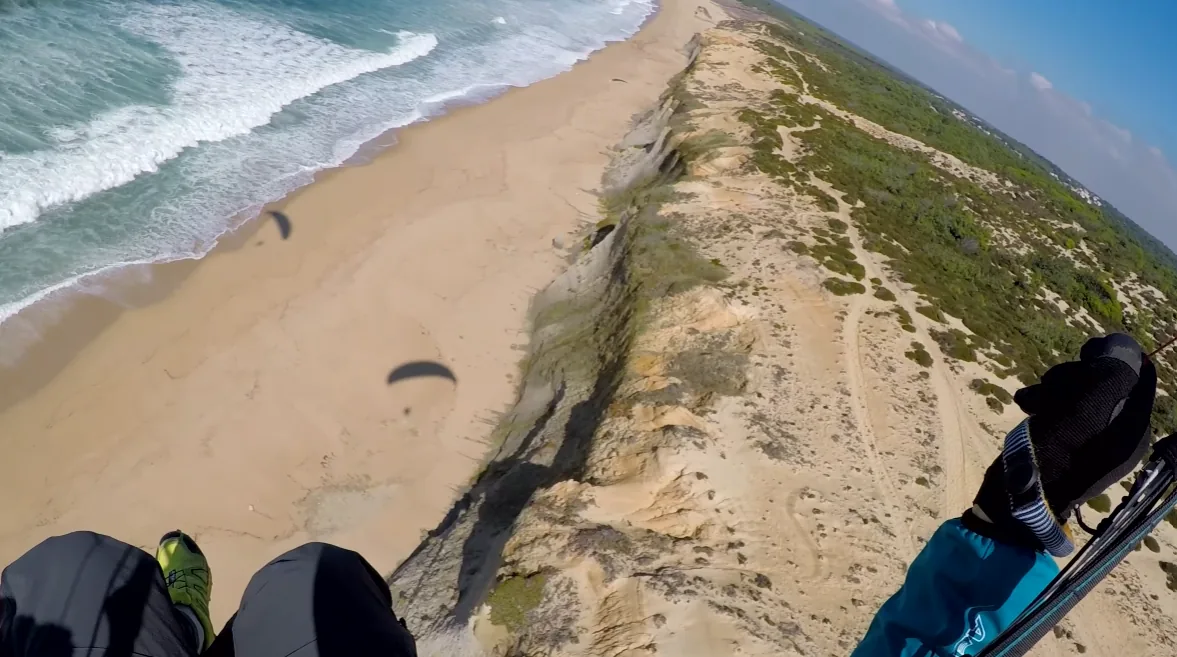
Comporta sits 60 km south of Sesimbra, at the point where the Setúbal Peninsula yields to the Alentejo coast. The landscape shifts completely here: no limestone cliffs, no ridges, no concentrated ridge lift. Instead there are wide white dunes, flooded rice paddies, cork oak groves, and a horizon that extends flat in every direction. It is a different kind of flying than the Sesimbra coastal ridge — quieter, more exploratory, with rewards for pilots who know how to read flat terrain.
What the Flying Is Like
The Comporta area is not a ridge soaring site. There are no cliffs tall enough or consistent enough in aspect to generate the kind of sustained ridge lift that pilots find at Sesimbra or Cabo Espichel. What Comporta offers instead is dune soaring on days when the nortada is moderate, and — more significantly — thermal flying over the contrast zones where the dune system meets the rice paddy flats and the pine forests inland.
The thermal triggers here are unusual. White sand dunes heat rapidly and generate strong convective lift, but they are surrounded by water-saturated rice paddies that cool quickly. The thermal boundary between these two surfaces — hot dune and cool paddy — creates reliable trigger lines that experienced pilots can follow. Add the pine forests inland, which heat more slowly but give longer, more consistent thermals, and the Comporta area becomes a fascinating ground-handling and thermalling laboratory.
Comporta is one of the most important white stork habitats on the Atlantic coast. In spring and summer, storks use the same thermal columns as paragliders — often circling in the same thermal at the same height. Following a stork to the core of a thermal is one of the most useful navigation tricks in Portuguese coastal flying. They are better at finding thermals than any instrument.
When to Fly Comporta
Spring (March–May) is the most reliable season for Comporta flights. The storks are present in large numbers, the nortada has not yet reached its summer strength, and the contrast between the warming dunes and the cooler paddy fields is at its sharpest. Days with a light to moderate north-westerly — 10–20 km/h at surface level — are ideal.
Summer is harder: the nortada can make the dune launches gusty and the thermals broken. Pilots with good ground handling skills can manage the conditions, but it is not the most forgiving site for pilots still developing their active flying instincts. Autumn is good again, particularly September when thermals are active and winds moderate.
How Comporta Fits Into a Flying Week
Comporta is typically a one-day excursion from Sesimbra rather than a destination in itself. The drive is about 75 minutes — south through the Troia Peninsula (requiring a short ferry crossing from Setúbal, or a longer inland drive via Alcácer do Sal). The ferry crossing takes 30 minutes and runs frequently in summer.
A Comporta day usually looks like this: morning ground handling and dune soaring when the nortada is manageable, lunch at one of the village restaurants (the seafood here is exceptional — less known and cheaper than Sesimbra), then afternoon thermal flying as the dunes heat and the wind typically backs off.
It is not a day for building hours or practising XC decisions — it is a day for experiencing a completely different landscape from the air, and for the pleasure of flying alongside storks in a place that looks like it has not changed in 50 years.
The Broader Alentejo Coast Context
Comporta is the northern end of the Alentejo coast — a 120 km stretch of largely undeveloped Atlantic shoreline that runs south to Porto Covo. The Setúbal Peninsula guide covers the flying immediately to the north. The Costa da Caparica to the north of Sesimbra offers a third variant — a different exposure, different conditions, different character.
For pilots who want to explore the full range of Atlantic coast flying rather than repeating the same ridge day after day, Comporta represents the southernmost node in a triangle of coastal flying that the Sesimbra area makes uniquely accessible.
To include a Comporta day in your week, mention it when you message Behrooz. He will assess the conditions mid-week and propose the day that gives the best chance of flyable dune conditions.