


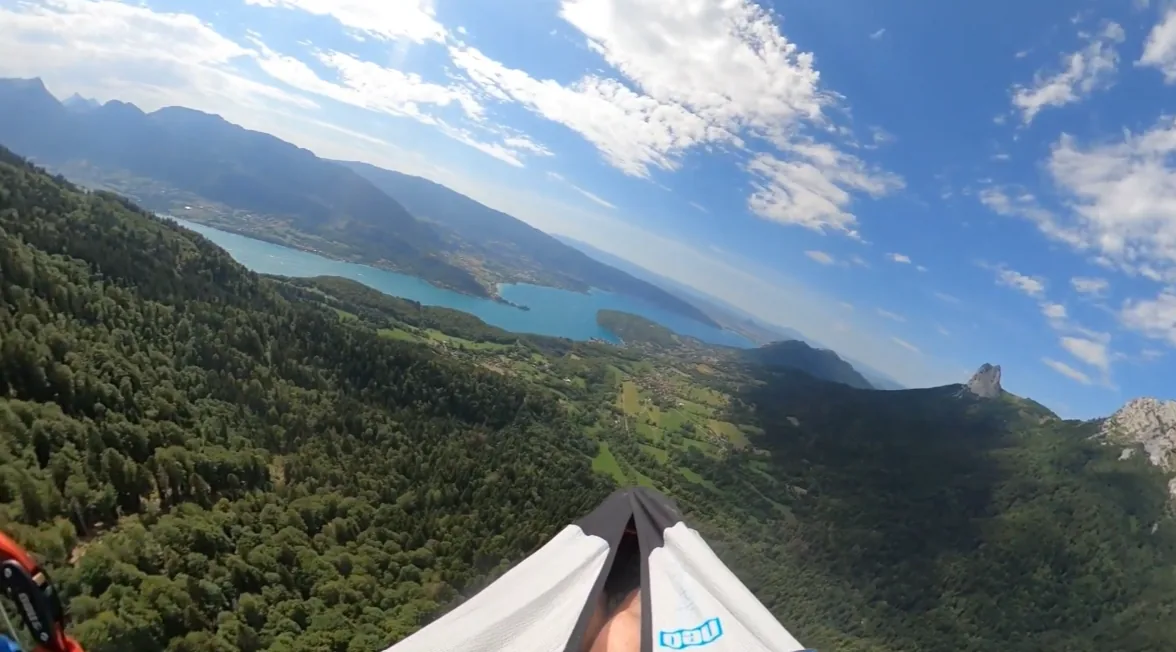
Ask any Northern European pilot where to go for a paragliding holiday and there is a good chance they will say Annecy. The town on the western shore of Lac d'Annecy in the French Alps has been paragliding's spiritual capital for thirty years. The lake is genuinely beautiful — turquoise water, Alpine peaks, a medieval old town — and the flying community is real and serious. This article is not a dismissal of Annecy. It is an honest assessment of what flying there actually looks like, what it costs, and why Portugal's Atlantic coast has become the more practical choice for a growing number of serious intermediate and advanced pilots.
Why Annecy Became Paragliding's Most Famous Destination
The reputation is earned. Col de la Forclaz at 1,157 metres and Planfait at 1,240 metres are both easily accessible — car parks at the top, cable cars from the valley — and the view from launch is genuinely one of the best in the sport. Lac d'Annecy stretches below you in shades of turquoise and blue-green, ringed by the Aravis, Bauges and Bornes massifs. The landing field at Doussard on the southern shore is large, flat and easy to locate from the air. There is a strong flying school presence, several qualified guides, and a well-developed competition calendar.
The town itself is one of the most attractive in France. Old stone canals, a perfectly preserved medieval château, excellent restaurants within walking distance of the lake. For pilots who want to combine flying with a proper cultural experience, Annecy delivers on both.
The Reality of Flying at Annecy
The season is the first thing pilots underestimate. Annecy's reliable flying window is June through September — four months at best. Outside of that, Alpine weather makes thermal flying unpredictable and mountain conditions require significantly higher skill to manage safely. Compare this to Sesimbra, where the Atlantic coast is flyable every month of the year with ten or more flying months in a typical year.
Summer crowds are significant. In July and August, Col de la Forclaz can see thirty or more pilots queuing to launch on a good weekend. The school operations, tandem flights, and free-flying pilots share the same launch, and the organisation — while generally managed — means waits of an hour or more at peak times. Pilots hoping for the quiet, unhurried experience of a coaching week may find the atmosphere closer to a busy ski lift than a serious flying environment.
The thermic cycle matters too. Mornings are typically reliable for thermal flying, with triggers coming up the south-facing slopes as the sun hits the Aravis chain. By mid-afternoon, the lac du Bourget valley wind from the west can arrive and make conditions uncomfortable on the lower ridges. The thermal window at Annecy is shorter than pilots accustomed to the long Atlantic soaring afternoons of Portugal often expect.
Airspace — The Factor Many Pilots Don't Research in Advance
This is the practical detail that most Annecy trip reports gloss over. The Annecy Control Zone (CTR) is Class D airspace that covers the lake and immediate environs up to significant altitude. Commercial and private aviation using Annecy-Meythet airport creates real constraints on cross-country routing. Pilots cannot freely fly northward toward Grenoble or eastward toward the Mont Blanc area without careful airspace planning and often radio contact with Annecy Approach.
The XC options from Forclaz are genuine but more constrained than the map suggests. Most pilots fly southward along the Aravis chain toward La Clusaz, or southeast toward the Bauges. The typical XC distance achievable in a day from Annecy sits between 20 and 60 km before airspace, terrain or the sea breeze cycle closes down the flight. Longer flights require careful pre-flight airspace study and often an early start to stay ahead of the valley wind.
Portugal's coastal and Alentejo XC flying areas operate essentially below uncontrolled airspace. Pilots fly freely below 1,500 metres without radio requirements or CTR constraints. On a good Alentejo day, the route is open in every direction. A 100+ km XC flight requires no airspace planning beyond basic map awareness. The contrast with Annecy is substantial for pilots who want distance freedom.
What a Week at Annecy Actually Costs
Geneva is the main airport hub — approximately 45 minutes by road or train from Annecy town. Direct flights to Geneva from UK, Germany and Scandinavia are well-served, but flights from Iberia, Eastern Europe and many smaller airports are not. Accommodation in Annecy during July and August is priced at €80 to €150 per night for anything decent — the town is one of France's most popular summer tourist destinations and prices reflect it.
Guided XC flying with a local operator typically runs €60 to €100 per day. Tandem flights are more expensive than at comparable sites elsewhere in Europe. Equipment hire is available but not cheap. A week in Annecy during peak season — flights, accommodation, guiding, food — realistically costs €1,400 to €2,000 per person.
By comparison, low-cost airlines serve Lisbon from virtually every Northern European city. Sesimbra accommodation is €50 to €90 per night year-round. Behrooz's coaching rates are €80 per day for coastal soaring and €120 for XC days — and the week runs across ten flyable months rather than four.
Annecy vs Sesimbra: Side by Side
| Factor | Annecy, France | Sesimbra, Portugal |
|---|---|---|
| Flying season | June–September (4 months) | Year-round (10+ months) |
| XC airspace | CTR restrictions, radio advised | Essentially unrestricted below 1,500 m |
| Typical XC distance | 20–60 km | 60–150+ km (Alentejo) |
| Summer crowds | High — 30+ pilots at Forclaz | Moderate, small guided groups |
| Nearest airport | Geneva (45 min drive) | Lisbon (30 min drive) |
| Accommodation cost | €80–150/night in season | €50–90/night year-round |
| Coastal soaring | Not available | Yes — Atlantic ridge soaring |
| Radio coaching | Rare — most guiding is group | Standard — in-air radio cues |
| Coaching group size | Typically 6–12 (school model) | Max 5–8 (personal model) |
Who Should Go to Annecy
The experience of flying above Lac d'Annecy is genuinely worth doing once in a flying life. The view is as good as advertised. If you are based in France or Switzerland and can get there for a long weekend without the flight cost and planning overhead, Annecy is an easy choice. For pilots who want to combine flying with an excellent French cultural experience — good food, beautiful town, Alpine hiking on non-flying days — Annecy earns its reputation.
It is also a legitimate choice for pilots who want to experience Alpine thermalling — the thermal character at Forclaz is different from coastal Atlantic lift, and time spent in Alpine conditions builds a particular type of meteorological reading skill. If your home flying is coastal or flat country and you want Alpine experience, Annecy is one of the most accessible entry points.
Who Should Come to Portugal Instead
Pilots who want to maximise flyable days in a single week will almost always do better in Portugal. A week in Sesimbra across ten months of the year statistically includes more flying days than a summer week at Annecy. The Atlantic nortada is reliable; the thermic season in the Alentejo is long; the coastal soaring has no Alpine equivalent.
For pilots specifically chasing XC improvement, the Alentejo offers flat, thermically reliable terrain with open-field outlanding options everywhere and essentially no airspace restrictions. A pilot who arrives at 30 km personal best can realistically target 80 to 100 km by the end of a coached week with Behrooz — something that the constrained XC environment at Annecy makes significantly harder to achieve.
Cost matters too. A pilot spending the same budget in Portugal as at Annecy gets more flyable days, more coaching hours, and more XC territory. The case for Portugal is strongest for the intermediate pilot who has done a few holidays and wants to genuinely progress rather than repeat the same experience with a better backdrop.
The Honest Verdict
Annecy and Portugal are not really competing for the same pilot. Annecy is the Alpine pilgrimage — beautiful, storied, worth doing. Sesimbra is where you come when you want to actually progress. The Atlantic coast in October or February or April, without crowds, with personal radio coaching and unlimited XC airspace, is a fundamentally different kind of flying week. Both deserve a place on a serious pilot's list. The question is what you want from the specific week you are planning.
If you are considering Portugal and want to talk through what a week looks like, message Behrooz on WhatsApp. He is usually able to answer the same day.