


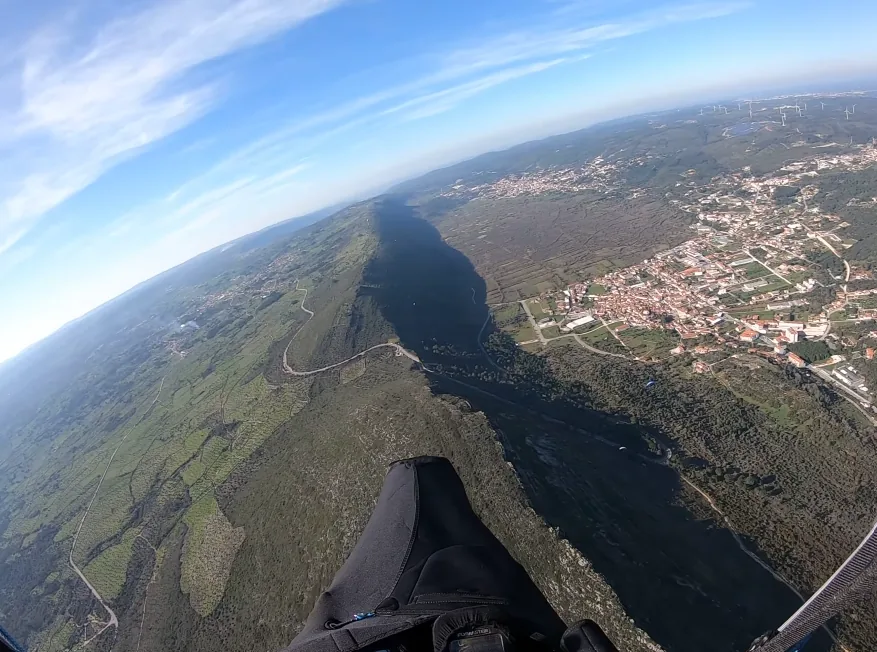
Every intermediate pilot has experienced the same plateau: days of flying that end at 30–40 km, the wing packed in a field while better-equipped pilots disappear toward the horizon. The frustrating part is that those further-flying pilots don't have a better wing, a better forecast, or a gift for meteorology that you lack. They're making consistently better decisions at five or six critical moments in every flight. This article explains what those decisions are and exactly how to change them.
The Two Metrics That Define XC Distance
Before we talk about technique, two numbers that every XC pilot needs to understand and track:
Best glide ratio (L/D) — the horizontal distance you cover for every metre of altitude lost in still air. A typical EN B recreational wing has a polar that peaks around L/D 9–10 at roughly 38–42 km/h. Flying above or below this speed costs you glide efficiency. The specific speed for your wing's best glide is published in the manual and easily confirmed in your track logs.
Average climb rate (ACR) — not your peak reading on the vario, but the actual metres per second you are gaining across the full duration of a thermal, including the centring spirals, the weak edges, and the time spent finding the core. ACR is what actually matters for your XC speed: a thermal peaking at 3 m/s that you work poorly for eight minutes might give you an ACR of 1.2 m/s. A thermal peaking at 2 m/s that you centre immediately and work cleanly might give you ACR 1.6 m/s. The second thermal makes you faster over distance.
Improving XC distance is largely a matter of improving both metrics simultaneously through better technique and decision-making. Let's go through the specific areas.
Glide Efficiency: Speed Bar and the Dolphin Technique
Most intermediate pilots underuse their speed bar in transitions. The logic of MacCready theory — simplified for practical paragliding use — is this: when gliding through sink, you lose altitude faster than you would in still air. To minimise that altitude loss, you need to cover the sinking section of air as quickly as possible. Push the speed bar.
Conversely, when you fly into lifting air during a transition, you should slow down to stay in the lift longer, converting the rising air into altitude rather than flying through it quickly. Release the bar, let the wing slow, and climb for free.
The dolphin technique is the practical application of this: as you transition between thermals, you're constantly adjusting speed in response to what the vario tells you. Sink zone — bar goes in. Lift detected — bar comes out. The transitions between these states should be smooth and continuous, not binary. A pilot who masters this technique covers more ground at a higher average altitude than one flying at constant speed.
The most common error I see on coaching weeks: pilots pushing the bar in strong lift because they want to "go faster overall." This throws away free altitude. If the vario is climbing, your job is to stay in that air, not sprint through it.
Thermal Selection: Commit to the Best, Not the First
The single biggest difference I observe between pilots flying 35 km days and 85 km days is thermal selection discipline. Low-airtime XC pilots stop at the first thermal they find. Experienced XC pilots stop at the thermal they want.
Concretely, this means: when you're at 1,200 metres and cruising in a reasonable glide, you have time to evaluate the thermal sources ahead before committing. A small whirling over a dark-coloured field is a thermal trigger. A cumulus building over a ridge is a stronger indicator. A convergence line developing between coastal and inland air is the jackpot. The pilot who identifies the strongest-looking thermal ahead and flies past three mediocre ones to reach it will consistently outperform the pilot who stops at the first available climb.
This requires height security — you need to be at a height where you can make selective choices without being forced to take the first thing you find. Which leads directly to the next point.
When to Leave a Thermal: The 50% Rule
The golden leaving rule that I teach on every XC coaching week: leave a thermal when your ACR drops below 50% of the expected ACR in your next thermal.
In practice, this looks like: you're in a thermal averaging 1.8 m/s. The cloud streets ahead suggest your next climb will be at least as good. Your current thermal has weakened to 0.8 m/s. Do you stay and squeeze another 50 metres out of a deteriorating climb, or do you leave and go find the better thermal ahead? You leave. Every time.
The psychological trap is attachment to height already gained. You've worked hard for 1,400 metres and you don't want to start a transition without squeezing every last metre. But the time spent in a weak thermal is time not spent gliding toward the next strong one. The arithmetic consistently favours the pilot who leaves early.
The corollary: never leave a thermal before you've reached a safe transition height. What that height is depends on the terrain below, the distance to the next thermal trigger, and the current conditions. In the Alentejo flatlands, a transition height of 800–900 metres above ground is generally comfortable. Over ridge terrain it might be 400 metres. Know your minimum before you start the flight.
The Outlanding Barrier
I've coached many pilots who could technically fly 80 km days but consistently turn back at 50 km. When I ask why, the answer is usually some version of "I didn't know if there were fields." They're not limited by their flying — they're limited by their willingness to commit to terrain they haven't pre-scouted.
Outlanding is not a failure. It is a planned component of XC flying. Every pilot who covers serious distances outlands regularly — in farmer's fields, on dirt tracks, on flat sections of hillside. The skill is in pre-scouting while airborne, not in avoiding the situation.
The pre-scout habit: at the start of every transition, before you leave the thermal, look at the terrain ahead and identify at least two potential landing fields. Not as emergency plans — as routine options. When outlanding is always on your radar as a comfortable choice rather than a disaster, your decision-making changes. You commit to longer transitions because you know you have a landing if the next thermal doesn't fire.
In the Alentejo specifically, this is straightforward. The plains are covered in large flat agricultural fields, most of them accessible by road within a few kilometres. The terrain that looks empty from height is usually very landable. I've never had a pilot on an XC coaching week fail to find a landable field when they needed one.
Vario Literacy: ACR Versus Peak Reading
Most pilots watch their vario and celebrate when it spikes at 4 m/s. That spike tells you there's strong lift somewhere in the air mass around you. It does not tell you your climb is good. What matters for thermal quality assessment is the running average — the ACR — over the last 30 to 60 seconds of the climb.
Modern varios — XCTracer, Naviter Oudie, Syride SYS'Nav — all display a running average in addition to instantaneous reading. Learn to read both. The instantaneous spike tells you where the core is right now. The running average tells you whether staying in this thermal is more or less efficient than moving on.
A related error: piloting to the peak reading by constantly chasing the strongest part of the vario. In a real thermal, the core drifts with wind. Chasing it means you're perpetually off-centre relative to where the core is going. Better technique: find the core, centre it, and then drift with it rather than always spiralling back to where it was strongest two circles ago.
Route Planning: Thermal Streets and Terrain Triggers
Experienced XC pilots don't just navigate from thermal to thermal — they read the day's structure and plan routes accordingly.
Thermal streets form when moderate wind (15–25 km/h) organises convection into lines parallel to the wind direction. Flying along a thermal street means shorter, more consistent transitions and predictable climbing spots. The visual cue is a line of cumulus clouds running with the wind. When you see one forming ahead, route toward it and stay under it for as long as possible.
Terrain triggers are the ground features that reliably produce thermals: dark-coloured ploughed fields, quarries, rocky outcrops, and the sunward-facing slopes of ridges in the morning. When route-planning on the fly, keep an eye on what's coming up below you and anticipate where the next thermal is likely to fire before your vario tells you it has.
Upwind sides of ridges typically produce better thermals than lee sides. In Portugal, with predominantly north-northwest maritime airflow in summer, this means the northern faces of east-west ridges are generally better thermal sources in the morning, while southern faces produce better afternoon climbs as the sun gets onto them.
How a Week in the Alentejo Changes This
One of the reasons I run XC coaching weeks based in Sesimbra with Alentejo inland days is the consistent and readable nature of the thermic cycle there. The flat terrain — the Alentejo is essentially a large tilted plain rising from sea level in the west to 400 metres in the east — produces textbook convection from around 10:30 am until late afternoon. There are no sudden mountain wave effects, no complex valley winds, and the fields are large and clearly landable.
For a pilot working on XC decisions, this is the ideal environment. The decisions are visible in the track log in the evening, the radio coaching identifies the exact moments where a different choice would have added 15 km, and the next day you fly with that specific correction in mind. Pilots who arrive with 30–40 km personal bests routinely leave with 70–100 km days in the same week. Not because the conditions are exceptional — but because the same conditions applied to better decisions produce dramatically different results.
Decision Reference: Common XC Scenarios
| Scenario | Wrong Decision | Right Decision | Why |
|---|---|---|---|
| Weak thermal at low height | Leave to find something better | Stay and work it patiently | You can't afford to gamble altitude — take what's available |
| Headwind transition | Slow down to feel safer | Push the speed bar | MacCready: speed = ground efficiency in a headwind component |
| Early afternoon OD risk building | Push further into the OD mass | Find a landing, wait for conditions to clear | OD overdevelopment risk is real — no XC distance is worth a storm |
| Strong thermal drifting with wind | Keep spiralling back to the original trigger | Drift with the thermal core | The thermal is moving — your spiral centre should move with it |
If you change only one thing after reading this article, make it this: pre-scout landing fields before you need them. The outlanding anxiety that makes pilots turn back early is entirely a function of not having identified safe options ahead of time. When you habitually carry two or three confirmed landing options in your mental picture at all times, your willingness to commit to longer transitions changes immediately — and your XC distances follow.