


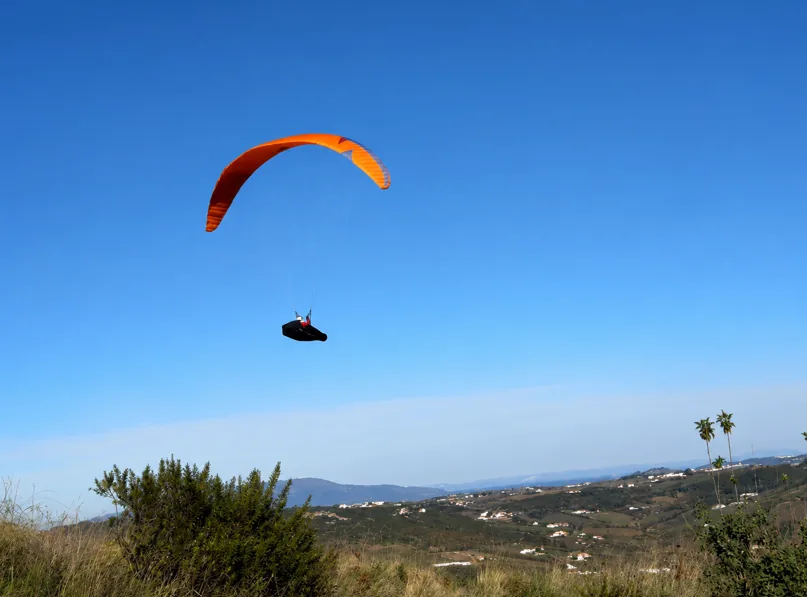
The night before a first XC day, I can tell which pilots have already figured out something has changed. They check the forecast twice at dinner. They look at the track log from the day before differently — studying it rather than just scrolling through. They're quieter. They're not quite sure what they've agreed to, but some part of them knows it's different from the soaring days that came before it. That restlessness is the right instinct. A first XC flight is a genuinely different kind of flying, and the fact that they feel it before it happens means they're ready for it.
The Morning Brief
On an XC day I'm up early. By seven o'clock I've already opened Skysight and Meteo Parapente on my laptop, and I'm working through the same checklist I use every time conditions look promising. The numbers I want to see: cloudbase forecast above 1,400 metres, which is where real XC becomes possible in the Alentejo landscape north of Sesimbra. CAPE index above 200 J/kg, which tells me the atmosphere has enough instability to build proper thermals — not just light drifters but real organised columns you can work. Afternoon wind direction aloft matters too; a north-westerly above 2,000 metres puts the good stuff in the wrong places. A light south-westerly or near-neutral direction aloft, and the terrain north of the ridge starts talking.
By ten o'clock the decision is made. I say it simply, at breakfast or in the van: "Today is an XC day." The group changes energy when they hear that. The pilots who've been waiting for it straighten up. The ones who weren't sure what they'd signed up for go slightly quiet. Both reactions are right.
The Drive to Launch
The atmosphere in the van is different on XC days. We're doing the same drive to the ridge, but the conversation is different. I use the time to walk through what we'll be managing in the air — not to add pressure, but because information is the antidote to anxiety. I explain the airspace boundaries: the Lisbon TMA cuts across north of us, and I've already checked the NOTAM. I explain the turnpoint system if we're running a task, or the open-distance protocol if it's a free flight day. I explain outlanding field selection: what to look for, how to judge a field from 400 metres, when to commit to your choice early rather than circling over it twice and arriving with nothing left.
I mark landing fields on the pilot's phone before we leave. Specific fields, not areas — the big grass strip east of the main village road, the harvested wheat field near the old farmhouse with the red roof, the football pitch in the next village. These become anchors when the mind starts working fast in the air. I also tell them about the one valley to avoid: a narrow corridor between two ridges where the wind accelerates and convergence creates unpredictable sink. We don't go there on a first XC day. Later, yes — when they can read it. Not today.
Pre-Flight
The pre-flight brief on an XC day is longer than a soaring day. Wing check runs the same — lines, risers, brakes, speed bar — but we add to it. GPS confirmed logging. Radio tested, frequency agreed. I check that every pilot has my number in their phone and knows to call if the radio drops. I remind them of the outlanding protocol: land safely first, then call. Don't keep flying to find signal while low. Land, call, wait.
I say the same thing to each pilot before they inflate, and I mean it every time: "Your job is to keep flying. My job is to call the corrections. Trust the radio." That division of labour is what makes coached XC work. The pilot doesn't have to carry the full cognitive load of route-finding, weather-reading, decision-making, and flying the wing simultaneously. I carry part of it. That frees them to actually fly.
Launch
Nothing about the launch itself is physically different. Same slope. Same wing. Same run, same rotation, same brake input to stop the overshoot. The wing comes up identical to every other day. But the intention is different, and that changes everything about how it feels. You're not staying on the ridge today. The ridgeline is a starting point, not a destination. The familiar thermal on the east face of the launch is the first climb — not the place you spend the whole morning.
I watch every launch from the side. I can tell in the first ten seconds whether a pilot's head is in the right place — whether they're already thinking forward, already looking toward the first climb point, or whether they're anchored to the ridge behind them. When they're forward-looking, the body language in the harness is different. The first XC day tends to produce the right posture. The gravity of it focuses people.
First Thermal Away from the Ridge
This is the moment. Everything before it is preparation. The wing starts climbing in that first thermal, the variometer singing, the ground falling away — and then you're past the ridge lip and there's nothing familiar below. The coastal village is behind you now. The launch site is out of view. Below: open country. Patchwork fields. Cork oak forest. A road going somewhere north. And 800 metres of air between the wing and all of it.
I hear the pilot's breathing change on the radio. Not panic — they're flying correctly, the wing is working, there's nothing wrong. But the breathing changes because the brain has registered that something irreversible just happened. They're not on the ridge anymore. There's no easy glide back to the landing beach.
"Good — you're in it. Keep the left turn. You've got another 40 metres to cloudbase."
That's usually what I say. Something specific, something that puts their attention on the task rather than the feeling. The climb needs to be worked. The thermal core needs to be found. The feeling of exposure can wait — it'll still be there when we debrief this evening, and it'll be a better feeling by then.
Over Unknown Terrain
The strangeness of XC flying, the thing that doesn't go away even after hundreds of flights, is the unfamiliar feeling of terrain that you don't know. On the ridge soaring day, every landmark becomes familiar within an hour. The brown outcrop, the shepherd's track, the lone pine tree. Flying XC means constantly moving through terrain you've never seen from this angle — fields that look like one thing from above and are something different when you land in them, roads whose destinations you don't know.
On the radio: "Thermal trigger coming up — the dark field on your right. You're at 850 metres, you can afford to set up for it. Turn so the field is at your two o'clock and fly toward it at best glide. The dark colour means it's been in the sun longer — it's your best bet before the next ridge."
What I'm doing on the radio is lending the pilot my pattern recognition. It takes years of XC flying over specific terrain to build an internal map of where thermals reliably form. Pilots on their first XC day don't have that map yet. So I share mine. The dark field. The ploughed corner. The village rooftops that heat up by midday. The bowl-shaped hillside that funnels rising air into a consistent column from eleven until two. This is the specific knowledge that makes Sesimbra work as a coaching environment — I know this landscape.
Decision Points
Every XC flight has moments where the pilot has to decide: push on or turn back? The first time, under coaching, I always say push on — provided the conditions support it. Not recklessly, but progressively. The tendency for a first-time XC pilot is to turn back at the first sign of things getting harder. To return to the familiar rather than continue into the unfamiliar.
On the radio: "You're at 900 metres and you have a clear grass field 2 kilometres ahead on a consistent bearing. The sink you just flew through was localised. Keep going."
The pilot has to decide whether to trust that call. That trust is something that builds during the week — it doesn't arrive on day one fully formed. But most pilots, when they hear a specific, confident instruction with a clear reason attached, find they can act on it. The doubt that would stop them flying alone doesn't have the same grip when there's a voice on the radio with local knowledge behind it.
I push them further than they would push themselves. Not into danger — but into the outer edge of their comfort zone, where the real learning happens. That's the point of the radio. Not safety net exactly, though it is that too. More like a permission slip to go further than you'd allow yourself alone.
Why Sesimbra Works for a First XC
The geography here is close to ideal for a first XC day. The Alentejo plain begins immediately north of the coastal ridge — 30 kilometres of consistent thermal country that builds reliably from late morning on a good summer day. The terrain is gently rolling, which means predictable triggers and readable sources. The fields are large, obvious, and accessible. I've landed in most of them at some point. I know which have irrigation ditches and which are clean all the way to the fence.
The radio range covers the entire flight. From the moment of launch to the outlanding call, I can reach every pilot on the standard frequency. That's not always the case — some XC coaching environments involve long valley transits or terrain features that break radio contact. Here the coverage is consistent. What that means practically is that no pilot is ever truly alone on their first XC day in Sesimbra, even when they're 25 kilometres from launch and 500 metres above a Portuguese farmer's cork oaks.
The Outlanding
The first outlanding is something I cannot accurately describe to a pilot beforehand, and I've stopped trying. I can tell them it will feel strange, that it will feel like an anticlimax and an arrival simultaneously, that the relief and the elation arrive at the same moment. But the feeling itself only happens the first time.
Walking across a Portuguese farmer's field with the wing bundled under one arm, grass and red soil underfoot, the distant sound of a tractor somewhere to the west — that's it. That's what you flew for. Not the air time, not the distance on the GPS, not the track log that will look impressive on the screen this evening. This: a place you've never stood before, that you arrived at through the air.
The phone call is always the same. I see the track log stop on my screen. I know they're down. They call a few seconds later.
"I'm in the field. 35 kilometres."
"Good. I see you on the track log. That's your first one."
There's usually a pause. They're processing something. Then they ask when the retrieve van is coming. That's the right response — it means they're already thinking about going again.
The Evening Debrief
The debrief is where the flight gets understood. We open the track log, overlay it on the terrain map, and go through it section by section. I show them the best thermal of the day — usually one they flew past without recognising it. The tell-tale signs were there: the darkened field edge, the subtle increase in turbulence on approach that signalled rising air nearby. We look at the glide sections and I show them where their best L/D ratio happened and where they were pushing into headwind unnecessarily.
The track log is honest in a way that memory isn't. Memory of a first XC flight tends toward the emotional — the feeling of crossing the ridge, the radio call at 850 metres, the walk across the field. The track log gives the technical picture: airspeed, sink rate, thermalling efficiency, distance made good versus distance flown. Both versions of the flight matter. The track log is where the improvement comes from.
I'll tell them what I'd do differently. Not as criticism — they flew it correctly, they landed safely, they committed when it mattered. But there were moments where a better choice was available, and those are worth examining now while the flight is fresh. The sink before the last thermal: that was caused by flying between two convergence lines rather than staying on the leeward side of the darker terrain. File that. It'll happen again.
And then I say the same thing I always say at the end of a first XC debrief: none of the analysis matters as much as the fact that you committed, flew cross-country, and landed safely in a new place. The improvements come from flying again. Tonight you understand something about XC flying that no amount of theory could have given you. Build on that.