


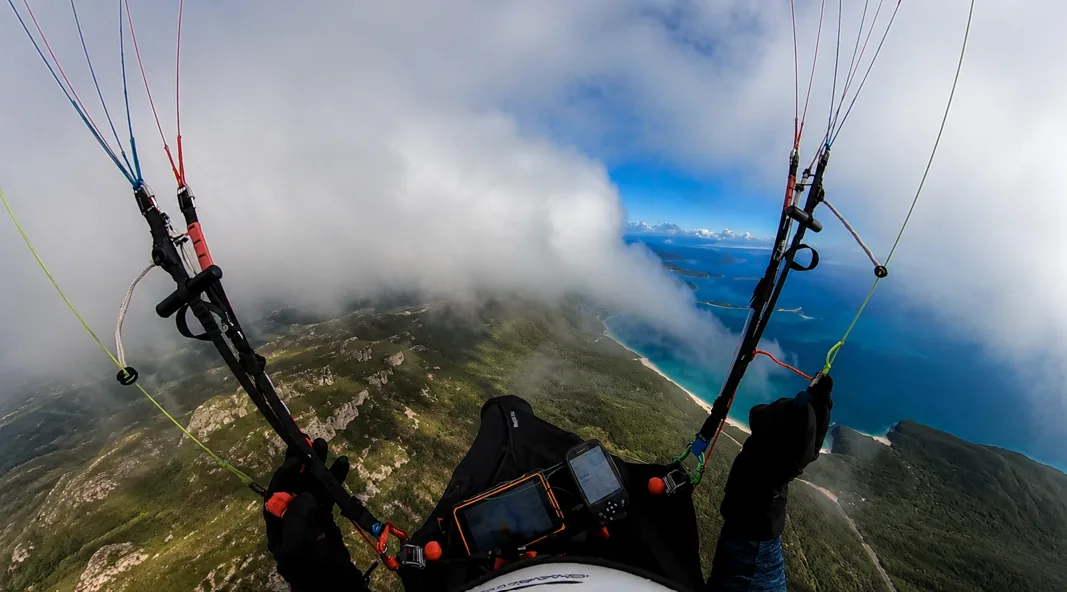
Coastal paragliding is the purest form of the sport. You launch from a cliff or headland, the Atlantic or Pacific pushes against the rock face and generates clean laminar lift, and you soar — sometimes for hours — in air that is smooth, consistent and utterly reliable. No thermal surprises, no overdevelopment, no racing the sky to land before a storm builds. Just ridge lift, the horizon, and the sound of the sea below. I have been flying coastal sites for over 25 years, based at Sesimbra on the Portuguese Atlantic coast, and I have spent my winters and touring seasons flying coastal sites around the world. This list covers the ten sites that stand out — for the quality of the lift, the scenery, or both.
What Makes a Coastal Paragliding Site World-Class
The physics are straightforward. Wind approaches a cliff face or headland, has nowhere to go but up, and creates a band of rising air that extends roughly one to two cliff heights above the ridge crest. Within that band — the soaring envelope — a paraglider can stay aloft indefinitely as long as the wind keeps flowing. This is ridge lift, and it requires no thermals, no sun, and no complex weather reading. On a good coastal day, the soaring band is clean, laminar and utterly predictable.
But not all ridge lift is created equal. What separates a world-class coastal site from a merely good one comes down to five factors. Wind direction consistency is the first: a site that works on one very specific wind direction and sees that direction reliably for six months is worth more than a site that works in all directions but rarely gets any of them. Landing options matter enormously — a beach directly below the cliff removes the most dangerous variable (where do you put down if the lift disappears?). Site accessibility separates places where you fly twice during a week from places you fly every day. Season length affects whether travel investment pays off. And finally, the quality of nearby infrastructure — accommodation, food, medical services — affects whether visiting pilots come once or return year after year.
The ten sites below have been assessed against all five criteria, not just headline conditions. Some are world-famous. A few are almost unknown outside their local flying community. All of them are, in my judgment, genuinely worth the journey.
1. Sesimbra, Portugal — Atlantic Ridge Lift All Year
Sesimbra sits 40 kilometres south of Lisbon on the Arrábida peninsula, where the limestone ridges of the Serra da Arrábida meet the Atlantic. It is my home base and the site I know better than any other on this list — and I put it first not out of patriotism but because it genuinely earns the position.
The variety is what sets Sesimbra apart. There are more than a dozen distinct launch sites within a 15-minute drive of the town: Bicas and the main Arrábida ridge for classic NW ridge soaring; Cabo Espichel for the powerful SW cycles; Costa da Caparica for dune soaring in northerly winds; and a handful of secondary sites that come into play for less common directions. Whatever the wind does, there is almost always somewhere to fly. This is unusual. Most coastal sites have one or two usable launches and shut down entirely when the direction shifts.
The wind pattern here is driven by the Atlantic pressure gradient. In summer, the Portuguese nortada — a reliable N/NW thermal-mechanical wind that switches on in late morning and builds through the afternoon — powers the north-facing launches for months at a time. In winter, the SW systems come through, and pilots migrate to south-facing sites at Cabo Espichel. The result is a flying season that runs, in practice, every month of the year. I have flown on Christmas Day more than once.
Sesimbra town sits directly below the main flying areas. It is a small fishing village with excellent seafood, affordable accommodation, and no tourist crowds outside of August. The combination of world-class flying and a genuinely pleasant place to spend a week is rare. Most sites that have one do not have the other.
For pilots who want to explore this area properly, I run a structured Coastal Soaring Week from Sesimbra that covers all the main launches, briefings on local meteorology, and XC flying when conditions allow. It is designed for pilots with at least 50 hours of solo time who want to get the most out of an Atlantic coastal environment they have probably not flown before.
2. Ölüdeniz, Turkey — Babadag and the Blue Lagoon
Babadag is one of the most recognisable paragliding images in the world: a mountain rising to 1,969 metres above sea level, launching directly into a valley that funnels flights toward the famous Blue Lagoon at Ölüdeniz beach. The site has been in continuous operation for decades and now sees hundreds of tandem flights daily at peak season.
Technically, Babadag is not a coastal ridge site in the traditional sense — it is a mountain thermal and coastal convergence site, where sea breezes from the Aegean interact with mountain thermals to create long, consistent flights. The typical experience for a tandem passenger is a 25–30 minute flight, launching from the 1,750 m platform and landing on the beach at the edge of the famous lagoon. The scenery is undeniably spectacular.
For serious pilots visiting as free-flyers rather than tandem passengers, Ölüdeniz offers interesting coastal and thermal soaring, but the summer months (June through September) are extremely crowded, with dozens of operators and hundreds of wings in the air simultaneously. Site management has improved significantly in recent years, but it remains a demanding airspace environment. The site shines most for bucket-list travellers who want the iconic photo and the experience of landing on a famous beach. Season runs April through November, with May, June and October offering the best balance of conditions and crowds.
3. Torrey Pines, California — San Diego's Living Laboratory
Torrey Pines is the oldest continuously operating paragliding and hang gliding site in North America, and it has earned that distinction. The sandstone cliffs rise roughly 100 metres above the Pacific, oriented almost perfectly to catch the prevailing afternoon onshore sea breeze that rolls in from the southwest. On a good day — which in San Diego terms means most days — pilots can stay aloft for two to three hours without effort, working the lift band above the gliderport and the adjacent cliff sections.
What makes Torrey Pines consistently excellent is the reliability of the afternoon wind cycle. The marine layer builds overnight, the onshore flow establishes itself by midday, and by early afternoon the cliffs are working. The landing area on the beach directly below is large, uncrowded by standards of California beaches, and forgiving. The site has operated under a formal permit system managed by the Torrey Pines Hang Gliding Association for many years, which means airspace, training standards, and site rules are well established.
Pilots visiting from outside California should note that Torrey Pines is a members-only site by arrangement — you fly with a local club observer until you demonstrate competency at the site. This is not bureaucracy for its own sake; the afternoon sea breeze can arrive faster and stronger than expected, and local knowledge matters. The site operates year-round, with spring and early summer offering the most consistent conditions. It also sits directly adjacent to one of the best preserved coastal habitats in Southern California, so the views are matched by the surroundings.
4. Mussel Rock, Pacifica — San Francisco Bay's Pacific Ridge
Forty minutes south of San Francisco, the coastal cliffs at Mussel Rock catch the famous Pacific sea breeze with minimal interruption. This is not a beginner site and it has never pretended to be. The wind that makes San Francisco Bay famous — the afternoon thermal-mechanical flow that pulls cool Pacific air through the Golden Gate and south along the peninsula — arrives at Mussel Rock compressed and powerful, often in the 15–25 mph range by early afternoon.
For pilots who can work it, the rewards are substantial. Extended coastal soaring above a wild and largely inaccessible stretch of Northern California coastline, with the hills of the San Francisco Peninsula rising to the east and the open Pacific to the west. On clear days, the view north to the Bay extends to the Golden Gate Bridge. Pilots have stayed aloft for four and five hours at Mussel Rock, thermalling off the coastal dunes and working the ridge back and forth. It has become a fixture in American paragliding culture precisely because it is demanding, consistent, and spectacularly located.
The site is managed by local pilots and operates informally but with strong community norms around site safety. First-time visitors are expected to introduce themselves and get a local briefing before flying. Year-round operation, with late spring through early autumn being the most reliably productive season.
5. São Conrado, Rio de Janeiro — Between Mountain and Ocean
The flight from Pedra Bonita is the most photographed paragliding experience in South America and probably one of the most photographed in the world. The launch ramp sits at 850 metres above sea level in the Tijuca Forest — the largest urban rainforest on earth — and the landing area is São Conrado beach, a crescent of white sand bounded by the Atlantic to the south and the forest-covered hills of Rio to the north. On a clear day, Corcovado and the Christ the Redeemer statue are visible from the air.
The flight mechanics are interesting: it is not a pure coastal ridge site but a combination of mountain-to-beach thermal soaring with Atlantic trade wind influence. The southerly Atlantic trades push inland, interact with the heated slopes of the Tijuca hills, and generate consistent soaring conditions that are relatively benign in the light morning hours and progressively more energetic through the afternoon. The flight takes roughly 8–12 minutes in its basic form, though experienced pilots can extend this significantly by working the coastal ridge above São Conrado.
Like Ölüdeniz, São Conrado is primarily a tandem destination. The number of tandem operators is large, and the site sees many flights daily on a good day. For free-flying visitors with local contacts, it is possible to fly more creatively — there are several XC routes that experienced local pilots use to cross from the Tijuca Forest toward the beaches of Ipanema and Leblon. The dry season from June through September offers the most reliable conditions, though the site operates year-round.
6. Iquique, Chile — Atacama Desert Meets Pacific
Iquique is where coastal paragliding becomes something else entirely. The Atacama coastal plateau — one of the driest landscapes on earth — drops sharply to the Pacific in a series of cliffs and headlands that catch the southerly sea breeze with extraordinary consistency. The wind here does not gust and fluctuate the way European sea breezes do. It simply blows, steadily, from the south, day after day, week after week, through the southern summer months from September through March.
The consequence of this consistency is distance. Pilots at Iquique regularly fly 60-kilometre coastal cross-country routes, working the lift band north along the cliff line with the confidence that the wind will not drop before they reach their destination. Record-setting coastal XC flights have been made from here. The entire South American paragliding XC community treats Iquique as a pilgrimage destination in the way that European pilots treat Annecy or St Hilaire — as the benchmark of what is possible.
The city of Iquique sits at the base of the cliffs, a former nitrate boom town with a pleasant centro histórico, good food, and direct flights from Santiago. The driving approach to the plateau launches is straightforward. What is less straightforward is the flying itself: the power and consistency of the Iquique sea breeze demands good active piloting, and first-time visitors should link up with local clubs before pushing into the long coastal runs.
7. Makapuu, Oahu Hawaii — Trade Winds and Pacific Panorama
The Makapuu headland on the eastern tip of Oahu is one of those sites where everything seems to have been arranged for the benefit of paragliding pilots. The northeast trade winds — among the most consistent wind patterns on earth — arrive at the headland with minimal obstruction, rise cleanly over the steep volcanic cliffs, and generate a soaring band that works reliably enough that visiting pilots schedule flights the way you would schedule a surfing session: arrive, check the wind, launch.
The view from the air is genuinely extraordinary. The turquoise shallows of the windward coast spread below, the island of Molokai sits on the horizon to the east, and on clear days Maui is visible beyond it. The landing area below the cliff is accessible, and the site is managed by the Hawaii Free Flyers, a long-established local club that welcomes visiting pilots who introduce themselves and demonstrate appropriate experience.
Makapuu is a pure ridge soaring site — no thermals, no complexity, just clean trade wind lift. This makes it accessible to pilots who are comfortable with ridge technique but would find thermal flying in unfamiliar terrain challenging. Year-round operation with very high reliability. The Hawaiian context — accommodation, food, the surrounding island — makes this one of the more enjoyable logistics packages on this list.
8. Gijón, Asturias — Cantabrian Spain's Hidden Atlantic Ridge
Almost no international paragliding visitors come to Gijón. This is a mistake. The launch at La Providencia sits above the San Lorenzo beach right inside the city of Gijón — an experience with no real parallel anywhere in Europe. You launch from a cliff directly above an urban beach, soar along the ridge line over the Cantabrian coast, and land on the same beach where families are having picnics and children are swimming. It is a genuinely strange and wonderful juxtaposition.
The Atlantic character of the Asturian coast means the flying conditions are more variable than at Sesimbra — the SW to W winds that work the coastal sites can be strong and gusty, and the northerly swells that batter the Cantabrian coast make this a place for experienced coastal pilots rather than beginners. The best seasons are spring (March through May) and autumn (September through November), when the Atlantic high pressure brings settled westerlies without the summer crowding. The green hills of Asturias behind the coast, the mediaeval city of Gijón, and the excellent Asturian cuisine make this an outstanding touring destination for pilots who like to fly and eat well in equal measure.
9. Cape Kiwanda, Oregon — Pacific Sandstone Drama
Cape Kiwanda is the most visually dramatic site on the North American Pacific coast. A massive sandstone headland, ochre and orange, rises above the Pacific with enough mass to generate powerful and consistent ridge lift when the onshore Pacific breeze arrives. The landscape is Oregon coast at its most elemental — heavy swell, sea stacks offshore, the Three Capes Scenic Route winding through headlands and bays in both directions.
Flying here is an experience for pilots who want something wilder than San Diego. The Pacific sea breeze arrives with more force and variability than the Southern California equivalent, and the landing terrain around the cape requires careful pre-flight planning. Active piloting skills and a good knowledge of the site's characteristics are essential. Local pilots and the Pacific Northwest Hang Gliding Association manage the site and are the right first contact for visitors.
The season runs April through October for the most consistent conditions, with midsummer (June through August) offering the most reliable soaring. Outside the season, the cape is subject to storm systems that make flying inadvisable and the coastline genuinely wild. It belongs on this list not because it is the easiest coastal site in the world, but because the combination of lift quality, scenery and raw coastal atmosphere is unmatched on the North American west coast.
10. Portorož, Slovenia — Adriatic Coastal Soaring
Portorož sits in the northernmost reach of the Adriatic, where the sea narrows into the Gulf of Trieste and the Julian Alps are visible across the bay on clear days. It is the most accessible coastal paragliding site in Central Europe — within a day's drive of Austria, northern Italy, the Czech Republic, and southern Germany — and it serves an enormous catchment of pilots who want coastal flying without a long-haul journey.
The flying itself uses the Bora (the cold northeasterly that descends from the Dinaric Alps) and the Sirocco (the warm southerly) to create varied coastal conditions that work across different parts of the local site network. The soaring above the small bay and the Slovenian coastal strip is pleasant rather than spectacular — this is not Iquique or Makapuu — but the logistics are excellent, the local flying community is welcoming, and the combination of Adriatic coast, Slovenian countryside, and easy access to the Soca Valley makes it an outstanding multi-activity destination.
Best seasons are April through June and September through October. The summer months can be hot and the Bora unpredictable. For European pilots wanting an introduction to coastal flying within driving distance, Portorož is the obvious starting point.
Comparison Table — All 10 Coastal Sites at a Glance
| Destination | Country | Flying Type | Best Season | Crowd Level | Skill Level |
|---|---|---|---|---|---|
| Sesimbra | Portugal | Ridge + XC | Year-round | Low | Intermediate+ |
| Ölüdeniz | Turkey | Mountain + Coastal (tandem focus) | Apr–Nov | Very High | All (tandem) |
| Torrey Pines | USA (California) | Pure Ridge | Year-round | Moderate | Intermediate |
| Mussel Rock | USA (California) | Ridge + Thermal | Spring–Autumn | Low–Moderate | Advanced |
| São Conrado | Brazil | Mountain-to-beach (tandem focus) | Year-round (Jun–Sep best) | High | All (tandem) |
| Iquique | Chile | Coastal XC | Sep–Mar | Low–Moderate | Intermediate–Advanced |
| Makapuu | USA (Hawaii) | Pure Ridge | Year-round | Low–Moderate | Intermediate |
| Gijón | Spain | Ridge | Spring + Autumn | Very Low | Intermediate–Advanced |
| Cape Kiwanda | USA (Oregon) | Ridge | Apr–Oct | Low | Advanced |
| Portorož | Slovenia | Ridge | Apr–Jun, Sep–Oct | Low–Moderate | Beginner–Intermediate |
Europe's Best Coastal Paragliding — Why Portugal Leads
Put the European sites from this list side by side and the verdict is clear. Sesimbra outperforms Ölüdeniz, Gijón and Portorož across the criteria that matter most to visiting pilots — not in any single dimension, but across all of them simultaneously.
Turkey's Ölüdeniz has arguably more famous scenery, but it is primarily a tandem-tourist operation. The flying experience for a skilled free-flying visitor is substantially diminished by the volume of tandem operations sharing the airspace in summer, and the site works less well for technical ridge soaring or XC potential. Gijón is a genuine hidden gem — the urban beach soaring is unique — but its season is shorter, the conditions more variable, and the infrastructure less developed for visiting pilots. Portorož is the most accessible option for Central European pilots, but it is a gentler experience with less flying variety and a season that ends in October.
Sesimbra's advantages stack: a 12-month season, 15 or more distinct launch sites, a dual character that works both as a pure coastal ridge destination and as an XC flying base, world-class consistency driven by the Portuguese nortada, and a town with genuine character at the foot of the cliffs. I have brought pilots here from all over Europe and the consistent response is that they wish they had discovered it sooner.
For a full breakdown of the local launches, the microclimate, and how the Atlantic ridge lift works at Sesimbra specifically, the guide at Paragliding in Sesimbra covers everything in detail. And if you want to understand the physics of what makes Atlantic ridge lift different from mountain or inland ridge sites, the Atlantic Coastal Soaring — How Ridge Lift Works guide goes deep on the mechanics.
Tips for Visiting Any Coastal Paragliding Site
Whether you're heading to Sesimbra, Iquique, or Makapuu, the same set of principles applies. Coastal flying has a distinctive character that catches out pilots who arrive with purely inland or mountain habits, and a few preparation steps make a significant difference to how the visit goes.
- Know the preferred wind direction before you arrive. Every coastal site has a preferred window — a range of wind directions and speeds within which it works well. Ask local pilots or clubs for the exact parameters. A site that works in NW winds may become dangerous in a NNW, where rotor behind a headland changes the picture entirely.
- Understand the landing zone before you launch. On coastal sites, landing options are often limited to a single beach or field. Know exactly where you are going before you leave the ground. Landing in the sea is possible at some sites; landing on rocks is rarely survivable. These are not inland landings where a field anywhere will do.
- Respect rotor hazards behind headlands and cliff edges. The lift band above a cliff is clean and laminar. The air immediately downwind of a headland or cliff corner is not. Rotor — turbulent, reversed airflow — forms in these zones and is the most common cause of coastal incidents. Know where the cliff corners are and stay away from the downwind side.
- Fly with someone who knows the site on your first visit. Every site has specific knowledge that is not in any guidebook — where the lift band narrows, which section of cliff generates the strongest turbulence in afternoon gusts, where the return flight from the far end of the ridge gets difficult. One flight with a local pilot is worth five solo days of figuring it out the hard way.
- Check your insurance covers overseas free-flying. Many federation policies have restrictions on overseas flying or have exclusions for competition events. Check the policy before you travel, not after you land. Some destinations also have mandatory third-party liability requirements for visiting pilots that your home federation policy may not satisfy automatically.