

Paragliding has no single international regulatory body. Each country — and in many cases each national aero club — issues its own qualification framework, which means the question "what licence do I need to fly in Portugal?" is genuinely complicated for pilots trained outside the country. This guide explains the main European and international licence systems, how they compare at each level, and what you actually need to fly at Sesimbra on a coached week with Fly with Behrooz.
Why There Is No Single "International Paragliding Licence"
Paragliding is largely unregulated airspace activity in most countries — it operates under national aviation authority rules for light sport and recreational aircraft, not under international ICAO pilot licensing. Each country's national aero sport federation runs its own pilot training and certification system, which means a British BHPA card, a German DHV card, and a Swiss SHV card are all legitimate proof of qualification, but they have been issued by completely different organisations using different syllabus structures.
The key point for travelling pilots: CIVL (Commission Internationale de Vol Libre), the paragliding committee of the FAI, provides a framework for mutual recognition of national licences, but this is a soft agreement between clubs rather than a legal requirement. In practice, what matters most when flying abroad is:
- Having a recognised national licence from your home country
- Having third-party liability insurance valid in the country you're flying in
- Meeting the coach's or operator's minimum experience requirements
The Major Licence Systems Explained
BHPA — British Hang Gliding and Paragliding Association (UK)
The BHPA uses a four-stage pilot rating system. Each rating is issued on a card that also serves as the pilot's third-party liability insurance document when flying at BHPA-affiliated sites.
| BHPA Rating | Equivalent level | What it means in practice |
|---|---|---|
| Student | Training, supervised only | Instructor-supervised flights only. Not a solo licence. |
| Club Pilot (CP) | CIVL P2 / Elementary Pilot equivalent | Cleared for solo flight at appropriate sites. Minimum for our programmes. |
| Pilot | CIVL P3 / Club Pilot equivalent | Cleared for advanced sites, SIV courses, and coached XC flying. |
| Advanced Pilot | CIVL P4 / Pilot equivalent | Cleared for competition and independent advanced flying. |
DHV — Deutscher Hängegleiterverband (Germany)
Germany's DHV is one of the most rigorously structured systems in the world. The DHV Schein (licence) combines theoretical exams with practical sign-off from a licensed instructor. The DHV also produces widely used glider certification ratings (EN-A through EN-D) that are adopted internationally.
| DHV Level | CIVL equivalent | Notes |
|---|---|---|
| A-Schein (basic) | CIVL P2 | Entry-level solo qualification. |
| B-Schein (standard) | CIVL P3 | Full independent pilot qualification. |
SHV / FSVL — Schweizerischer Hängegleiterverband (Switzerland)
Switzerland's system mirrors the BHPA's four-stage structure, with training, basic, licence (Brevet), and advanced ratings. Swiss pilots have a well-deserved reputation for rigorous mountain flying training. An SHV Brevet is broadly equivalent to a BHPA Pilot or DHV B-Schein.
FFVL — Fédération Française de Vol Libre (France)
The FFVL issues a Brevet Initial (BI), followed by a Brevet de Pilote (BP), and a Brevet de Pilote Confirm² (BPC). The BP corresponds roughly to CIVL P3. FFVL cards include third-party insurance for flying in France and, with certain membership levels, across Europe.
USHPA — United States Hang Gliding and Paragliding Association
The USHPA uses a numeric rating system: P1 (beginner), P2 (novice), P3 (intermediate), P4 (advanced), P5 (master). USHPA P2 is roughly equivalent to CIVL P2; P3 to CIVL P3. One important note: USHPA's third-party liability cover may not be valid in Europe — American pilots flying in Portugal need to verify their insurance position separately (see below).
CIVL IPPI Card — International Pilot Proficiency Identification
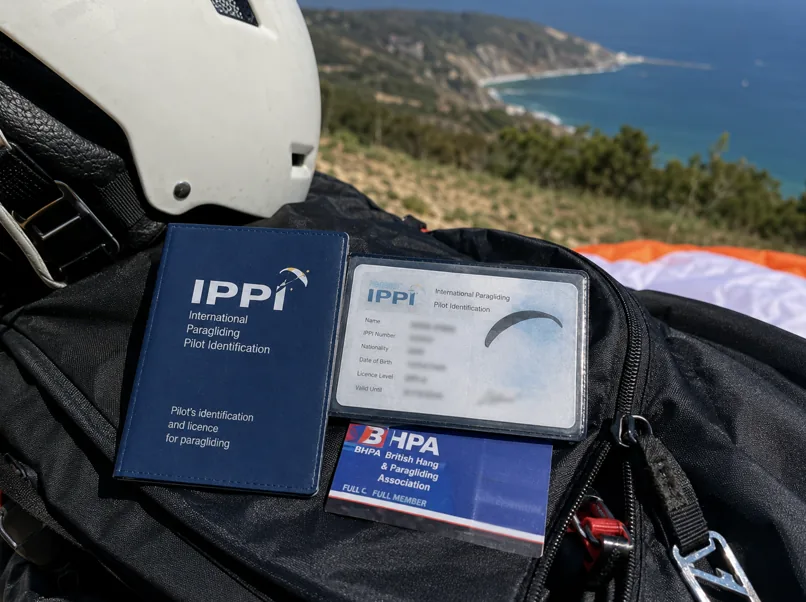
The CIVL IPPI Card is an internationally recognised standardised card issued by national aero clubs. It has five levels (IPPI 1–5) that map directly to CIVL pilot grades P1—P5. Many European countries and operators accept an IPPI card as the standard evidence of qualification. If you fly internationally regularly, obtaining an IPPI card from your national club is a straightforward way to have universally recognised proof of qualification without needing to explain your national system at every site you visit.
| CIVL / IPPI Level | BHPA | DHV | USHPA | FFVL |
|---|---|---|---|---|
| P1 / IPPI 1 | Student | Training | P1 | Stagiaire |
| P2 / IPPI 2 | Club Pilot (CP) | A-Schein | P2 | Brevet Initial (BI) |
| P3 / IPPI 3 | Pilot | B-Schein | P3 | Brevet de Pilote (BP) |
| P4 / IPPI 4 | Advanced Pilot | B-Schein + endorsements | P4 | Brevet Confirm² (BPC) |
What You Need to Fly in Portugal
Portugal's national paragliding authority is the FPVL (Federa——o Portuguesa de Voo Livre). Portuguese airspace law requires pilots to hold a recognised national or CIVL-equivalent qualification, and third-party liability insurance is mandatory.
In practice, flying on a coached programme with Fly with Behrooz works as follows:
- Your national licence card (BHPA, DHV, SHV, FFVL, USHPA, or equivalent) is accepted as proof of qualification
- You must have third-party liability insurance — for most European licence holders, this is bundled with their annual membership card. Check your card's documentation to confirm coverage extends to Portugal.
- The minimum licence for any Fly with Behrooz programme is P2 / Club Pilot / A-Schein or equivalent
- The XC Week and Coastal Soaring Week require P3 / Pilot / B-Schein or equivalent as a minimum. The XC Coastal Combo is the only programme open to P2 holders.
If you hold a USHPA rating or an Australian, Canadian, or other non-European licence, your national third-party insurance may not cover flying in Portugal. The most straightforward solution is to purchase a temporary CIVL/IPPI affiliated membership that includes European liability cover — the BHPA offers visitor membership to non-UK pilots for this purpose, as does the FFVL. Ask your national body or message me before your trip and I'll advise on the best route.
What Proof to Carry
On any flying week with Fly with Behrooz, bring the following:
- Your current pilot rating card (physical card or verifiable digital membership)
- Written confirmation of third-party liability insurance coverage (check the dates and geography)
- Your logbook, if you have one — not mandatory, but useful for me to assess where you are in your development
Do not bring expired cards or hope that verbal claims about your rating will be sufficient. Site owners and coaches are responsible for the pilots they fly with, and proper documentation protects everyone.
Frequently Asked Questions
My BHPA card says "Club Pilot" but I've heard this is equivalent to P2. Can I join the XC week?
A BHPA Club Pilot card is indeed equivalent to CIVL P2. The XC Week and Coastal Soaring Week require P3 / BHPA Pilot as a minimum. If you hold Club Pilot, the programme available to you is the XC Coastal Combo, which is specifically designed to be accessible to P2 pilots. Many P2 holders who come for the Combo feel ready for a dedicated XC or Coastal week after completing it — at that point, upgrading your rating back home becomes the priority.
I'm a USHPA P3. Does my insurance cover Portugal?
USHPA membership includes third-party liability cover within the United States and Canada, but this cover does not typically extend to Europe. Before flying in Portugal, you will need to arrange separate European liability cover. The BHPA offers a 12-month international visitor membership specifically for this situation (currently under €50/year as of 2025); it covers flying in most European countries including Portugal. The FFVL offers a similar visitor licence. Contact your nearest club or message me and I'll help you sort it quickly.
Do I need to register with the Portuguese authority (FPVL) to fly?
No. Flying as a visiting pilot on a coached programme under a licensed instructor does not require separate FPVL registration. If you were planning to fly independently at Portuguese sites on your own (not as part of a coached week), FPVL membership would normally be required. For all Fly with Behrooz programmes, your home national licence and valid insurance are sufficient.
I qualified with a school in a country that isn't on this list. Will my certificate be accepted?
Contact me directly on WhatsApp with a photo of your certificate and a description of your training school and the exam/practical sign-off process. Most structured national programmes are CIVL-affiliated and recognised. The main exceptions are one-off school certificates with no national body backing, or very early qualifications from before national systems were established. In those cases, I may ask for a practical assessment on the first day to establish where you are — this protects both of us.
Not sure if your licence qualifies?
Message me with a photo of your card and a brief note about your experience. I'll tell you exactly which programme is right for you and what insurance you need to sort before arriving.