


Insurance is one of those topics that experienced pilots know matters but often research too late — typically when booking a trip abroad and realising they're not certain whether their home federation's coverage follows them. For paragliding in Portugal, the legal requirement is straightforward, and most pilots who hold valid membership with a major European or US federation are already covered. This guide explains exactly what's needed, how the main federations handle it, and what a separate travel insurance policy should cover on top.
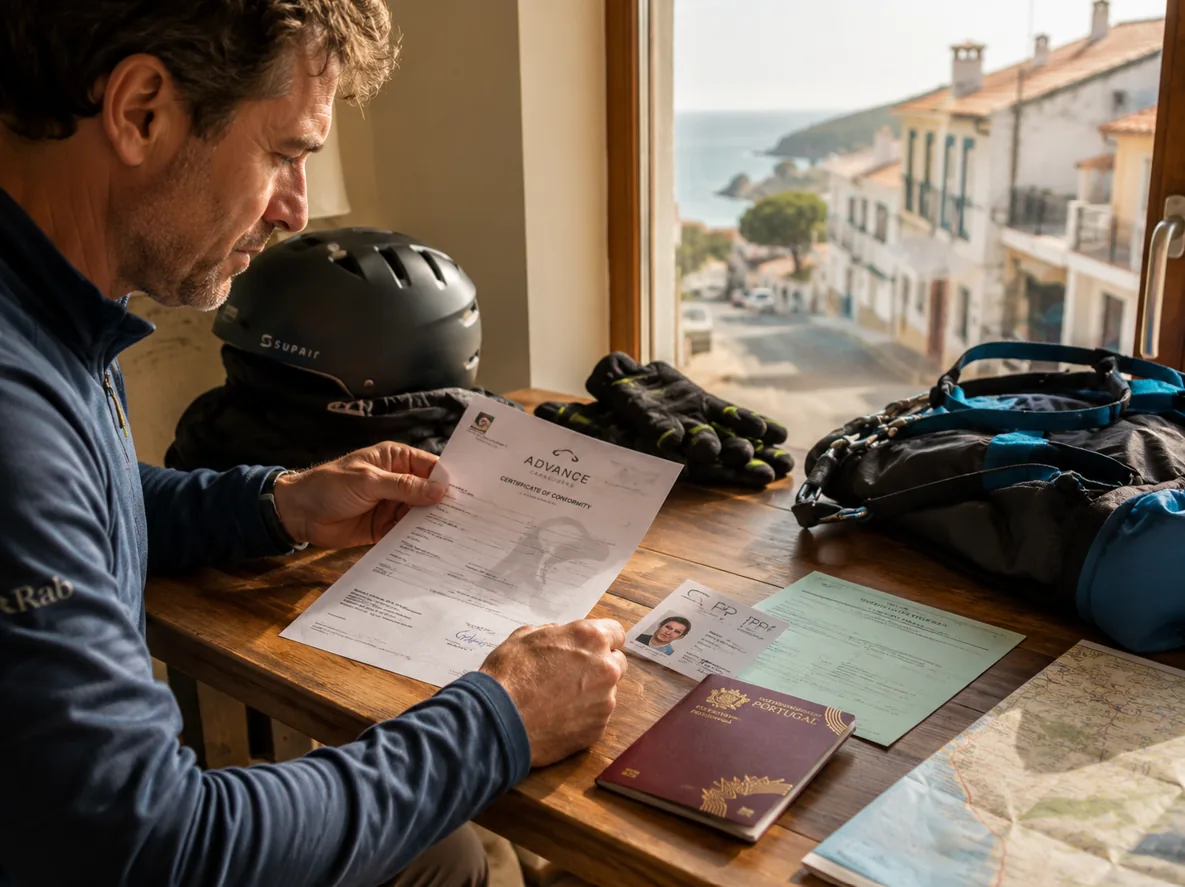
Portugal requires a minimum of €150,000 third-party liability cover to operate a paraglider. Standard membership with DHV, BHPA, SHV, FFVL, or most national federations provides cover well above this amount and is valid throughout the Schengen Area including Portugal. Bring your membership card and an insurance certificate or document confirming the coverage. That is sufficient. Behrooz confirms this with every pilot before flying.
Third-Party Liability: What Portuguese Law Requires
Under Portuguese aviation regulations, any aircraft operating in national airspace — including free-flight aircraft such as paragliders and hang gliders — must carry civil liability insurance with a minimum coverage of €150,000 per incident. This is the legal baseline. Flying without it is technically illegal and, more importantly, exposes you to personal financial liability if you cause damage to property or injure a third party.
In practice, inspections on the launch field are rare. Portuguese authorities do not routinely check pilot documentation. But the legal requirement is real, and Behrooz requires all pilots flying with him to have adequate coverage before departure. This is a straightforward condition: if your home federation provides liability insurance (all the major ones do), you are covered.
How the Major Federations Cover You Abroad
Here is how the most common federations handle coverage in Portugal specifically:
DHV (Germany)
DHV membership includes third-party liability cover (Haftpflichtversicherung) valid throughout Europe, including Portugal. The standard cover amount is €1.5 million per incident, which exceeds Portugal's legal minimum by a wide margin. The DHV membership card is your proof of cover. Bring your current year's card. If you have an AUA policy in addition to DHV membership, that also provides European-wide cover.
BHPA (UK)
BHPA full membership includes third-party liability insurance valid across Europe (including post-Brexit arrangements with Schengen countries). The coverage limit under the BHPA policy is €5 million. Bring your BHPA membership card and your current insurance schedule or certificate (available from the BHPA website logged in as a member). A digital copy on your phone is sufficient.
SHV / FSVL (Switzerland)
SHV membership includes liability insurance valid across Europe. Coverage is €3 million per incident. SHV members are fully covered in Portugal. Bring your membership card or the confirmation document.
FFVL (France)
FFVL membership includes third-party liability cover valid throughout the European Union and Schengen Area. Coverage is €8 million. FFVL members are covered in Portugal. Bring your licence card and the annual insurance sticker or digital proof.
—AeC / DHV equivalents (Austria, other German-speaking countries)
Austrian pilot federation (—AeC) and equivalent small national federations in German-speaking Europe typically provide the same EU-wide cover. Confirm with your federation before travelling; most small European national clubs do include Schengen-wide liability.
USHPA (United States)
USHPA membership includes liability insurance in the USA. European coverage is not automatically included in the standard USHPA membership. US pilots should contact USHPA before travelling to confirm whether their policy includes international cover or whether they need a separate add-on. Some USHPA plans do include international cover; others require purchasing European liability separately. This is the one case where pilots should verify explicitly rather than assuming coverage transfers.
Other federations
If your national federation is not listed above, contact them directly and ask: "Does my membership include third-party liability cover for paragliding in Portugal / the EU?" In most cases, European federations will say yes; non-European federations should be verified individually. The FAI/CIVL Sporting Licence (IPPI card) does not itself provide liability insurance — it is a pilot competency card, not an insurance document.
| Federation | Country | EU/Portugal Cover | Amount |
|---|---|---|---|
| DHV | Germany | Yes — automatic with membership | €1.5 million |
| BHPA | UK | Yes — EU-wide post-Brexit confirmed | €5 million |
| SHV / FSVL | Switzerland | Yes — European-wide | €3 million |
| FFVL | France | Yes — Schengen Area | €8 million |
| USHPA | USA | Verify with USHPA — not automatic | Varies by plan |
| Other European | Various | Typically yes — confirm with federation | Varies |
Travel Insurance — Separate from Liability
Third-party liability insurance protects other people if you injure them or damage their property. It does not cover you. For personal medical costs, rescue, evacuation, and equipment loss, you need a separate travel insurance policy that explicitly covers paragliding.
Medical and rescue cover
Standard travel insurance policies frequently exclude aerial sports and adventure activities. Before travelling, read the exclusions section of your policy carefully. You need a policy that explicitly includes "paragliding" as a covered activity. Most reputable adventure travel insurers — Snowcard, SportsCover Direct, IMG Global, and similar — offer specific paragliding packages. The key things to confirm are:
- Medical treatment (in-country hospital costs)
- Medical evacuation (helicopter rescue to hospital and repatriation flight home if needed)
- Trip cancellation due to injury or illness
- Cover for flying at your licence level (some policies exclude solo flying above a specific grade)
Portugal's state healthcare is accessible to EU citizens with an EHIC/GHIC card. UK citizens should carry their GHIC card as it covers EU state healthcare costs. This reduces the financial exposure for non-emergency treatment significantly. However, helicopter rescue from an outlanding in rough terrain is not covered by EHIC and can be expensive — this is the main gap that adventure travel insurance fills.
Equipment cover
Paragliding equipment is valuable and typically not covered by standard travel insurance. A wing, harness, and reserve together commonly exceed €3,000 in replacement value. Check whether your travel policy includes sports equipment cover and at what value. Dedicated adventure sports policies often allow you to declare equipment value separately and insure it accordingly. If your home contents policy includes accidental damage and worldwide cover, it may extend to equipment taken abroad — this is worth checking before buying a second policy.
How Behrooz Handles This
Before any pilot flies on a Fly with Behrooz programme, Behrooz asks for confirmation of:
- A valid pilot licence / federation card for the current year
- Confirmation of valid third-party liability insurance (the federation card is sufficient for most European pilots)
- A current reserve repack (date visible on the reserve or in your reserve logbook)
This is a condition of participation, not an administrative hurdle. The check is a 30-second document look at the start of the first day. If you're unsure whether your documentation is in order, message Behrooz before travelling — he can confirm whether your specific federation's coverage is acceptable without any delay.
Outlanding on Private Land
One practical scenario worth knowing about: if you outland on private agricultural land — which can happen on XC days — Portuguese landowners are generally pragmatic and friendly about it. Paragliding is an established and widely understood sport in the region. The cultural norm is to greet the landowner, explain what happened, apologise briefly for landing in their field, and offer a token of appreciation if crops were disturbed. Conflicts are extremely rare. Your third-party liability cover would handle any legitimate damage claim; in practice, the gesture of acknowledgment is usually all that's needed.