


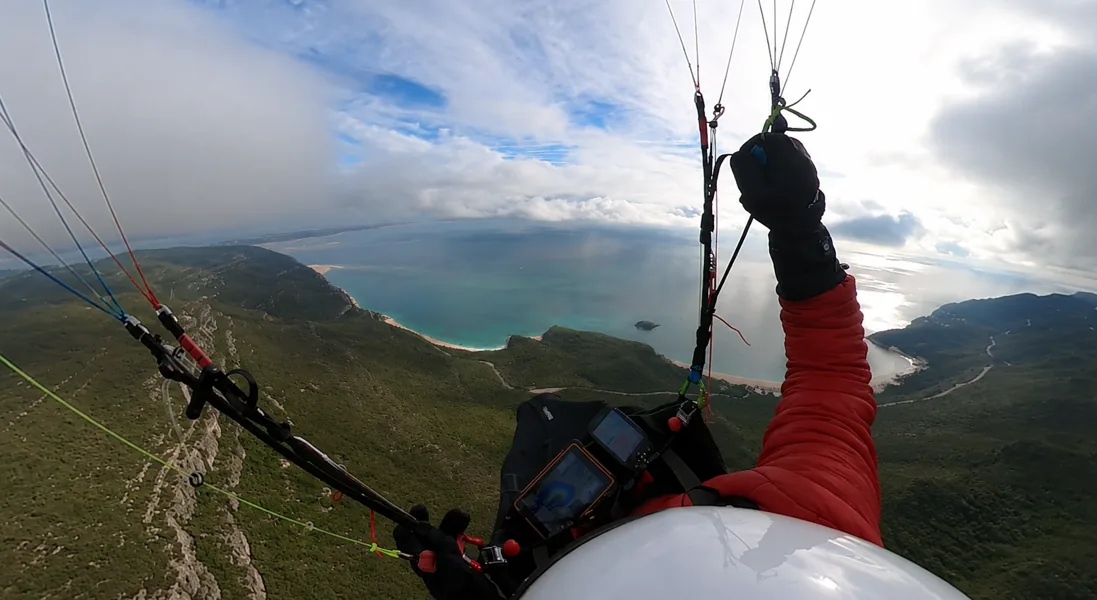
I've been flying for over 20 years. Not all of that has been in Portugal — I flew sites across Europe and beyond during my competition years, and I've landed on grass strips, beach runways, vineyard edges and lakefronts across the continent. When pilots ask me whether Sesimbra is really worth it compared to somewhere else, I tell them the same thing: there is no single best view in paragliding, but there are views that stay with you for the rest of your flying life. These are ten of mine.
1. Pokhara, Nepal — The Annapurna Backdrop
There is a view in this sport that has become almost mythological among pilots who have seen it, and it belongs to Pokhara. You launch from Sarangkot ridge at 1,600 metres above sea level, and the Annapurna range occupies the entire northern horizon — peaks at 7,000 and 8,000 metres, so high and so close they seem to belong to a different category of landscape than anything you've seen before. Machapuchare, the fish tail peak, sits directly in front of you. The rice paddies below are a green so intense it reads as artificial. Phewa Lake shimmers underneath your feet.
I have not flown Pokhara personally — this is one destination that remains on my list. But the pilots who have come through my coaching weeks and have flown Nepal describe the same thing every time, and their descriptions don't change year to year: the scale of the Himalayas from the air is unlike any other experience the sport has to offer. It is not just height; it is the accumulated mass of those peaks filling your peripheral vision from horizon to horizon while you float at what would be considered altitude anywhere else in the world. Best season is October through November, after the monsoon clears and before winter sets in. Intermediate ability minimum; a local guide is essential and non-negotiable.
2. Rio de Janeiro, Brazil — Pedra Bonita
The city from the air. You launch from Pedra Bonita inside the Tijuca National Forest at 520 metres, and you are immediately above one of the world's most cinematically dramatic urban landscapes. Sugarloaf to your left. Corcovado and Christ the Redeemer behind and above you. The long white crescents of Ipanema and Leblon stretching below, and the open ocean beyond. Landing on the sand at São Conrado beach, where the bathers look up and the vendors don't bother — they've seen it enough times.
The view here is so composed, so perfectly arranged by geography, that it barely feels real from the air. Sugarloaf is not a mountain in any Alpine sense — it is a granite dome rising straight from Guanabara Bay, surrounded by city on three sides and ocean on the fourth, and from the air it sits exactly where a film director would place it. The operational setup at Pedra Bonita is well-developed with both tandem and solo operations running regularly. Best season is May through September when the winds are more consistent. A site that earns its place on every bucket list for good reason.
3. Queenstown, New Zealand — The Remarkables
Lake Wakatipu from above, with the Remarkables mountain range rising along the eastern shore and the town of Queenstown on the western lakefront 300 metres below your landing zone. New Zealand's adventure capital has built a paragliding scene as polished as any in the world, and the scenery delivers that particular New Zealand combination — scale, clarity, and a quality of light that photographs approach but never quite capture.
The thermals in summer, which runs December through February in the Southern Hemisphere, are reliable and well-developed by mid-morning. The landing is on the Queenstown lakefront, which means you finish your flight in the centre of one of the most beautiful small towns in the world, and then you walk into a café and try to explain to a non-pilot what just happened to you, and the words are not quite adequate. I have flown here, and the adequacy problem is real. The Remarkables in snow from 1,000 metres above the lake is a view I carry with me.
4. Annecy, France — Lac d'Annecy
The most famous paragliding view in Europe and one of the most argued about in the sport. Col de la Forclaz at 1,150 metres, and below you is Lac d'Annecy — 14 kilometres of turquoise water contained by limestone peaks, the kind of landscape that makes you want to slow your glide ratio and stay up as long as possible. It is genuinely beautiful. The photographs you've seen represent it accurately.
I have flown Forclaz during competition years, and I want to give you an honest picture alongside the beauty: the season is short — reliably good from May through September only — the airspace above the lake is strictly managed and can be frustrating for pilots wanting to push their XC flying, and the launches in midsummer develop queues that would embarrass a budget airline. None of that diminishes the view. But if you are planning a dedicated trip to Annecy expecting the solitary mountain flying experience the photographs suggest, plan for July crowds. The lake remains extraordinary. Come prepared.
5. Ölüdeniz, Turkey — The Blue Lagoon
Babadag at 1,969 metres above sea level, and below is the Blue Lagoon of Ölüdeniz — a natural tidal lagoon of water so intensely turquoise it reads as artificially coloured from altitude, connected to the Aegean by a narrow channel, framed by pine-covered peninsulas and the open sea. It is on every paragliding bucket list, and rightly so. As pure visual spectacle from above, it is hard to argue with.
The tandem operation here is enormous — Ölüdeniz runs more commercial tandem flights annually than almost anywhere in the world — and the experienced solo pilot will find the site less suited to technical development than the visual reputation suggests. Thermals from the mountain are strong and can be demanding; the landing zone on the lagoon beach is one of the busiest stretches of sand in Turkey in summer. But as a view — as the specific experience of seeing that lagoon open below you as you come off the ridge — it belongs on this list. Some landscapes you need to see from above at least once.
6. Chamonix, France — Above Mont Blanc
This is not beginner flying and should not be treated as aspirational until you have the experience to handle it safely. But for pilots who have built the mountain flying background and the technical skill, the launch sites around Chamonix offer altitude flights in the presence of the Mont Blanc massif — the Aiguille du Midi at 3,842 metres, the Grandes Jorasses, the Mer de Glace glacier thousands of metres below your feet, the Italian Alps on the far horizon.
Nothing in European flying matches the scale. The window is narrow — July and August — and the conditions demand real mountain experience and conservative decision-making. I have flown the Chamonix valley during a competition year, not at the highest altitudes, and even at more moderate heights the presence of those peaks changes the nature of the experience. Flying next to rock faces and glaciers that predate recorded human history does something to your sense of proportion. It is humbling in the most specific and useful way.
7. Interlaken, Switzerland — The Eiger Backdrop
The Eiger, the Mönch, and the Jungfrau from the air above the Bernese Oberland. The three north faces — the Eiger especially, its 1,800-metre vertical face the most notorious wall in Alpine climbing — seen from across the valley while you soar on the thermals above Interlaken. It is a view that belongs in painting. The scale of those north walls from the air, in the right afternoon light, is staggering.
Interlaken is primarily a tandem destination for licensed pilots; the flying options for solo XC are more limited than the setting might suggest. But as a visual experience, and particularly if you are considering introducing a non-flying partner to the air for the first time, the Interlaken tandem operations are world-class and the backdrop they offer is among the finest in the Alps. The landing meadows below the three faces are perfectly placed.
8. Medellín, Colombia — Urban Paragliding
This one surprises people, and I include it because the surprise is itself part of what makes it worth discussing. Medellín sits in a valley at 1,500 metres above sea level, and the paragliding thermals lift you above a city of three million people. The Andes surround the valley on all sides. Below you is an urban canopy — tower blocks, barrios climbing the hillsides, the famous cable cars and outdoor escalators connecting communities that once had no other access to the city centre — and the whole thing is contained within the mountain walls like a city in a bowl.
The transformation of Medellín over the past 25 years is one of the most remarkable urban stories in the world, and from the air you see the physical evidence of it: the infrastructure built into the hillsides, the green spaces threaded through what was once inaccessible slope. It's unlike anywhere else in the sport. The thermals are generated by the city's heat and the valley walls; the flying season is year-round at altitude. A site that rewards going with no expectations and being surprised by what you find.
9. Madeira, Portugal — Cabo Girão
The world's second-highest sea cliff — 580 metres of sheer basalt dropping directly into the Atlantic. If you have visited Madeira as a tourist, you may have walked to the glass-floored viewing platform at the edge and looked down. From the air, it is a different thing entirely. The cliff face drops away beneath your feet, the ancient grape terraces cling to the slope below it, the Atlantic stretches south without interruption, and you understand that you are looking at a vertical kilometre of world from an altitude that still feels intimate because the cliff is so close.
Madeira has approximately 330 flyable days per year — more than almost any location in Europe — and the west-coast flying combines the sea cliff spectacle with consistent Atlantic lift that makes soaring here genuinely extended rather than brief. The island's volcanic topography creates dramatic site variety; the flying here is world-class and still largely undiscovered by the international paragliding community that fills Annecy every summer. I have flown Madeira repeatedly and I believe it deserves far more attention than it currently receives. The Cabo Girão view alone is worth the flight.
10. Sesimbra, Portugal — The Atlantic Ridge
I am not going to pretend I am objective about this one. Twenty years of launching from Bicas will do things to your objectivity that are probably irreversible. But I watch pilots arrive here every week from across Europe and beyond, and I watch their faces when they land after their first Atlantic ridge flight. The Moorish castle on its hill to the east, the limestone cliffs of Arrábida stretching west, the Serra below covered in Portuguese oak and cork, the Atlantic south to the horizon — and the silence. The particular silence of coastal soaring, where the ridge lift is smooth enough that the wing makes no sound and the world below sounds very far away.
What I can tell you objectively is this: the Atlantic ridge at Bicas produces laminar, consistent lift that rewards beginners and advanced pilots in equal and different ways. Beginners find it forgiving and buildable — the lift is not aggressive, the landing zone is generous, the conditions are readable. Advanced pilots find it deep — flights of two and three hours are normal, the ridge extends far enough west to make meaningful XC possible, and the thermal cycle in the afternoon opens up the sky above the ridge for those who want to climb and cross. The view does not diminish with repetition. After 20 years of the same castle on the same hill above the same ocean, it still gets me. Not every day. But more days than not.
The elevation reveals something you cannot see from the ground. Not just height — the angle. The way a coastline becomes a shape from above. The way a city reveals its geography when you rise above it. The way a mountain shows you its true scale only from a position that puts you level with its upper third. These ten places show you versions of the world that are genuinely invisible to everyone who stays on the ground. That is not hyperbole. It is the most straightforward description I have of why I have been doing this for 20 years.